
Whether you’re labeling packaged foods, calculating shipping costs, managing inventory, or complying with FDA and USDA regulations, understanding the difference between net weight, gross weight, and tare weight is essential. Although these terms are closely related, each serves a different purpose in manufacturing, distribution, warehousing, and logistics.
Net weight refers to the weight of the product itself, excluding all packaging.
Gross weight is the total weight of the product plus its packaging.
Tare weight is the weight of the packaging or container alone.
These measurements affect everything from product labeling and freight charges to inventory accuracy, production planning, and regulatory compliance. The table below summarizes the differences.
Net Weight vs. Gross Weight vs. Tare Weight
| Term | Definition | What It Includes | Common Uses | Formula |
| Net Weight | Weight of the product only | Product, excluding all packaging | Product labels, sales, inventory, nutrition labels | Gross Weight − Tare Weight |
| Gross Weight | Total weight of the product and packaging | Product plus all packaging materials | Shipping, freight, warehousing, logistics | Net Weight + Tare Weight |
| Tare Weight | Weight of the empty container or packaging | Packaging only | Shipping calculations, manufacturing, warehouse operations | Gross Weight − Net Weight |
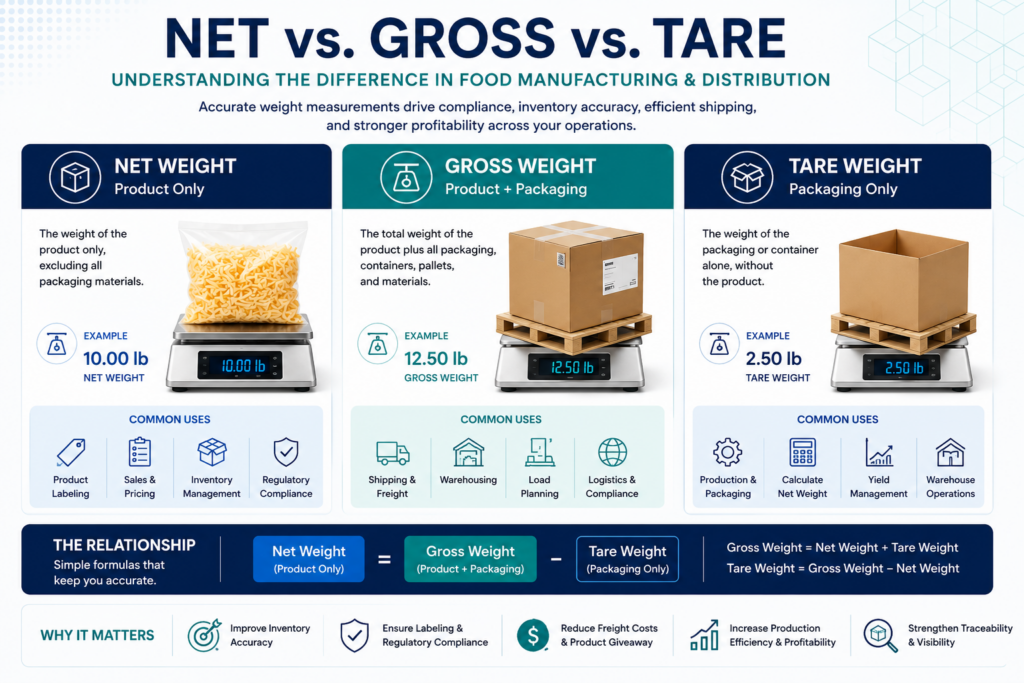
In this guide, you’ll learn what net weight, gross weight, and tare weight mean, how they’re calculated, where they’re used, common label abbreviations like Net Wt. and NW, and why accurate weight measurements are critical for food manufacturers, distributors, and logistics operations.
Net weight is the weight of a product alone, excluding all packaging, containers, wrapping materials, pallets, or other packing components. It represents the actual amount of product a customer receives and is the weight most commonly displayed on product labels.
Whether you’re buying a box of cereal, a wheel of cheese, or a case of frozen seafood, the net weight refers only to the edible or usable product inside the package. The weight of the box, bag, can, tray, or shipping materials is not included.
Net weight plays an important role across manufacturing, distribution, retail, and logistics. Manufacturers use it to verify production output, manage inventory, calculate yields, and meet labeling requirements.
Retailers rely on net weight to ensure consumers receive the quantity stated on the package, while distributors and logistics providers use it to improve inventory accuracy and shipping documentation.
In the food industry, accurate net weight is especially important because it affects product labeling, regulatory compliance, pricing, profitability, and customer trust. Even small weight discrepancies can result in labeling violations, inventory inaccuracies, customer complaints, or unnecessary product giveaway.
On food packaging, net weight identifies the amount of food contained inside the package, excluding the weight of the container or packaging materials. In the United States, the FDA requires most packaged foods to display a net quantity statement on the principal display panel, making accurate net weight a regulatory requirement rather than simply an operational best practice.
You may see net weight abbreviated in several ways on product labels, shipping documents, and invoices, including:
These abbreviations all indicate the weight of the product itself, excluding packaging.
In shipping and logistics, net weight represents the weight of the cargo before packaging materials, pallets, crates, or shipping containers are included. Carriers often use net weight alongside gross weight and tare weight to calculate freight charges, optimize load planning, and prepare customs documentation for domestic and international shipments.
For food manufacturers and distributors, accurately recording net weight also helps improve warehouse operations, inventory control, and order fulfillment while reducing costly shipping discrepancies.
Calculating net weight is straightforward once you know the total weight and the weight of the packaging.
Formula
Net Weight = Gross Weight − Tare Weight
Example
A packaged cheese block has a gross weight of 10.5 lb. The plastic packaging weighs 0.5 lb.
Net Weight = 10.5 lb − 0.5 lb = 10 lb
The net weight printed on the label would therefore be 10 lb.
Gross weight is the total weight of a product, including the product itself and all packaging materials, containers, wrapping, pallets, and other shipping components. In other words, it represents the complete weight of an item as it is prepared for storage, transportation, or delivery.
For example, if a case of frozen seafood weighs 40 pounds and the cardboard carton, insulation, and packaging materials weighs 3 pounds, the gross weight is 43 pounds, while the net weight is 40 pounds.
Gross weight is an important measurement throughout manufacturing, warehousing, transportation, and logistics. Carriers use gross weight to calculate freight costs, warehouses use it to optimize storage and handling, and manufacturers rely on it to ensure products comply with shipping regulations and vehicle weight limits.
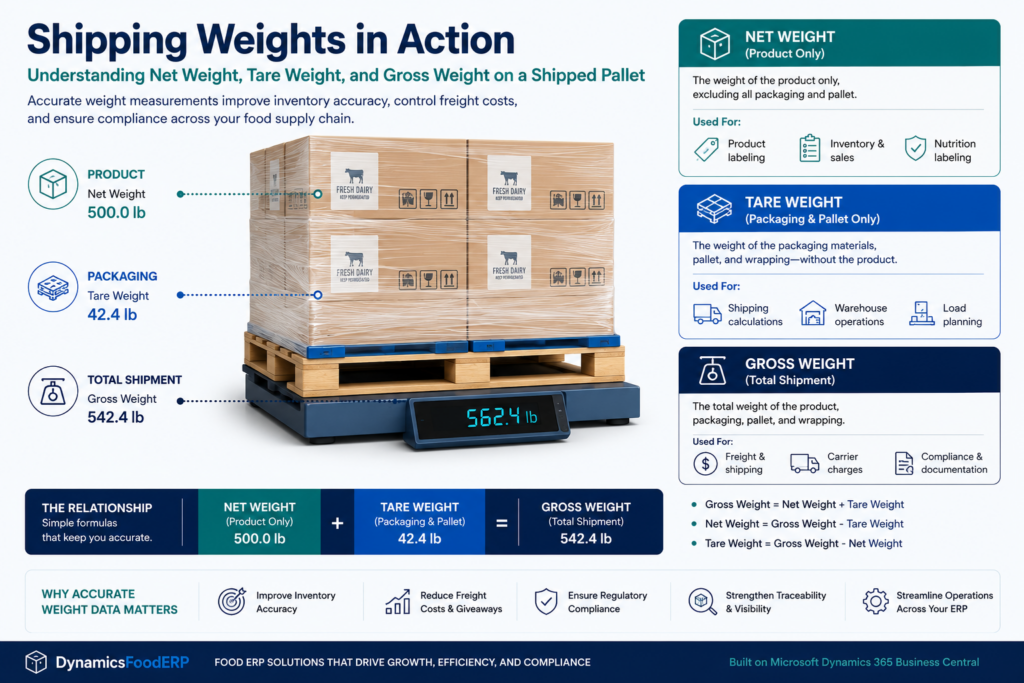
In the food industry, accurate gross weight helps businesses manage transportation costs, improve warehouse efficiency, maintain accurate shipping documentation, and reduce delays caused by incorrect freight information.
While consumers typically see the net weight on product packaging, gross weight is the measurement that keeps products moving efficiently through the supply chain.
In shipping and logistics, gross weight refers to the total weight of the shipment, including the product, packaging, pallets, crates, and any other materials used to prepare goods for transport. Freight carriers often use gross weight to calculate shipping charges, determine load capacities, and ensure compliance with transportation regulations.
For food manufacturers and distributors, accurately recording gross weight helps improve freight planning, warehouse operations, export documentation, and carrier billing while reducing costly shipping discrepancies and unexpected transportation charges.
Gross weight may appear in several formats on shipping documents, bills of lading, warehouse records, and freight labels, including:
These abbreviations all refer to the total weight of the product and its packaging.
Calculating gross weight requires adding the weight of the product to the weight of its packaging.
Formula
Gross Weight = Net Weight + Tare Weight
Example
A case of cheese has a net weight of 25 lb. The carton and packaging materials weigh 2 lb.
Gross Weight = 25 lb + 2 lb = 27 lb
The gross weight of the shipment is 27 lb, which is the weight used for transportation and freight calculations.
Tare weight is the weight of the empty packaging, container, pallet, or other materials used to hold or transport a product. It does not include the weight of the product itself. Tare weight is used to determine the net weight of a product by subtracting the packaging weight from the total gross weight.
For example, if a bucket of cheese spread has a gross weight of 22 pounds and the empty plastic bucket weighs 2 pounds, the tare weight is 2 pounds, and the net weight is 20 pounds.
Tare weight is an essential measurement in manufacturing, food processing, warehousing, and logistics because it ensures only the product itself is measured for labeling, inventory, pricing, and regulatory compliance.
Without accurate tare weight, businesses risk overstating product quantities, creating inventory discrepancies, and violating labeling requirements.
In the food industry, tare weight becomes especially important when products are packaged in containers of different sizes or when reusable bins, totes, trays, or pallets are used throughout production and distribution.
Accurately recording tare weights helps manufacturers improve production accuracy, reduce product giveaway, and maintain consistent labeling.
Food manufacturers routinely use tare weight during production to determine the actual weight of packaged products before they are labeled and shipped.
Modern scales can automatically deduct the known weight of a container, allowing operators to measure only the product inside.
This process is particularly important for products packaged in tubs, jars, cans, vacuum-sealed bags, and reusable containers where packaging weights may vary between product lines.
Tare weight may appear on shipping documents, warehouse records, and logistics labels as:
These abbreviations all refer to the weight of the empty packaging or container.
To calculate tare weight, subtract the net weight of the product from the gross weight.
Formula
Tare Weight = Gross Weight − Net Weight
Example
A pallet of frozen poultry has a gross weight of 1,050 lb. The poultry itself has a net weight of 1,000 lb.
Tare Weight = 1,050 lb − 1,000 lb = 50 lb
The tare weight is 50 lb, representing the pallet, boxes, liners, and other packaging materials used to prepare the shipment.
Although net weight, gross weight, and tare weight are closely related, each measures a different part of a product’s total weight. Understanding the differences is essential for food manufacturers, distributors, warehouses, and logistics providers because each measurement serves a unique purpose in production, labeling, shipping, and inventory management.
In simple terms:
Together, these three measurements provide a complete picture of a product’s weight throughout the supply chain.
| Weight Type | Includes | Excludes | Primary Use |
| Net Weight | Product only | Packaging and containers | Product labeling, pricing, inventory, regulatory compliance |
| Gross Weight | Product plus packaging | Nothing | Shipping, freight calculations, warehouse operations |
| Tare Weight | Packaging and containers only | Product | Calculating net weight, production, packaging operations |
The three measurements are directly connected.
Gross Weight = Net Weight + Tare Weight
Because of this relationship, knowing any two values allows you to calculate the third.
For example:
Likewise, if you know the gross weight and tare weight, you can calculate the net weight by subtracting the packaging weight from the total shipment.
A dairy processor ships a pallet containing cases of shredded cheese.
In this example:
The net weight appears on the product label, while the gross weight is used for freight planning and transportation. The tare weight allows the manufacturer to accurately determine the amount of cheese in each shipment and maintain accurate inventory records.
Using the correct weight measurement helps food manufacturers and distributors:
Whether you’re labeling consumer products, managing inventory, or preparing shipments, understanding the differences between net weight, gross weight, and tare weight helps improve operational efficiency while reducing costly errors across the food supply chain.
Accurately measuring net weight, gross weight, and tare weight is about more than recording numbers on a scale. These measurements affect product quality, regulatory compliance, inventory accuracy, shipping costs, and profitability across the entire food supply chain.
For food manufacturers and distributors, even small weight discrepancies can create significant operational challenges. Incorrect measurements may result in mislabeled products, inventory inaccuracies, higher freight costs, customer complaints, or regulatory penalties. Establishing standardized weight measurements helps businesses improve efficiency while reducing costly errors.
Regulatory agencies such as the U.S. Food and Drug Administration (FDA) require packaged foods to display the correct net quantity of contents on product labels. This information allows consumers to understand exactly how much product they are purchasing and helps ensure fair marketplace practices.
Maintaining accurate net weight records also simplifies quality audits and helps manufacturers demonstrate compliance with food labeling regulations.
Inventory Accuracy
Inventory systems rely on accurate product weights to calculate available stock, production yields, and order fulfillment. When net, gross, or tare weights are recorded incorrectly, inventory balances can quickly become inaccurate.
For manufacturers processing cheese, meat, seafood, dairy, and other variable-weight products, precise weight tracking helps reduce shrinkage, improve inventory visibility, and support more accurate forecasting.
Freight and Transportation Costs
Transportation providers calculate shipping charges using shipment weight, making gross weight a critical factor in logistics planning. Incorrect gross weights can lead to unexpected freight charges, overloaded shipments, delivery delays, or compliance issues with transportation regulations.
Accurate weight information allows businesses to optimize truck loads, improve warehouse planning, and better control transportation expenses.
Production Efficiency and Yield Management
During production, operators use tare weight to separate packaging weight from product weight, ensuring filling equipment dispenses the correct amount of product. This improves consistency while minimizing both product giveaway and underfilled packages.
Tracking accurate weights also provides valuable production data that can be used to monitor yields, identify process improvements, and reduce waste across manufacturing operations.
Modern ERP systems help eliminate manual calculations by automatically recording and managing net weight, gross weight, and tare weight throughout production, inventory, warehousing, and shipping.
For food manufacturers using DynamicsFoodERP powered by Microsoft Dynamics 365 Business Central, weight information can be integrated with:
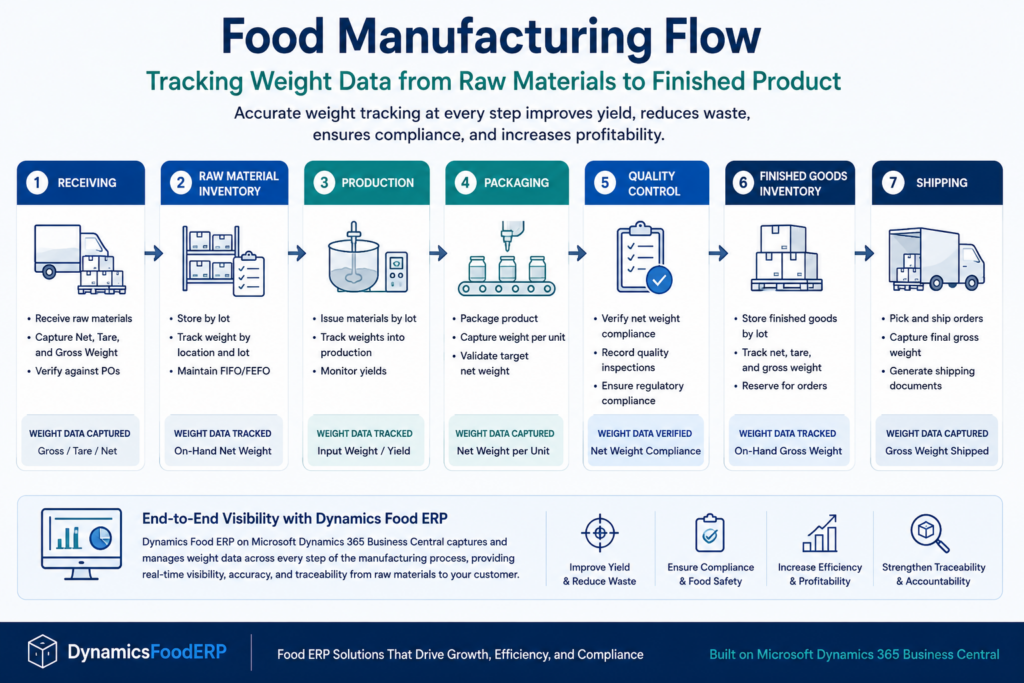
By maintaining a single source of accurate weight data, manufacturers gain greater visibility across their operations, reduce manual data entry, and make better decisions based on real-time information.
Maintaining accurate net weight, gross weight, and tare weight requires more than reliable scales. Food manufacturers need standardized processes, consistent data, and integrated systems to ensure weight measurements remain accurate from production through shipping.
Following these best practices can help improve operational efficiency, reduce waste, and support regulatory compliance.
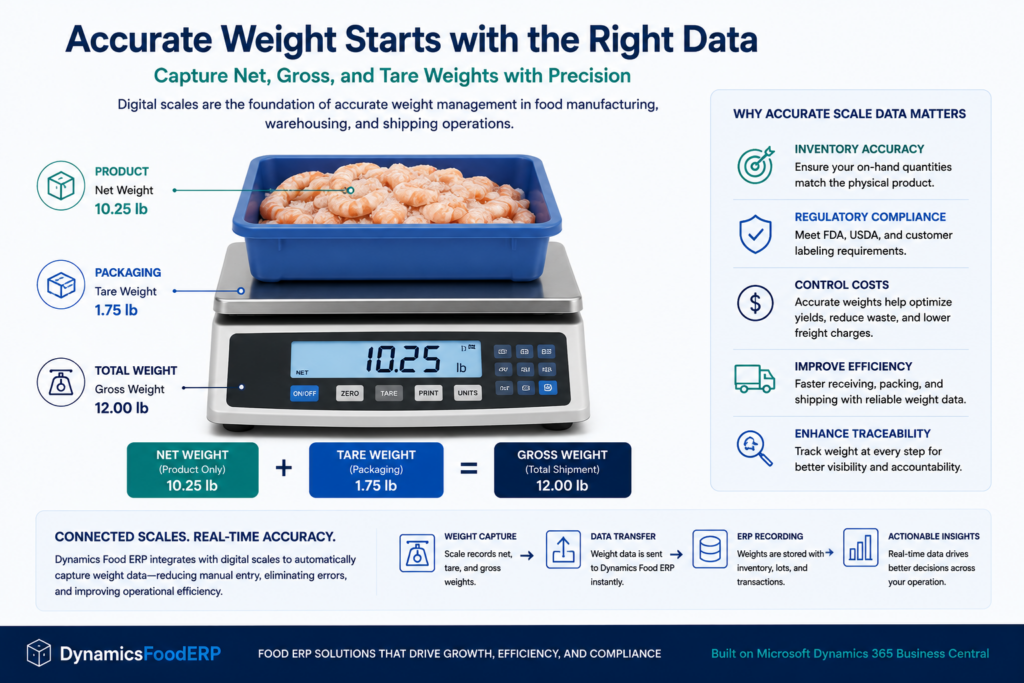
Calibrate Scales Regularly
Accurate weight measurements begin with properly calibrated equipment. Over time, scales can drift from their original settings, leading to incorrect product weights, inconsistent labeling, and inventory discrepancies.
Establishing a routine calibration schedule helps ensure weighing equipment remains accurate and compliant with quality standards.
Standardize Tare Weights
Packaging materials should have documented tare weights that are consistently applied throughout production. This is especially important when using reusable containers, pallets, bins, or multiple packaging formats.
Maintaining standardized tare values reduces manual calculations and improves the accuracy of net weight measurements.
Automate Weight Data Collection
Manual data entry increases the risk of errors and inconsistencies. Integrating digital scales with an ERP system allows weight data to be captured automatically during receiving, production, packaging, and shipping.
Automating weight capture reduces manual entry errors and creates a more reliable record for inventory, shipping, and customer transactions.
Verify Label Accuracy
Before products leave the facility, manufacturers should verify that product labels accurately reflect the net weight of the contents. Routine quality checks help identify filling inconsistencies before products reach customers or regulators.
Accurate labeling supports regulatory compliance while reinforcing consumer confidence in your brand.
Monitor Production Yield
Comparing expected yields with actual production weights helps identify overfilling, underfilling, equipment issues, and process inefficiencies.
Regularly reviewing yield data enables manufacturers to reduce product giveaway, improve profitability, and maintain consistent product quality.
Use ERP Software to Maintain a Single Source of Truth
As food businesses grow, managing weight information across spreadsheets and disconnected systems becomes increasingly difficult. Modern ERP software centralizes weight data, ensuring every department works from the same accurate information.
With DynamicsFoodERP powered by Microsoft Dynamics 365 Business Central, manufacturers can manage net weight, gross weight, and tare weight alongside inventory, production, lot traceability, quality management, warehouse operations, and shipping. This unified approach reduces manual errors, improves operational visibility, and supports faster, more informed decision-making.
Organizations that consistently manage weight accuracy are better positioned to:
By combining standardized processes with integrated technology, food manufacturers can turn weight management from a routine operational task into a competitive advantage.
Net weight is the weight of the product alone, excluding all packaging materials. Gross weight is the total weight of the product plus its packaging, containers, pallets, and other shipping materials.
For example, if a package of cheese weighs 10 pounds and the packaging weighs 0.5 pounds, the net weight is 10 pounds, while the gross weight is 10.5 pounds.
Tare weight is the weight of the empty packaging or container. It is used to calculate the net weight of a product by subtracting the packaging weight from the gross weight.
Formula:
Net Weight = Gross Weight − Tare Weight
Food labels display the net weight, which represents the amount of food inside the package. Packaging weight is not included because consumers are purchasing the product, not the container.
Gross weight is primarily used for transportation, warehousing, and logistics. Shipping companies rely on gross weight to calculate freight costs, determine vehicle load limits, and ensure shipments comply with transportation regulations.
Tare weight ensures manufacturers accurately measure only the product itself. Without accounting for packaging weight, businesses could overstate product quantities, create inventory inaccuracies, or fail to meet labeling requirements.
To calculate net weight, subtract the tare weight from the gross weight.
Example:
Net Weight = 55 lb − 5 lb = 50 lb
While these measurements are used across many industries, they are especially important in:
Any business that manufactures, packages, stores, or ships products relies on accurate weight measurements to support compliance, inventory management, and transportation.
Modern ERP software centralizes weight information across production, inventory, warehousing, purchasing, and shipping. Instead of relying on manual calculations or disconnected spreadsheets, manufacturers can automatically track net weight, gross weight, and tare weight throughout the supply chain.
For food manufacturers, DynamicsFoodERP powered by Microsoft Dynamics 365 Business Central helps improve inventory accuracy, simplify lot traceability, reduce manual data entry, and provide real-time visibility into production and logistics operations.
Understanding the difference between net weight, gross weight, and tare weight is essential for food manufacturers, processors, and distributors. While these measurements may seem straightforward, they play a critical role in product labeling, regulatory compliance, inventory management, production efficiency, and transportation planning.
Together, these measurements provide the foundation for efficient food manufacturing operations. When weight data is captured accurately and managed consistently, businesses can reduce waste, improve inventory visibility, streamline shipping, and maintain compliance with FDA and USDA requirements.
As operations grow, manually tracking weight information across spreadsheets and disconnected systems becomes increasingly difficult. Modern ERP software helps eliminate these challenges by integrating weight data with inventory, production, quality management, warehouse operations, and traceability.
DynamicsFoodERP powered by Microsoft Dynamics 365 Business Central, gives food manufacturers a centralized platform to manage net weight, gross weight, and tare weight alongside the operational data that drives better business decisions. From receiving raw materials to shipping finished goods, accurate weight management helps improve efficiency, reduce costs, and strengthen supply chain visibility.
If your organization is looking to modernize food manufacturing operations, improve traceability, and gain better control over inventory and production, implementing a food-specific ERP solution can provide the visibility and automation needed to support long-term growth.
Contact us today to schedule a demo or speak with a food ERP expert.