

Expanding into the United States, the United Kingdom, or the Canadian food market presents significant growth opportunities, but each market comes with its own regulatory requirements.
While all three countries share the same objective of protecting consumers and ensuring food safety, they differ in how they regulate manufacturing, labeling, traceability, recalls, and compliance.
For food manufacturers and distributors, understanding these differences is more than a regulatory exercise.
It directly impacts production, inventory management, supplier oversight, product labeling, and the ability to respond quickly to audits or recalls.
As food supply chains become more global and traceability requirements continue to evolve, compliance depends on having accurate data, standardized processes, and complete visibility across the business.
This guide compares the food safety standards of the United States, United Kingdom, and Canada, highlighting the regulatory agencies, legislation, and compliance requirements that food businesses need to understand in 2026.
You’ll also see how technologies such as Microsoft Dynamics 365 Business Central and industry-specific ERP solutions help manufacturers strengthen traceability, improve quality management, and simplify compliance across multiple jurisdictions.
Whether you’re entering a new market, managing operations across borders, or evaluating your current compliance strategy, this guide provides a practical comparison of the regulations and operational considerations that matter most.
Although the United States, the United Kingdom, and Canada all share the goal of protecting public health, each has developed its own regulatory framework based on its legal system, food supply chain, and approach to risk management.
As a result, manufacturers that operate across multiple markets must comply with different requirements for food safety, labeling, traceability, inspections, and recordkeeping.
These differences affect more than regulatory compliance.
They influence how products are manufactured, labeled, stored, transported, and recalled.
A process that satisfies U.S. Food and Drug Administration (FDA) requirements may require additional documentation or different labeling to meet the standards of the UK Food Standards Agency (FSA) or the Canadian Food Inspection Agency (CFIA).
For food manufacturers and distributors, managing these requirements manually becomes increasingly difficult as operations grow.
Multiple suppliers, production facilities, distribution centers, and export markets all increase the complexity of maintaining accurate records and demonstrating compliance.
This is where standardized business processes and integrated ERP systems become increasingly valuable.
Centralized product data, lot traceability, quality management, and document control help manufacturers adapt to country-specific regulations while maintaining consistent operational practices across the organization.
Understanding where these regulations align and where they differ is the first step toward building a compliant, efficient, and scalable food business.
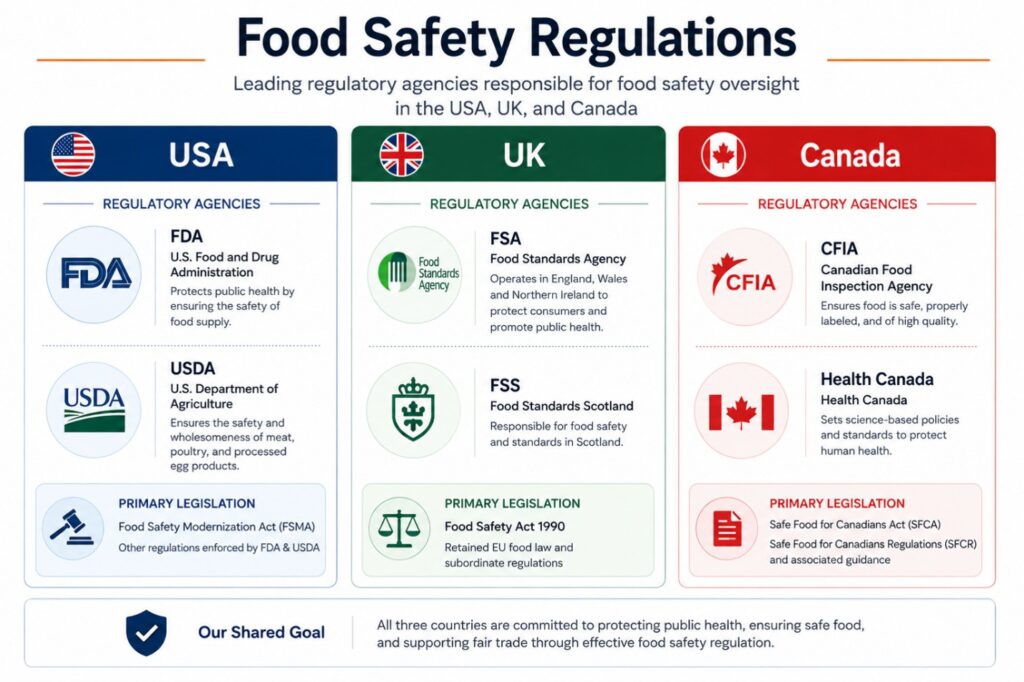
The United States maintains one of the world’s most comprehensive food safety systems, with responsibility shared primarily between the U.S. Food and Drug Administration (FDA) and the U.S. Department of Agriculture (USDA).
While the FDA regulates approximately 80% of the U.S. food supply, the USDA oversees meat, poultry, and processed egg products.
Together, these agencies establish standards designed to protect public health, improve food traceability, and reduce the risk of foodborne illness.
For food manufacturers, compliance extends beyond producing safe food. Companies must implement preventive controls, maintain detailed production and traceability records, verify supplier compliance, and demonstrate the ability to respond quickly during inspections or product recalls.
The FDA regulates most domestic and imported foods, including seafood, dairy products, produce, beverages, packaged foods, and dietary supplements. Its responsibilities include establishing food safety regulations, conducting inspections, overseeing labeling requirements, and enforcing compliance with the Food Safety Modernization Act (FSMA).
The USDA’s Food Safety and Inspection Service (FSIS) regulates meat, poultry, and processed egg products.
FSIS inspectors are present in federally inspected processing facilities, ensuring products meet safety, sanitation, and labeling requirements before entering commerce.
Enacted in 2011, the Food Safety Modernization Act fundamentally changed the U.S. approach to food safety by shifting the focus from responding to contamination to preventing it.
Key FSMA requirements include:
FSMA applies to both domestic manufacturers and many imported food products sold in the United States.
One of the most significant recent developments is FSMA Rule 204, which establishes enhanced traceability requirements for foods included on the FDA’s Food Traceability List (FTL).
Manufacturers handling foods on the FTL must maintain detailed Key Data Elements (KDEs) at Critical Tracking Events (CTEs), allowing regulators to trace products rapidly throughout the supply chain during a food safety investigation or recall.
For many manufacturers, this represents a major shift toward digital recordkeeping and end-to-end lot traceability.
Hazard Analysis and Critical Control Points (HACCP) remains a foundational food safety methodology in the United States.
HACCP is mandatory for seafood, juice, and USDA-regulated meat and poultry facilities, while FSMA’s Preventive Controls framework expands similar risk-based principles across much of the food industry.
Manufacturers are expected to identify potential biological, chemical, and physical hazards, implement preventive controls, monitor critical processes, and maintain documented records demonstrating compliance.
U.S. food labeling regulations require manufacturers to provide accurate product information, ingredient statements, allergen declarations, nutrition facts, and country-of-origin information where applicable.
Requirements vary depending on product type and whether the FDA or USDA has regulatory authority.
Traceability has become an increasingly important compliance requirement.
Manufacturers must be able to identify the origin of ingredients, track products through production and distribution, and quickly retrieve records during inspections or recalls.
Meeting U.S. food safety requirements requires more than written procedures.
Manufacturers must integrate compliance into daily operations through standardized processes, accurate inventory management, lot and batch traceability, quality control, and supplier oversight.
As traceability requirements continue to evolve, many food manufacturers are replacing manual spreadsheets and paper records with integrated ERP systems that centralize production data, automate documentation, and improve recall readiness.
These capabilities not only support regulatory compliance but also improve operational efficiency and supply chain visibility.
The United Kingdom maintains a robust food safety system built on risk-based controls, traceability, and transparency throughout the food supply chain.
Following Brexit, the UK retained many core food safety principles while developing regulations tailored to its own legal and regulatory framework.
Today, food manufacturers must comply with requirements governing food hygiene, labeling, allergen management, traceability, and product recalls.
For manufacturers exporting to or operating within the UK, compliance means implementing documented food safety procedures, maintaining complete production records, and demonstrating the ability to trace products throughout the supply chain.
The Food Standards Agency (FSA) is responsible for food safety and food hygiene across England, Wales, and Northern Ireland. The agency develops food safety policy, oversees enforcement, monitors food incidents, and works with local authorities to ensure businesses comply with food legislation.
In Scotland, the Food Standards Scotland (FSS) serves as the national food safety authority. While its responsibilities closely align with those of the FSA, it operates independently and oversees food safety policy, inspections, and public health initiatives within Scotland.
The Food Safety Act 1990 forms the foundation of UK food law. It establishes the legal responsibilities of food businesses to ensure food is safe, accurately described, and suitable for consumption.
Manufacturers are responsible for preventing contamination, maintaining hygienic production environments, and ensuring food labels are truthful and compliant.
UK food businesses must also comply with food hygiene regulations that require documented food safety management systems based on the principles of Hazard Analysis and Critical Control Points (HACCP).
These regulations cover:
Unlike the United States’ emphasis on Preventive Controls under FSMA, the UK continues to rely heavily on HACCP as the foundation of food safety management.
Manufacturers are expected to identify food safety hazards, establish critical control points, monitor production processes, implement corrective actions, and maintain detailed documentation to demonstrate compliance during inspections.
Many retailers and foodservice organizations also require suppliers to maintain certifications such as BRCGS Global Food Safety Standard, which builds upon HACCP principles and is widely recognized throughout the UK food industry.
UK food labeling regulations require manufacturers to provide clear and accurate information on ingredients, allergens, nutritional content, storage instructions, and, where applicable, country of origin.
Following Brexit, manufacturers exporting between the UK and the European Union should also understand differences in labeling requirements, import documentation, and market-specific regulations.
Traceability remains a fundamental requirement.
Food businesses must be able to identify suppliers, customers, and affected products quickly, enabling rapid action during food safety incidents or product recalls.
Meeting UK food safety requirements requires more than complying with legislation.
Manufacturers must establish standardized processes that support food safety across production, warehousing, distribution, and supplier management.
Strong traceability, documented quality controls, effective allergen management, and accurate production records not only support regulatory compliance but also help businesses meet customer expectations, retailer requirements, and third-party certification standards.
As regulatory expectations continue to evolve, manufacturers are increasingly adopting integrated ERP systems to centralize product data, improve lot traceability, streamline quality management, and simplify audit preparation.
The UK’s food safety system is built around HACCP, food hygiene, and end-to-end traceability.
Food manufacturers must maintain documented food safety management systems, comply with strict labeling and allergen requirements, and demonstrate complete product traceability to support audits, retailer standards, and product recalls.
Canada’s food safety system is built on preventive controls, traceability, and science-based regulation.
The country has modernized its regulatory framework to better protect consumers, strengthen supply chain transparency, and support international trade.
Food manufacturers operating in Canada must comply with requirements governing food safety, preventive controls, licensing, labeling, and traceability.
For manufacturers producing or exporting food products in Canada, compliance requires more than meeting product quality standards.
Businesses must maintain documented preventive control plans, demonstrate end-to-end traceability, and retain records that support inspections, audits, and product recalls.
The Canadian Food Inspection Agency (CFIA) is Canada’s primary food regulatory authority.
The CFIA is responsible for enforcing food safety regulations, conducting inspections, overseeing food imports and exports, managing recalls, and verifying compliance with the Safe Food for Canadians Regulations (SFCR).
Health Canada establishes food safety policies and regulations related to public health.
The agency develops food safety standards, approves food additives, establishes nutritional requirements, and sets labeling regulations, while the CFIA is responsible for enforcement.
The Safe Food for Canadians Act (SFCA) provides the legislative foundation for Canada’s food safety system.
It consolidates several previous food laws into a single framework designed to strengthen food safety, improve consistency across the industry, and support domestic and international trade.
The Safe Food for Canadians Regulations (SFCR) establish the operational requirements that many food businesses must follow.
Depending on the type of food and business activities, manufacturers may be required to obtain licenses, implement preventive control plans, maintain traceability records, and meet specific import and export requirements.
Key SFCR requirements include:
Canada’s food safety system emphasizes prevention through Preventive Control Plans (PCPs). Similar in concept to HACCP and FSMA Preventive Controls, PCPs require manufacturers to identify potential hazards, implement preventive measures, monitor critical processes, and document corrective actions when issues occur.
Preventive Control Plans should address:
Well-designed PCPs help manufacturers reduce food safety risks while demonstrating compliance during regulatory inspections.
Canadian food labeling regulations require manufacturers to provide accurate product information, ingredient declarations, allergen labeling, nutrition facts, bilingual labeling where applicable, and country-of-origin information for certain products.
Traceability is a core requirement under the SFCR.
Food businesses must be able to identify where products came from and where they were shipped, allowing regulators and manufacturers to quickly isolate affected products during a food safety incident or recall.
Canada’s regulatory framework requires manufacturers to integrate food safety into every stage of operations.
Preventive controls, supplier verification, inventory management, production documentation, and lot traceability all play an important role in maintaining compliance.
As businesses expand across provincial and international markets, managing these requirements manually becomes increasingly difficult.
Integrated ERP systems help manufacturers centralize product information, maintain complete lot genealogy, automate compliance documentation, and improve visibility across purchasing, production, warehousing, and distribution.
These capabilities simplify regulatory compliance while supporting operational efficiency and customer confidence.
Canada’s food safety system emphasizes preventive controls, comprehensive traceability, and standardized compliance through the Safe Food for Canadians Regulations.
Food manufacturers must maintain documented Preventive Control Plans, accurate traceability records, and effective recall procedures to meet regulatory requirements and support domestic and international trade.
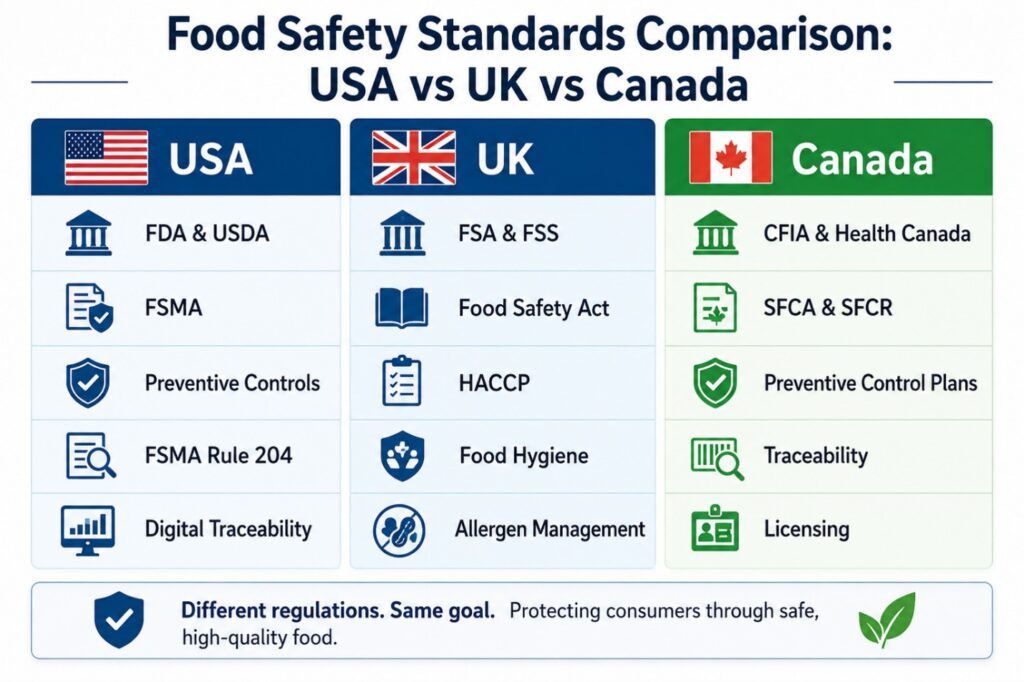
While the United States, United Kingdom, and Canada all share the same objective of protecting consumers and ensuring safe food production, their regulatory frameworks differ in several important ways.
Understanding these differences helps manufacturers prepare for cross-border trade, maintain compliance, and reduce operational risk.
| Category | United States | United Kingdom | Canada |
| Primary Regulatory Agencies | FDA, USDA FSIS | Food Standards Agency (FSA), Food Standards Scotland (FSS) | Canadian Food Inspection Agency (CFIA), Health Canada |
| Primary Food Safety Law | Food Safety Modernization Act (FSMA) | Food Safety Act 1990 | Safe Food for Canadians Act (SFCA) |
| Food Safety Approach | Preventive Controls | HACCP-based Food Safety Management | Preventive Control Plans (PCPs) |
| Traceability Requirements | FSMA Rule 204 for Food Traceability List foods | Mandatory product traceability and recall capability | Mandatory traceability under SFCR |
| Primary Inspection Authority | FDA & USDA FSIS | Local Authorities under FSA/FSS oversight | CFIA |
| Food Business Licensing | Required for certain facilities | Registration with local authorities | Licensing required for many food businesses under SFCR |
| Labeling Requirements | FDA/USDA labeling regulations, Nutrition Facts, allergen declarations | UK food labeling, allergen information, nutrition labeling | Bilingual labeling (English & French), Nutrition Facts, allergen declarations |
| Recall Authority | FDA & USDA coordinate recalls | FSA/FSS coordinate recalls | CFIA manages recalls |
| Supplier Controls | Foreign Supplier Verification Program (FSVP) and supply chain programs | Supplier verification through HACCP and retailer standards | Supplier verification within Preventive Control Plans |
| Common Food Safety Certifications | SQF, BRCGS, HACCP, FSSC 22000 | BRCGS, SALSA, FSSC 22000 | SQF, BRCGS, FSSC 22000 |
| Key Compliance Focus (2026) | Preventive controls and enhanced digital traceability | HACCP, food hygiene, allergen management | Preventive controls, traceability, import/export compliance |
Food safety regulations continue to evolve as governments respond to increasingly complex supply chains, digital traceability requirements, and growing consumer expectations for transparency.
While the United States, United Kingdom, and Canada each follow different regulatory frameworks, the overall direction is the same: stronger preventive controls, improved traceability, enhanced recordkeeping, and faster response during food safety incidents.
For food manufacturers and distributors, these changes require more than regulatory awareness.
They require systems and processes that can capture accurate production data, maintain complete product histories, and demonstrate compliance throughout the supply chain.
The timeline below highlights the key regulatory developments that have shaped modern food safety requirements across the United States, United Kingdom, and Canada.
Together, these milestones demonstrate the global shift toward preventive controls, digital traceability, and stronger compliance requirements.
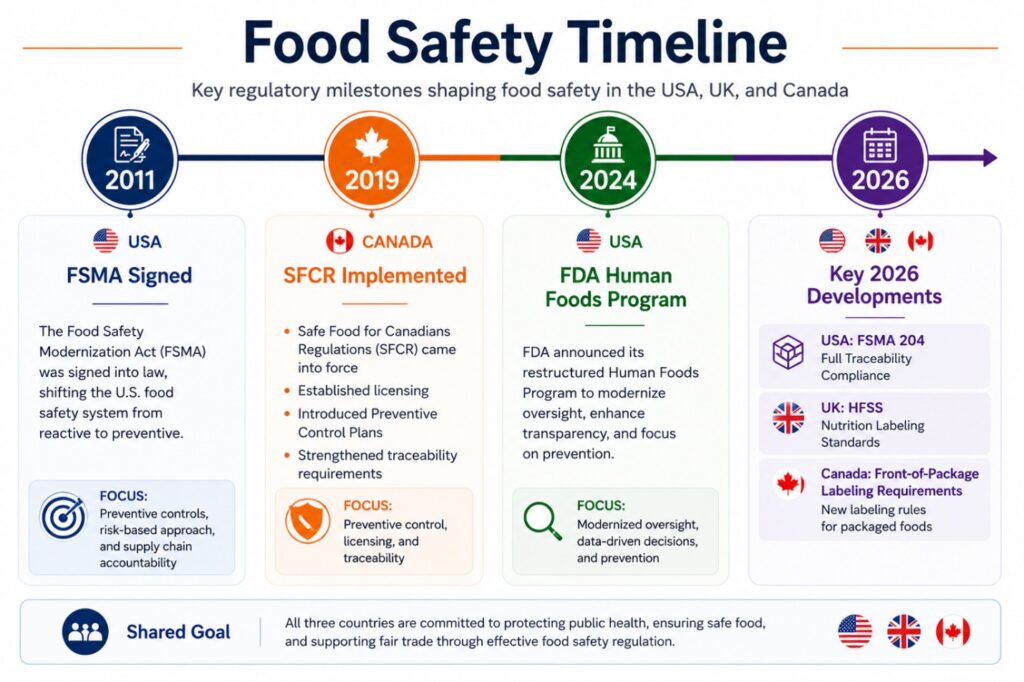
One of the most significant developments in U.S. food safety is the continued implementation of FSMA Rule 204, which establishes enhanced traceability requirements for foods included on the FDA’s Food Traceability List (FTL).
Affected businesses must capture and maintain Key Data Elements (KDEs) at designated Critical Tracking Events (CTEs) throughout the supply chain.
These records must be readily available to support FDA investigations and product recalls.
For manufacturers handling foods covered by the rule, digital traceability has become increasingly important. Manual recordkeeping processes can make it difficult to retrieve accurate information quickly during regulatory inspections or food safety investigations.
The UK continues to strengthen food safety through rigorous food hygiene enforcement, improved allergen labeling, and supply chain transparency.
Food manufacturers are expected to maintain documented HACCP-based food safety management systems while ensuring labeling remains accurate and compliant with current UK requirements.
Businesses exporting to both the UK and the European Union should also monitor regulatory changes that may affect labeling, import documentation, and product compliance across different markets.
Canada continues to refine implementation of the Safe Food for Canadians Regulations (SFCR), with ongoing emphasis on preventive control plans, licensing, traceability, and import and export compliance.
Regulators continue to encourage consistent recordkeeping and improved traceability throughout the food supply chain, helping manufacturers respond more efficiently to inspections, audits, and product recalls.
Companies expanding into Canadian markets should regularly review licensing obligations and ensure their preventive control plans remain current as regulatory guidance evolves.
Although regulations differ by country, one trend is consistent across all three markets: digital traceability is becoming an operational expectation rather than a competitive advantage.
Regulators increasingly expect manufacturers to quickly identify:
Manufacturers relying on disconnected spreadsheets or paper-based records often face longer response times during inspections and recalls.
Integrated digital systems improve visibility across purchasing, production, inventory, quality management, and distribution while helping organizations maintain accurate compliance records.
As food safety regulations continue to evolve, manufacturers should take a proactive approach to compliance by:
Meeting food safety regulations requires more than documented policies and periodic audits.
Manufacturers must consistently capture, manage, and retrieve accurate information across purchasing, production, quality control, warehousing, and distribution.
As regulatory requirements continue to evolve, manual processes and disconnected systems make compliance increasingly difficult to maintain.
Modern Enterprise Resource Planning (ERP) systems provide a centralized platform that connects business operations with food safety compliance.
Rather than managing production records, inventory, quality inspections, supplier documentation, and traceability across multiple spreadsheets or standalone applications, manufacturers can maintain a single source of truth that supports both operational efficiency and regulatory compliance.
For food manufacturers operating across the United States, United Kingdom, and Canada, an ERP system helps standardize processes while supporting country-specific regulatory requirements.
Food safety compliance depends on maintaining complete visibility as products move through the supply chain.
The following workflow illustrates how an integrated ERP system captures critical data at every stage, creating complete lot traceability from supplier to customer.
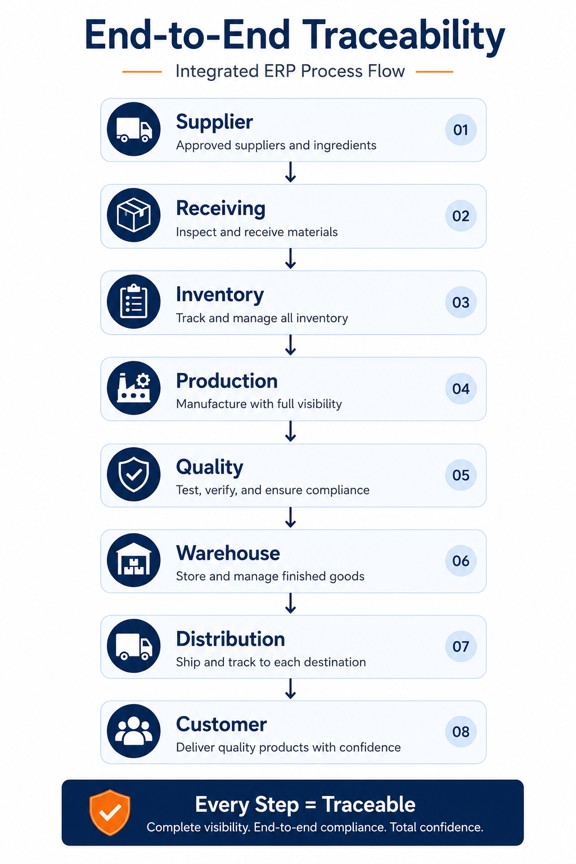
Traceability is a common requirement across all three regulatory frameworks.
Whether complying with the FDA’s Food Safety Modernization Act (FSMA), the UK’s HACCP-based food safety requirements, or Canada’s Safe Food for Canadians Regulations (SFCR), manufacturers must be able to identify where products originated, how they were processed, and where they were distributed.
An industry-specific ERP system enables manufacturers to:
This level of visibility helps reduce response times during food safety investigations while improving confidence in the accuracy of compliance records.
Food safety regulations increasingly emphasize prevention rather than correction.
Manufacturers must demonstrate that quality controls are integrated into day-to-day operations rather than applied only after production is complete.
An ERP system supports these efforts by helping organizations:
Centralized quality management helps ensure that compliance activities become part of normal business operations rather than separate administrative tasks.
Food manufacturers must maintain accurate inventory records while managing expiration dates, shelf-life requirements, and stock rotation.
Errors in inventory management can increase waste, create compliance risks, and complicate product recalls.
ERP systems help manufacturers improve inventory accuracy by supporting:
Accurate inventory data improves both operational performance and regulatory readiness.
Food safety begins long before ingredients enter the production facility.
Manufacturers are responsible for verifying suppliers, maintaining supporting documentation, and ensuring raw materials meet regulatory and quality standards.
ERP systems centralize supplier information, making it easier to manage:
Maintaining complete supplier records helps simplify audits while reducing the risk of introducing non-compliant materials into production.
No manufacturer wants to initiate a product recall, but every manufacturer should be prepared to manage one efficiently.
During a recall, speed and accuracy are critical. Manufacturers must quickly determine:
An integrated ERP system provides immediate access to production, inventory, shipping, and customer records, helping manufacturers reduce recall response times and minimize business disruption.
For manufacturers operating across the United States, United Kingdom, and Canada, maintaining separate compliance processes for each market creates unnecessary complexity.
Industry-specific ERP solutions built on platforms such as Microsoft Dynamics 365 Business Central help organizations standardize operations while accommodating country-specific requirements for traceability, labeling, documentation, and reporting.
This enables manufacturers to support multiple regulatory frameworks without duplicating processes or maintaining disconnected systems.
Key Takeaway
Food safety compliance is no longer just about understanding regulations. It depends on having accurate data, standardized processes, and complete visibility across the supply chain.
An industry-specific ERP system helps food manufacturers integrate compliance into daily operations by strengthening traceability, improving quality management, supporting audit readiness, and simplifying compliance across multiple regulatory jurisdictions.
The United States and Canada share many of the same food safety objectives, including protecting public health, preventing foodborne illness, and improving supply chain traceability.
However, they achieve these goals through different regulatory frameworks.
In the United States, food safety is regulated primarily by the U.S. Food and Drug Administration (FDA) and the U.S. Department of Agriculture (USDA) under the Food Safety Modernization Act (FSMA). Canada regulates food safety through the Canadian Food Inspection Agency (CFIA) and Health Canada, with compliance governed by the Safe Food for Canadians Regulations (SFCR).
While both countries require preventive controls, traceability, and documented food safety procedures, manufacturers must understand the specific licensing, labeling, recordkeeping, and inspection requirements that apply in each market.
Key Takeaway: The United States and Canada share similar food safety goals, but manufacturers must comply with different regulatory agencies, legislation, and operational requirements.
The United Kingdom follows a HACCP-based food safety framework that differs from the regulatory systems used in the United States and Canada.
Food safety in the UK is overseen by the Food Standards Agency (FSA) and Food Standards Scotland (FSS). Following Brexit, the UK retained many established food safety principles while developing regulations tailored to its own legal framework.
Compared with North America, the UK places significant emphasis on food hygiene, allergen management, and documented HACCP procedures.
Manufacturers exporting to the UK should also understand country-specific labeling, import, and traceability requirements.
Key Takeaway: Although the UK shares many food safety objectives with the United States and Canada, its regulatory framework, agencies, and compliance requirements differ.
No. Unlike the United Kingdom, the United States does not have a single Food Standards Agency.
Food safety responsibilities are shared primarily between the U.S. Food and Drug Administration (FDA), which regulates most foods, and the U.S. Department of Agriculture (USDA) Food Safety and Inspection Service (FSIS), which oversees meat, poultry, and processed egg products.
Together, these agencies establish regulations, conduct inspections, oversee food labeling, and coordinate food recalls.
Key Takeaway: Food safety oversight in the United States is divided between the FDA and USDA rather than managed by a single national agency.’
Food safety regulations differ because each country develops its own legal framework, regulatory agencies, inspection programs, and risk management approach.
Differences commonly include:
Despite these differences, modern food safety systems increasingly share common principles, including preventive controls, supply chain traceability, documented quality management, and rapid recall capabilities.
Key Takeaway: While regulations vary by country, the industry’s direction is consistent: greater transparency, stronger traceability, and preventive food safety management.
There is no single country with the “strictest” food safety regulations. Each regulatory system reflects its own legal framework and public health priorities.
The United States emphasizes preventive controls through FSMA, the United Kingdom focuses on HACCP-based food safety management, and Canada combines preventive controls with licensing and traceability under the Safe Food for Canadians Regulations.
For manufacturers, success depends less on determining which system is stricter and more on understanding the specific requirements of each market.
Key Takeaway: Every market has rigorous food safety requirements. Manufacturers should focus on meeting the regulations applicable to where their products are produced and sold.
All three countries require accurate food labeling, but the specific requirements vary.
Manufacturers may encounter differences in allergen declarations, nutrition labeling, ingredient statements, country-of-origin requirements, language requirements, and product claims.
For example, Canada generally requires bilingual labeling in English and French, while labeling requirements in the United States and United Kingdom follow their own regulatory standards.
Companies selling products internationally should review labeling requirements for each destination market before introducing new products.
Key Takeaway: Product labels that comply in one country may require modification before they can be sold in another.
Food manufacturers must comply with both domestic regulations and the requirements of the destination market.
Depending on where products are sold, manufacturers may need to meet requirements related to:
Understanding these requirements before entering a new market helps reduce delays, avoid compliance issues, and strengthen customer confidence.
Key Takeaway: Export compliance begins long before products are shipped. Manufacturers should verify regulatory requirements during product development and production planning.
Food safety compliance depends on accurate data, standardized processes, and complete traceability. Industry-specific ERP systems help manufacturers centralize production records, inventory, quality management, supplier documentation, and lot traceability within a single platform.
Solutions built on Microsoft Dynamics 365 Business Central, such as DynamicsFoodERP, support compliance by improving traceability, simplifying quality management, strengthening recall readiness, and reducing reliance on manual recordkeeping.
Rather than replacing food safety programs, ERP systems provide the operational foundation needed to execute them consistently.
Key Takeaway: ERP systems don’t create compliance, but they make compliance easier to manage, document, and demonstrate.
The most effective preparation begins long before an audit or recall occurs.
Manufacturers should maintain standardized procedures, validate traceability processes, conduct mock recalls, and keep supplier, production, and quality records current.
Organizations with centralized operational data can retrieve information more quickly during inspections, customer audits, and food safety investigations, reducing both response time and business disruption.
Key Takeaway: Audit readiness is the result of consistent daily processes, not last-minute preparation.
Although the United States, United Kingdom, and Canada each have their own food safety regulations, they all share the same objective: protecting consumers through safe, transparent, and traceable food production.
For food manufacturers and distributors, the challenge isn’t simply understanding these regulations. It’s implementing the operational processes needed to ensure consistent compliance across every facility, product, and market.
As regulatory expectations continue to evolve, compliance has become a business-wide responsibility.
Accurate lot traceability, standardized quality management, supplier oversight, compliant labeling, and complete production records are essential not only for passing audits but also for improving operational efficiency, protecting brand reputation, and responding confidently to food safety incidents.
Whether your business serves a single market or exports products internationally, success depends on more than keeping pace with changing regulations.
It requires reliable data, standardized processes, and complete visibility across purchasing, production, inventory, quality management, and distribution.
Manufacturers that build these capabilities into their daily operations are better positioned to reduce compliance risk, strengthen customer confidence, and support long-term growth.
The regulatory landscape will continue to change. Businesses that treat compliance as an integrated part of their operations, rather than a periodic exercise, will be better prepared to adapt, compete, and succeed in an increasingly connected global food industry.
Managing food safety compliance across multiple facilities, products, and markets doesn’t have to rely on spreadsheets, disconnected systems, or manual recordkeeping.
DynamicsFoodERP, built on Microsoft Dynamics 365 Business Central, helps food manufacturers and distributors centralize traceability, quality management, inventory control, production, and compliance within a single, integrated platform.
Whether you’re preparing for evolving regulations, improving recall readiness, or expanding into new markets, DynamicsFoodERP provides the operational visibility and control needed to support your compliance strategy.
Learn how DynamicsFoodERP can help your business simplify compliance and strengthen food safety operations. Contact our team to schedule a personalized demonstration or speak with a food ERP specialist today.