When I talk with executives about food traceability, I don’t begin by asking whether their company tracks lot numbers.
I ask a different question.
Suppose one of your suppliers calls this afternoon and tells you there may be a problem with a raw-material lot you received three weeks ago. How quickly can your organization determine what happened?
Which lots did you receive? Which production runs consumed the material? What finished products were created? Is any affected inventory still in your facilities? Has some of it already shipped? Which customers received it?
Those are not just quality-department questions. They are CEO, COO, and CFO questions because the answers can affect customer relationships, production schedules, inventory availability, working capital, operational continuity, and business risk.
I’ve seen companies that technically have all the information required to answer those questions. The problem is that the information lives in different places.
That distinction matters.
“Having traceability records and having actionable traceability are not necessarily the same thing. The real test is how quickly you can turn those records into a confident business decision.” Andrew Good, CEO, DynamicsFoodERP
The goal of food traceability should be more than proving that records exist. It should give the organization connected information it can act on when time matters. That speed-of-information principle is central to this new series.
What Is Food Traceability?
Why Lot Tracking Alone Is Not the Entire Traceability Story
Traceability Through Production
Speed of Recall: Minutes Matter
Where Microsoft Dynamics 365 Business Central Fits
Advanced Lot Management and Food-Specific Requirements
Traceability Looks Different Across Food Industries
Questions Executives Should Ask About Traceability
Frequently Asked Questions
Turning Traceability Information Into Action
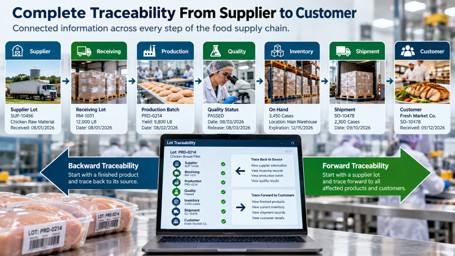
Food traceability is the ability to follow food, ingredients, and relevant materials through the operational chain and reconstruct where they came from, what happened to them, and where they went.
In practical terms, that chain might look like:
Supplier → Receiving → Raw Material Lot → Production → Quality → Finished Product → Inventory → Shipment → Customer
But effective food traceability must work in both directions.
Backward traceability helps you start with a finished product or customer shipment and work back through production, ingredients, and receiving to determine its origin.
Forward traceability starts with a supplier or raw-material lot and follows it through production and inventory to identify every resulting finished product and customer shipment.
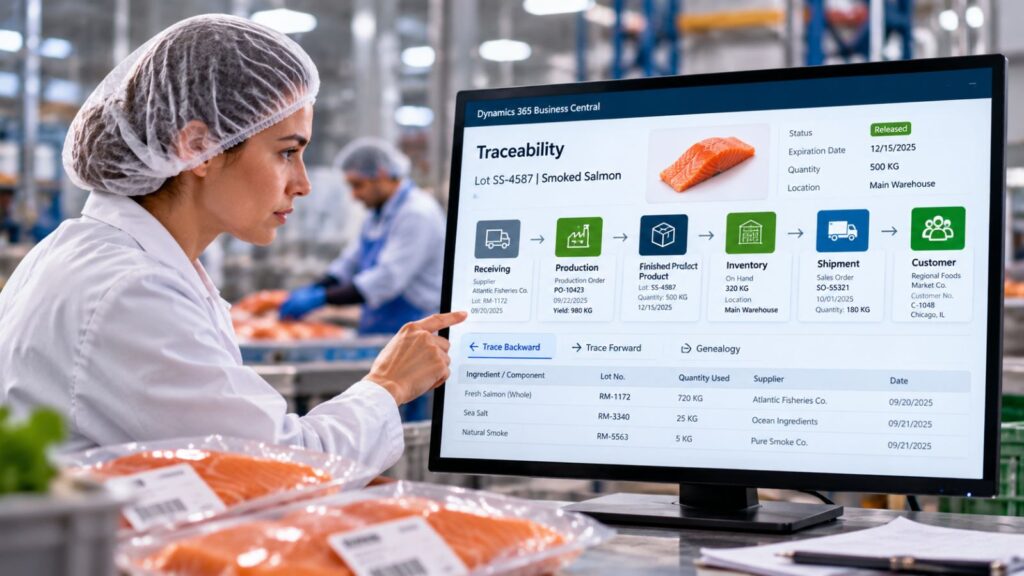
Microsoft Dynamics 365 Business Central supports item tracking using serial, lot, and package numbers, and Microsoft documents the ability to trace item-tracked inventory both backward and forward through posted inventory transactions.
From an executive perspective, however, I would broaden the definition beyond the mechanics of lot tracing.
Traceability is really about preserving relationships.
If your system knows which raw material arrived but loses the connection when it enters production, you have receiving history, not complete product genealogy.
Lot tracking is foundational to food traceability, but it isn’t the entire story.
A company can assign a lot number at receiving and still struggle to answer important questions later.
Why?
Because product doesn’t simply sit still after receiving.
It moves between locations. It can be placed on quality hold. It can be consumed in production, combined with other ingredients, split into multiple outputs, repacked, or transformed into another product. Finished goods are then stored, allocated, and shipped to customers.
Effective lot and batch traceability may therefore depend on connections among:
Microsoft’s standard Business Central item tracking provides a strong foundation for following lot and serial numbers through inventory transactions. Food companies may then need additional food-specific functionality and processes on top of that foundation.
I often describe it this way:
A lot number tells you what to follow. Traceability tells you the story of what happened to it.
That is why executives evaluating food traceability software should look beyond whether a product has a “lot tracking” checkbox.
The better question is: How much of the product’s history can we reconstruct without manually assembling the story?
Production is where traceability can become significantly more complicated.
Imagine a manufacturer receives three ingredient lots. Two are combined in one production run. That run creates multiple finished-product lots. Part of the finished product is repacked for another customer.
The traceability relationships have multiplied.
The business needs to preserve the connection between the raw materials consumed and the finished products created. That is product genealogy.
This matters in both directions.
If a customer reports a problem with Finished Lot 4587, you may need to trace backward to determine which production run created it and which raw-material lots were consumed.
If a supplier later identifies a potential issue with Raw Material Lot 1172, you need to trace forward to identify every production run that consumed it, every resulting finished product, where those products are now, and which customers received them.
This is where manual processes can become fragile.
I’ve worked in operations, and one thing experience teaches you: the person who “knows how everything works” can be extraordinarily valuable. But an executive should be uncomfortable when critical traceability depends primarily on what someone remembers.
Operational knowledge is an asset. It should not be your traceability architecture.
A scalable food manufacturing ERP environment should preserve those relationships as transactions occur, rather than requiring employees to recreate them later.
When a serious traceability question arises, speed becomes part of operational control.
I’m not going to tell an executive that installing an ERP system automatically means a trace can be completed in a predetermined number of minutes. Traceability performance depends on data quality, processes, configuration, integrations, employee practices, and business complexity.
But I would absolutely ask this:
Why should your team spend valuable time searching for information that your operational systems should already connect?
Picture two environments.
In the first, purchasing finds the supplier record. Production searches batch records. Quality opens a spreadsheet. Warehouse personnel investigates physical inventory. Sales exports shipment history. Then somebody reconciles the results.
In the second, connected ERP information lets the organization trace the affected lot’s history through related operational records.
The business still has to investigate. The difference is how much time is spent finding and reconciling information rather than acting on it.
Faster access can help teams identify affected inventory, place appropriate product on hold, determine which finished products may be involved, identify affected customers, and give management better information for operational decisions.
For a CFO, another consideration matters. If you cannot confidently define the boundaries of affected inventory, you may struggle to understand the potential financial exposure.
For a COO, the question may be which production or shipments can continue.
For the CEO, it may be how confidently the company can communicate with customers.
Traceability speed is therefore not merely a compliance metric. It is a decision-making capability.
Microsoft Dynamics 365 Business Central can provide the ERP foundation that connects many transactions involved in food traceability.
That includes purchasing, inventory, production, warehousing, sales, and financial information. Business Central’s native item-tracking functionality supports serial, lot, and package numbers, including tracking through inbound and outbound transactions and internal inventory movements. Microsoft also provides Item Tracing functionality for following item-tracked inventory backward and forward.
That is valuable, but I make an important distinction with food companies.
Business Central is the ERP foundation. Food-specific requirements can extend that foundation.
Not every capability a food manufacturer, processor, or distributor needs should be represented as native Business Central functionality.
This is where DynamicsFoodERP fits.
The objective is to build on Business Central with food-industry functionality that addresses more specialized operational requirements while maintaining the value of connected ERP information.
For executives, the architecture matters because traceability shouldn’t become another isolated application sitting beside ERP. The greater opportunity is to connect traceability to the transactions that already run the business.
Advanced Lot Management and Food-Specific Requirements
Food companies often need to make decisions about a lot based on more than its identity.
Shelf life, expiration, vendor requirements, customer preferences, quality status, and other characteristics can influence whether you should receive, allocate, pick, or ship particular inventory.
Business Central itself supports expiration rules associated with item tracking. More sophisticated food operations, however, may require additional controls around how lots are managed and selected.
That’s where advanced lot management becomes important.
The executive issue is not simply whether an expiration date can be stored. It is whether the operational process helps employees make the correct decision using that information.
I would ask:
Does the information that makes a lot acceptable or unacceptable actually influence what happens next?
A system becomes much more useful when traceability information participates in the operating process instead of sitting passively in a database.
We created this series because no single operational model fits food traceability.
The principles remain consistent, but the product journey changes significantly by industry. The brief intentionally follows this pillar with dedicated articles for seafood, cheese and dairy, and meat and poultry.
Seafood
Seafood traceability can involve source and origin information, short shelf life, cold storage, variable weights, processing, repacking, and customer requirements.
Many fish may be received at one weight, split, processed into multiple products, and shipped at different actual weights. That means traceability may need to preserve not only lot identity but also the relationship between logistical units and actual weight.
Our next article will examine seafood traceability from source to customer.
Cheese and Dairy
Cheese and dairy introduce different genealogy challenges.
Milk, cultures, ingredients, additives, and packaging can all feed into production batches. Some cheese products then remain in aging or maturation for extended periods before cutting, packaging, and shipment.
Traceability must survive that entire lifecycle.
The third article in this series will explore cheese and dairy traceability, including production batches, quality, aging, shelf life, and finished products.
Meat and Poultry
Meat and poultry processors can face complex relationships among incoming raw-material lots, cutting, processing, blending, variable weights, yields, packaging, and finished products.
Multiple raw-material lots may contribute to one production batch, while one incoming lot may ultimately appear in several finished products.
Our final article will examine meat processing traceability and how product genealogy can be maintained from receiving through production and customer shipment.
These aren’t merely different examples of the same software feature.
They demonstrate why ERP evaluation should begin with how the product actually moves through the business.
When executives evaluate food ERP traceability, I recommend testing the process rather than simply reviewing a feature list.
Pick a real product and a real operational scenario.
Then ask:
That last question is the one I would take into the executive meeting.
A system can look impressive during a demonstration. What matters is whether your organization can reproduce the product’s story when somebody asks a difficult question.
What is food traceability?
Food traceability is the ability to follow food, ingredients, and relevant materials through the supply chain and operational process. Effective traceability connects supplier and receiving information with raw-material lots, production, quality, finished goods, inventory, and customer shipments. It should support both forward tracing from source to customer and backward tracing from a finished product or shipment to its origin.
Why is food traceability important for recalls?
Traceability helps an organization determine which product may be affected, where remaining inventory is located, and which customers received relevant finished goods. During a recall or investigation, connected information can reduce time spent searching and reconciling records, allowing quality, operations, and leadership teams to focus more quickly on appropriate action. Response effectiveness still depends on the company’s data, processes, people, and systems.
Is lot tracking the same as traceability?
No. Lot tracking is a critical foundation, but traceability is broader. A lot number identifies inventory that needs tracking. Effective traceability also preserves relationships among supplier records, production activity, transformations, inventory movements, quality status, finished products, and customer shipments. This connected history lets the business reconstruct product genealogy.
How does ERP improve food traceability?
ERP improves food traceability by connecting operational information that might otherwise live in separate systems or spreadsheets. Microsoft Dynamics 365 Business Central provides native item tracking and forward/backward item tracing capabilities, while food-specific functionality can extend the ERP foundation for specialized traceability and lot-management requirements.
Turning Traceability Information Into Action
After years of working with ERP and operational systems, I’ve come to believe that one of the best ways to evaluate technology is to stop asking what information the system can store and start asking what decisions the information helps people make.
Food traceability is a perfect example.
You can have supplier records. Lot numbers. Production records. Quality data. Inventory transactions. Shipment history.
But when a serious question arises, can your organization connect them?
Good traceability isn’t measured only by whether you can eventually find the answer. It is measured by how confidently you can turn information into action when the business needs it.
For the C-suite, that means better visibility into operational risk, inventory exposure, customer impact, and business continuity.
For the people running the operation every day, it means spending less time reconstructing the past and more time deciding what happens next.
DynamicsFoodERP combines Microsoft Dynamics 365 Business Central with food-specific functionality designed to support the connected operational foundation food manufacturers, processors, and distributors need.
Learn how DynamicsFoodERP supports food traceability and advanced lot management, and evaluate how quickly your organization can turn a traceability question into a confident answer.
Andrew Good is the founder of DynamicsFoodERP and a trusted advisor to food manufacturers and distributors seeking to improve operations through technology. With more than two decades of experience in manufacturing, operations, and ERP systems, Andrew helps food businesses strengthen traceability, improve inventory visibility, support compliance initiatives, and build scalable foundations for growth.
Before specializing in Microsoft Dynamics solutions, Andrew held engineering, maintenance, and operational leadership roles with global organizations including Unilever and Sony Music. His hands-on experience on the plant floor, combined with more than 14 years of working with Microsoft Dynamics NAV and Dynamics 365 Business Central, gives him a practical understanding of the challenges food manufacturers face every day.
Andrew works closely with companies across dairy, seafood, meat and poultry, and food distribution, helping them modernize ERP systems, streamline processes, improve food safety and compliance, and gain greater visibility across production and supply chain operations.