
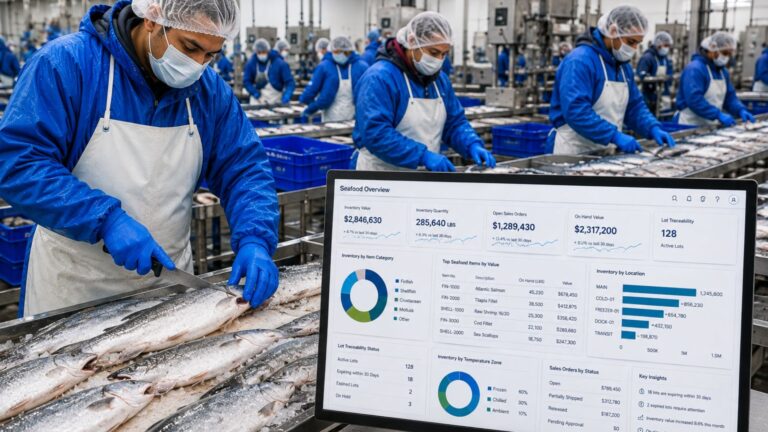
Seafood businesses have always dealt with complexity.
Product arrives in different weights. Shelf life is limited. Supply can change quickly. One item may be purchased whole, processed into several products, repacked, frozen, stored, and ultimately sold to multiple customers under different specifications.
None of that is new.
What has changed is how much visibility executives need into that complexity.
Customers expect dependable fulfillment. Finance needs accurate margins. Operations needs to know what inventory is truly available. Quality teams need confidence in lot status and traceability. Leadership needs information quickly enough to make decisions while those decisions still matter.
And that is often where I see seafood businesses begin to outgrow their systems.
It rarely happens overnight.
Instead, another spreadsheet gets created. Someone builds a workaround for catch weight. Quality maintains information separately. Warehouse employees enter information into one system while finance reconciles it in another. A process that worked reasonably well when the company was smaller gradually becomes harder to control.
I’ve seen some remarkably capable teams keep environments like this running for years.
But eventually, the question changes from:
“Can we make this work?”
to:
“Can we continue growing this way?”
That is the conversation seafood executives should be having when they begin evaluating seafood ERP software.
The objective is not simply to replace accounting software or eliminate spreadsheets. It is to create a connected operational foundation that gives people confidence in inventory, costing, traceability, quality, fulfillment, and financial performance.
As I often tell executives:
“The value of ERP isn’t that it records more information. The value is that it helps the entire organization make decisions from the same information.”– Andrew Good, CEO, DynamicsFoodERP
What Is Seafood ERP Software?
Who Uses Seafood ERP Software?
Why Seafood Operations Require Specialized ERP Capabilities
Essential Seafood ERP Capabilities
What Are the Business Benefits of Seafood ERP?
How User-Friendly Should Seafood ERP Be?
Seafood ERP Evaluation Checklist
Questions to Ask a Seafood ERP Provider
Choosing a Platform That Can Grow with the Business
Ready to Evaluate Seafood ERP?
Frequently Asked Questions
Seafood ERP software is an integrated business management system that connects the financial, inventory, purchasing, processing, quality, traceability, warehousing, sales, and distribution requirements of seafood companies into a unified operational environment.
For companies looking for an ERP built specifically around these requirements, DynamicsFoodERP for seafood processors and distributors connects these capabilities within Microsoft Dynamics 365 Business Central.
The distinction is important.
A general ERP system may do an excellent job managing financials, purchasing, sales orders, and conventional inventory. Seafood businesses often need to manage additional variables that standard inventory processes were not designed to handle naturally.
These can include:
The objective of a seafood ERP system is not to create a separate piece of software for each requirement.
It is to connect those requirements.
That distinction becomes increasingly important as a seafood company grows.
Seafood ERP is not limited to one type of seafood company.
It can support organizations across the seafood supply chain, including:
Seafood Processors
Processors may receive whole fish or other raw seafood and transform it into fillets, portions, cuts, packaged products, or other saleable items.
They need visibility into raw material consumption, actual weights, yields, trim, losses, output inventory, costing, and traceability.
Seafood Importers
Importers need to understand much more than what they ordered.
They may need visibility into suppliers, origins, incoming lots, expected receipts, freight and other landed costs, product status, documentation, inventory availability, and customer commitments.
Seafood Distributors and Wholesalers
Distributors need accurate information about what is available to sell, where it is located, its lot and shelf-life status, its actual weight, and whether it meets the customer’s requirements.
Cold-Storage Operations
Inventory location, lot status, shelf life, weight, movement, and availability can all become important when managing seafood through cold-storage environments.
Vertically Integrated Seafood Companies
The more stages of the supply chain a company manages, the more important connected information becomes.
A vertically integrated operation may be purchasing, processing, storing, selling, and distributing product within the same organization.
That makes disconnected systems particularly difficult to sustain.
One mistake I sometimes see during ERP evaluations is starting with the software instead of the business.
Executives begin asking whether a system has purchasing, inventory, financial reporting, or production.
Those are reasonable questions.
But they are not enough.
The more useful question is:
Can the system represent how our product actually moves through our business?
Seafood creates several challenges that make that question particularly important.
Two cases containing the same number of items may not weigh the same.
That creates an immediate disconnect if an inventory system assumes quantity alone represents the product accurately.
A seafood company may buy by weight, store by case, process by actual weight, price using another measure, and ultimately invoice according to the customer’s requirements.
That is why catch weight management and dual units of measure can become fundamental requirements rather than optional features.
Perishability and Shelf Life
Seafood inventory does not simply exist or not exist.
It has time associated with it.
Operations may need to know not only that 5,000 pounds are available, but which lots should ship first, which are approaching expiration, and which meet a customer’s remaining shelf-life requirements.
For the CFO, that uncertainty has a financial consequence. Excess inventory ties up working capital, aging product increases exposure to write-offs, and inaccurate availability can lead the business to purchase inventory it already has but cannot confidently identify or allocate.
Complex Sourcing
Seafood companies may source products from multiple suppliers, regions, vessels, farms, or countries.
That makes supplier and origin information operationally important, particularly when combined with quality, traceability, and customer requirements.
Product Transformation
The product you receive is often not the product you sell.
A raw product can be cut, trimmed, graded, repacked, frozen, thawed, or otherwise transformed.
Every transformation affects inventory, yield, cost, and lot genealogy.
Quality Status
Inventory may physically be in the warehouse but still not be available for sale.
It may be awaiting inspection, on hold, rejected, released only for certain uses, or subject to another quality status.
That distinction matters.
For seafood processors, quality controls also operate within an established regulatory environment. The FDA’s Seafood HACCP requirements reinforce the importance of maintaining disciplined processes and reliable records around seafood safety and processing.
One seafood company I worked with had what initially appeared to be an inventory availability problem. Sales believed product was available. Operations knew some of that inventory couldn’t be allocated. Quality had the reason, but that information lived outside the system everyone else was using.
Each department was technically correct.
The business still had the wrong answer.
Once the quality status became part of the same operational picture, the conversation changed dramatically. Sales could see what was actually available rather than what was merely physically present.
That’s a good example of something I see repeatedly:
“Inventory accuracy isn’t just knowing how much product you have. It’s knowing what you have, where it is, what condition it’s in, and whether you can actually sell it.”– Andrew Good
Every seafood business is different, so there is no single checklist that applies equally to everyone.
However, there are several capabilities I believe executives should evaluate carefully.
1. Catch-Weight and Dual-Unit Inventory
A strong seafood processing ERP should be able to maintain both inventory quantity and actual weight where the business requires it.
That information should remain connected through purchasing, inventory movements, processing, sales, and fulfillment rather than being reconciled later in spreadsheets.
2. Lot and Origin Traceability
Seafood businesses need the ability to follow product through the organization.
That can mean connecting:
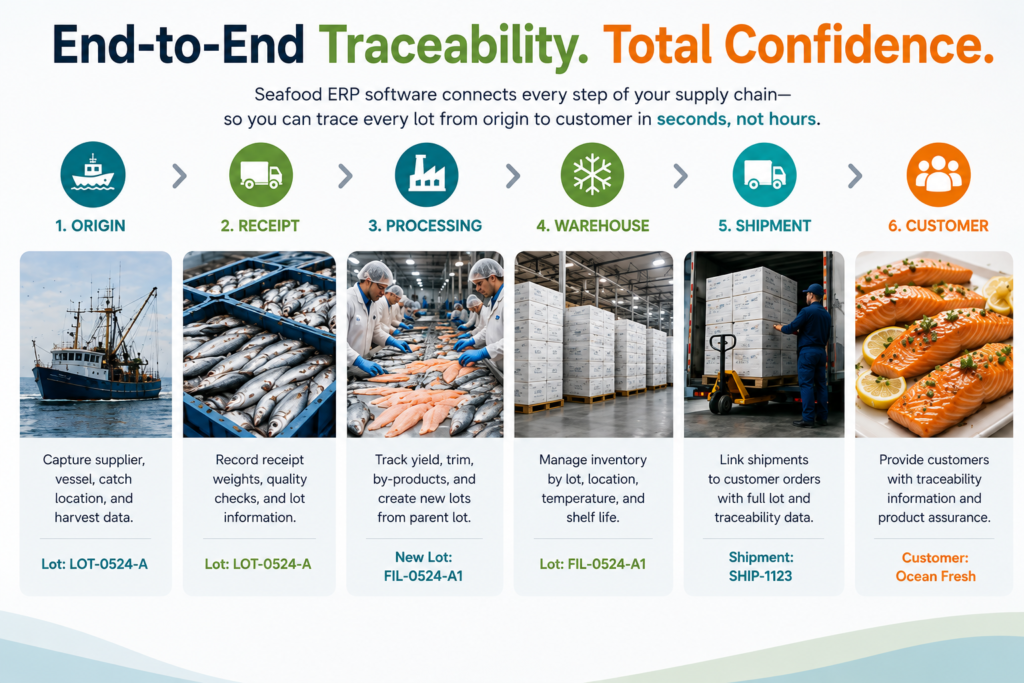
supplier → receipt → lot → processing → output lot → warehouse → shipment → customer.
Traceability should not require someone to reconstruct the history manually from several applications.
Microsoft Dynamics 365 Business Central provides native item-tracking capabilities for serial, lot, and package numbers, including forward and backward tracing of item-tracked transactions. Seafood-specific ERP functionality can build on that foundation to address the additional operational requirements of the industry.
For seafood companies, traceability is not a single transaction. It is a connected chain of information that must remain intact as product moves from origin through processing, storage, shipment, and ultimately to the customer.
Business Central also provides inventory availability capabilities that bring together on-hand quantities with supply and demand, providing a broader foundation for inventory planning and fulfillment decisions.
3. Shelf-Life and Expiration Management
The system should help teams understand aging inventory and support appropriate allocation and fulfillment decisions.
This becomes especially valuable when different customers have different shelf-life requirements.
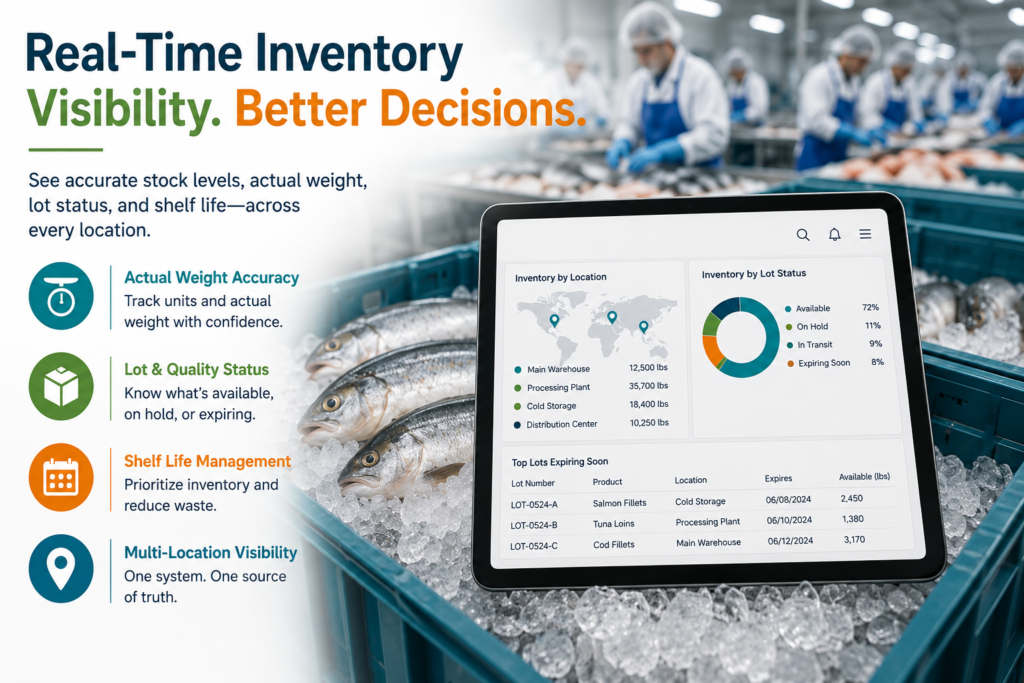
For seafood companies, inventory visibility means more than knowing how many cases are on hand. Leadership needs to understand actual weight, lot status, shelf life, and location at the same time to make confident purchasing, fulfillment, and margin decisions.
4. Quality Control and Inventory Status
Quality information should influence operational decisions.
If a lot is on hold, restricted, or awaiting release, employees who are allocating and shipping inventory should know that before product moves.
5. Yield, Trim, and Processing Loss
Seafood processing changes both the physical product and its economics.
Executives should be able to understand what went into a process, what came out, what was lost, and what that means financially.
If yield is declining, leadership should not have to wait until month-end to discover the impact.
6. Purchasing and Supplier Management
Purchasing visibility should include more than purchase orders.
Companies may need to evaluate expected receipts, supplier performance, lot and origin information, product availability, and the complete cost of bringing seafood into inventory.
7. Landed-Cost Visibility
Purchase price is not necessarily product cost.
Freight and other acquisition-related costs can materially change the margin on imported or transported seafood.
Executives need a reliable picture of those costs when evaluating pricing and profitability.
8. Warehouse Scanning and Scale Integration
Every time someone rekeys a weight or lot number, the business introduces another opportunity for error.
Handheld scanning and scale integration can help capture information closer to the physical transaction and reduce unnecessary manual entry.
9. EDI and Order Management
Many seafood companies serve customers with demanding order and document requirements.
EDI can reduce repetitive manual processing while connecting customer orders, fulfillment, and related transactions more directly.
10. Financial and Margin Reporting
This is where everything comes together.
Operations may think in pounds, cases, yields, and lots.
Finance thinks in inventory value, cost, revenue, margin, and working capital.
A good ERP environment connects those perspectives.
Microsoft Dynamics 365 Business Central provides the core ERP foundation for financial management and business operations. DynamicsFoodERP builds on BC with food-industry capabilities such as catch-weight management, advanced lot management, scanning, EDI, and connected operational processes.
The goal is not technology for technology’s sake.
The goal is reliable business information.
When executives ask me about ERP benefits, I try to avoid promising dramatic outcomes simply because software is being installed.
Software doesn’t fix a business by itself.
Good processes, accurate data, thoughtful implementation, training, and leadership still matter.
What an appropriate ERP for seafood companies can do is create the foundation for better performance.
Potential benefits include:
Improved Inventory Accuracy
Connecting quantity, actual weight, lots, locations, quality status, and transactions can reduce the need for manual reconciliation.
Better Margin Visibility
When purchasing, processing, inventory, landed cost, sales, and finance share information, leaders have a stronger basis for understanding profitability.
Faster Traceability Investigations
Connected lot genealogy can reduce the time required to determine where product came from, what happened to it, and where it went.
Reduced Manual Entry
Scanning, integration, and connected workflows can reduce duplicate entry and the errors that come with it.
More Reliable Fulfillment
Better visibility into actual available inventory helps customer-service and sales teams make commitments with greater confidence.
Stronger Operational Reporting
Instead of asking different departments to produce different spreadsheets, leadership can work toward a common operational view.
Better Scalability
Growth becomes difficult when every increase in transaction volume requires additional manual reconciliation.
ERP should allow processes and information to scale more effectively with the organization.
I remember working with a company where part of the leadership meeting had effectively become an inventory reconciliation exercise.
Operations came prepared with one view of inventory. Finance had another. Sales had its own understanding of what was available to promise customers. Before the executive team could discuss purchasing, margins, customer commitments, or growth, they first had to determine which numbers they trusted.
What struck me wasn’t that anyone had done anything wrong. Each team had built the best picture it could from the systems and information available to them.
The problem was the time being consumed by uncertainty.
Once the underlying operational information was brought together, those meetings changed. Leadership could spend less time debating what had already happened and more time deciding what should happen next.
That’s an important distinction for executives considering ERP modernization.
The return on connected information isn’t measured only in fewer spreadsheets or faster reporting. It is also measured in the quality and speed of the decisions leadership can make.
As I often tell executive teams: “If your management meeting starts with everyone reconciling whose numbers are right, you don’t have a reporting problem. You have a confidence problem. Executives don’t need another dashboard telling them what happened. They need confidence that the information behind the dashboard reflects what’s actually happening in the business.”
Andrew Good is the founder of DynamicsFoodERP and a trusted advisor to food manufacturers and distributors seeking to improve operations through technology. With more than two decades of experience in manufacturing, operations, and ERP systems, Andrew helps food businesses strengthen traceability, improve inventory visibility, support compliance initiatives, and build scalable foundations for growth.
Before specializing in Microsoft Dynamics solutions, Andrew held engineering, maintenance, and operational leadership roles with global organizations including Unilever and Sony Music. His hands-on experience on the plant floor, combined with more than 14 years of working with Microsoft Dynamics NAV and Dynamics 365 Business Central, gives him a practical understanding.