Introduction
After years of working with food manufacturers, I’ve noticed something interesting.
When executives tell me they have an inventory problem, they’re usually describing something much larger.
Inventory isn’t matching expectations.
Production yields vary from forecast.
Costing seems inconsistent.
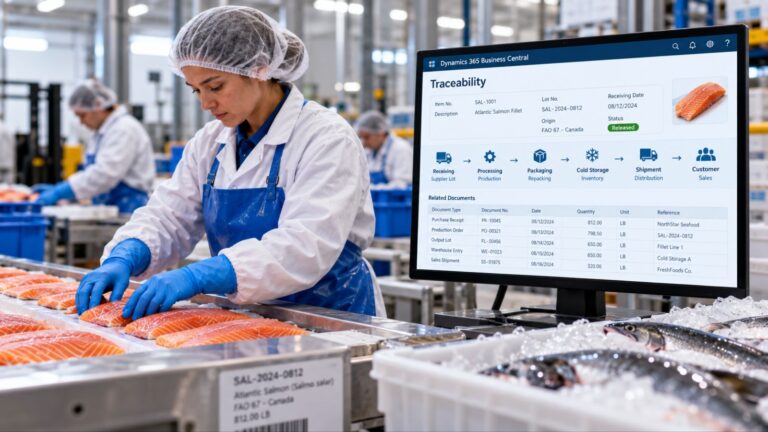
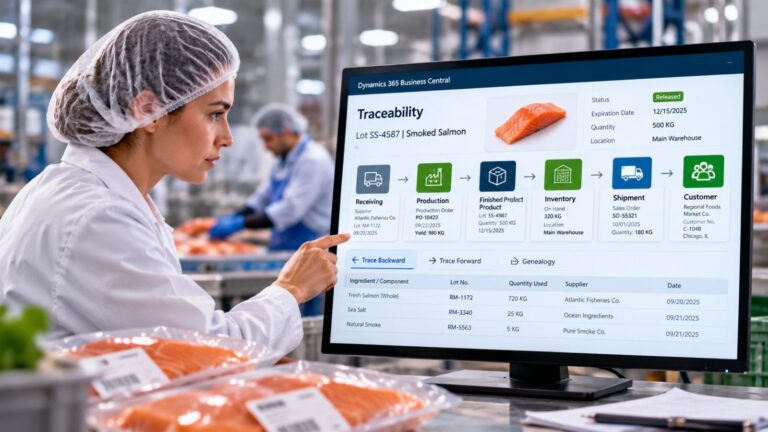
Traceability takes longer than it should.
Quality information isn’t available when decisions need to be made.
Customer service teams spend valuable time tracking down answers instead of helping customers.
On the surface, these appear to be separate operational challenges.
In reality, they often share the same root cause.
A lack of operational visibility.
That distinction matters.
Most food manufacturers don’t struggle because they lack data.
Quite the opposite.
Today’s food businesses collect more operational information than ever before.
Production systems generate thousands of transactions.
Quality teams capture inspection records.
Warehouse systems monitor inventory movement.
Finance tracks costs and profitability.
Traceability records continue to expand as regulatory requirements evolve.
The problem isn’t the amount of information.
The problem is whether leaders can trust it.
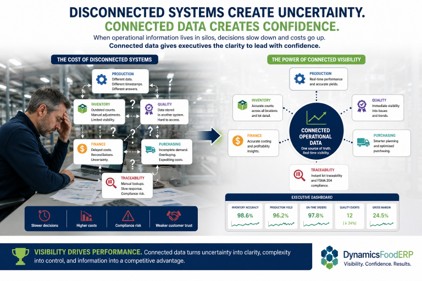
When inventory, production, quality, finance, purchasing, and traceability operate in disconnected systems, executives are forced to make important decisions using incomplete information.
That’s not simply an inventory problem.
It’s a business visibility problem.
“The manufacturers achieving the strongest results aren’t necessarily collecting more data than everyone else. They’re creating confidence in the information they already have.” — Andrew Good, CEO, DynamicsFoodERP
Over the past four articles, we’ve explored catch-weight management from the perspective of meat and poultry, seafood, dairy, and the broader operational challenges unique to food manufacturing.
Each industry has different products.
Different regulations.
Different production environments.
Yet every conversation leads to the same conclusion.
Successful food manufacturers don’t eliminate operational complexity.
They gain visibility into it.
In the Previous Article
In our previous article, “Dairy Catch-Weight Management: Why Visibility Matters from Production Through Aging,” we explored how changing product weights, moisture loss, and aging create challenges that extend far beyond inventory management.
We discussed why dairy manufacturers need to track actual product weight throughout the production lifecycle, how accurate catch-weight data improves profitability and traceability, and why connected operational information has become essential for maintaining confidence in inventory, costing, and compliance.
Perhaps the most important lesson was this:
Many food manufacturers believe they have an inventory problem when they actually have a visibility problem.
That observation doesn’t apply only to dairy.
Throughout this Catch-Weight Management series, we’ve seen the same pattern emerge across meat and poultry, seafood, and dairy manufacturing. Every segment has its own operational challenges, but each demonstrates the same fundamental truth: executives make better decisions when production, inventory, quality, finance, traceability, and compliance are connected through trusted operational information.
That brings us to the final article in this series.
Rather than focusing on one segment of the food industry, I’d like to step back and examine the broader lesson we’ve uncovered together: why operational visibility has become one of the most important competitive advantages in modern food manufacturing.
Table of Contents
Why Visibility Has Become a Strategic Priority
The Hidden Cost of Disconnected Systems
What Catch-Weight Management Has Taught Us
What Modern Food ERP Should Deliver
A Story I See Repeatedly
Why Executive Confidence Depends on Connected Data
Looking Beyond Inventory Accuracy
A Final Thought
Ready to Improve Food Manufacturing Visibility?
Frequently Asked Questions
Why Visibility Has Become a Strategic Priority
Food manufacturing has never been simple.
Today’s executives are balancing rising ingredient costs, changing customer expectations, labor shortages, tighter margins, increasingly complex supply chains, and expanding regulatory requirements.
At the same time, they are expected to make faster decisions with greater confidence.
That combination has fundamentally changed what manufacturers need from their ERP systems.
Ten years ago, many organizations viewed ERP primarily as a transactional system.
It recorded inventory.
It processed orders.
It supported accounting.
Today, executive teams expect something much more valuable.
They expect visibility.
Visibility means understanding what’s happening across the business in real time.
It means knowing whether inventory records accurately reflect what is on the warehouse floor.
It means understanding how production performance affects profitability.
It means seeing quality events before they become customer issues.
It means tracing products confidently when regulators or customers request information.
Most importantly, it means making business decisions based on trusted operational information rather than assumptions.
“Visibility isn’t about seeing more reports. It’s about reducing uncertainty. When executives trust the operational information in front of them, they make better decisions faster.” — Andrew Good
The FDA’s FSMA 204 Final Rule reinforces why connected operational information has become essential for food manufacturers. Organizations that already maintain integrated production, inventory, and traceability records are significantly better positioned for compliance and recall readiness.
This has become particularly important as FSMA 204 raises expectations around traceability and recordkeeping.
Many organizations initially view the regulation as another compliance requirement.
I see it differently.
FSMA 204 highlights something manufacturers have needed for years.
Connected operational information.
Manufacturers with strong visibility are better positioned not only for compliance but also for inventory management, customer responsiveness, profitability, and long-term growth.
The Hidden Cost of Disconnected Systems
When people think about disconnected systems, they often picture inconvenience.
A few spreadsheets.
Multiple reports.
Manual data entry.
The reality is much more significant.
Disconnected operational information affects nearly every function within a food manufacturing business.
Inventory teams may not have complete visibility into available stock.
Production schedules rely on outdated information.
Purchasing decisions are made using incomplete forecasts.
Finance spends valuable time reconciling numbers instead of analyzing performance.
Quality teams search through multiple systems during investigations.
Customer service representatives struggle to answer simple questions because the information exists in several different places.
I’ve watched leadership meetings where everyone was looking at different reports generated from different systems.
Each report was technically accurate.
None of them told the complete story.
The conversation quickly shifted from solving business problems to debating which report should be trusted.
That is one of the most expensive forms of operational waste.
Not because inventory is inaccurate.
Because leadership loses confidence in the information guiding every important decision.
The financial impact extends well beyond inventory adjustments.
It influences:
- Production efficiency
- Yield performance
- Inventory carrying costs
- Customer satisfaction
- Regulatory compliance
- Profitability
- Executive confidence
Those costs are rarely identified on a financial statement.
Yet they influence nearly every business decision made throughout the organization.
What Catch-Weight Management Has Taught Us
One of the reasons I wanted to build this series around catch-weight management is that it provides a clear illustration of a much larger business challenge.
Whether we’re talking about meat processors, seafood companies, or dairy manufacturers, every industry experiences products that naturally change.
Weights vary.
Yields fluctuate.
Moisture changes.
Processing conditions evolve.
Customer specifications differ.
At first glance, those seem like inventory management issues.
They aren’t.
They’re visibility issues.
Throughout this series, we’ve explored how:
- Meat and poultry manufacturers manage variable-weight products while protecting margins and maintaining traceability.
- Seafood processors deal with changing yields, seasonal variability, and complex inventory movements.
- Dairy manufacturers balance aging, moisture loss, and continuously changing product weights.
Each sector presents unique operational challenges.
But each one demonstrates the same lesson.
Reliable business decisions depend on connected operational information.
When production, inventory, quality, finance, and traceability share a common source of truth, executives gain confidence.
When they operate independently, uncertainty grows.
That uncertainty costs money.
More importantly, it slows decision-making at precisely the time manufacturers need greater agility.
“Catch-weight management isn’t really about weight. It’s about confidence. If executives can’t trust the operational information behind those numbers, every decision becomes more difficult.” — Andrew Good
Organizations such as the International Dairy Foods Association (IDFA) continue to emphasize operational excellence, product quality, and supply chain visibility as essential components of long-term competitiveness.
Publications like Dairy Foods Magazine regularly highlight how improving operational visibility helps manufacturers respond to changing market demands while improving efficiency and profitability.
What Modern Food ERP Should Deliver
When manufacturers evaluate Food ERP solutions, conversations often begin with functionality.
Can the system manage catch-weight?
Can it support lot traceability?
Can it handle quality records?
Can it meet FSMA 204 requirements?
Those questions matter.
But I encourage executive teams to ask something even more important.
Will this system improve confidence in the way we run the business?
Technology alone doesn’t create better decisions.
Connected operational information does.
A modern Food ERP platform should help organizations create a single, trusted view of their operations by connecting:
- Production
- Inventory
- Quality
- Purchasing
- Finance
- Costing
- Traceability
- Compliance
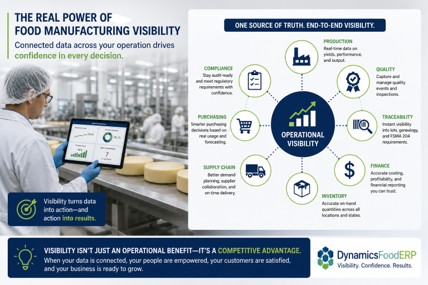
When those functions operate together rather than independently, inventory becomes more accurate.
Traceability becomes faster.
Financial reporting becomes more reliable.
Customer service improves.
Executive teams spend less time questioning information and more time acting on it.
That’s where the real return on ERP investment comes from.
Not simply automating transactions.
Building confidence across the business.
Industry standards such as GS1 traceability guidelines demonstrate that successful traceability depends on standardized, connected operational information rather than isolated recordkeeping.
A Story I See Repeatedly
One engagement several years ago continues to shape how I think about Food ERP.
A food manufacturer contacted us because inventory accuracy had become a growing concern. The leadership team believed their warehouse processes needed attention, so they expected the project to focus on inventory management.
As we worked through the discovery process, we found something quite different.
The inventory system wasn’t the primary issue.
Production was recording information correctly.
Quality was maintaining its own records.
Finance had accurate costing information.
Customer service tracked order activity.
Each department was doing its job.
The problem was that none of the information connected in a meaningful way.
During executive meetings, different departments presented different reports. Each report was technically correct, but each represented only part of the operational picture. As a result, leadership spent valuable time reconciling information instead of making decisions.
Once production, inventory, quality, finance, and traceability information were connected through a single operational platform, something changed.
The conversations became shorter.
More importantly, the leadership team stopped debating the numbers and started discussing the future of the business.
The questions became more strategic.
Instead of asking, “Which report is correct?” executives began asking, “What should we do next?”
That shift is far more valuable than improving inventory accuracy by a few percentage points.
“I’ve learned that the biggest operational improvements rarely come from collecting more information. They come from connecting the information manufacturers already have.” — Andrew Good
Why Executive Confidence Depends on Connected Data
One lesson has become increasingly clear throughout this series.
Inventory is not an isolated function.
Neither is production.
Or quality.
Or finance.
Every operational decision depends on information flowing accurately across the business.
Consider a simple customer inquiry.
A customer asks whether a shipment can leave tomorrow.
Answering that question confidently requires visibility into:
- Available inventory
- Production schedules
- Quality status
- Lot traceability
- Shipping priorities
- Customer commitments
If even one of those pieces is disconnected, uncertainty enters the conversation.
The same principle applies to executive decision-making.
Can we increase production?
Should we purchase additional raw materials?
Is this product profitable?
Are we prepared for an audit?
Can we respond confidently to a recall?
Those decisions cannot be made effectively when operational information exists in isolated systems.
Connected data transforms information into confidence.
That confidence enables better planning, faster response times, stronger customer relationships, and more informed strategic decisions.
“Visibility isn’t something executives purchase. It’s something they build by connecting the information that already exists throughout the organization.” — Andrew Good
Looking Beyond Inventory Accuracy
Throughout this series, we’ve explored catch-weight management across several food manufacturing sectors.
The products changed.
The operational challenges changed.
The regulations changed.
Yet one theme remained remarkably consistent.
Manufacturers often believe they’re solving an inventory problem when they’re actually addressing a visibility challenge.
Inventory accuracy is important.
But inventory alone doesn’t explain profitability.
It doesn’t explain production performance.
It doesn’t explain yield.
It doesn’t explain customer satisfaction.
It doesn’t explain compliance.
Those outcomes depend on the quality of the information connecting every operational process.
This is where modern Food ERP systems create their greatest value.
Not because they store more data.
Because they help manufacturers trust the information they already use to make decisions.
That distinction may seem subtle.
In practice, it changes everything.
When executives trust their operational information, they make decisions more quickly.
Production teams respond more effectively.
Finance gains greater confidence in costing and profitability.
Quality investigations become faster.
Traceability becomes more reliable.
Customer service improves.
Growth becomes easier to manage.
That’s the competitive advantage modern operational visibility creates.
For manufacturers handling products included on the FDA’s Food Traceability List, accurate, connected operational information is becoming increasingly important for maintaining compliance while supporting efficient day-to-day operations.
“In my experience, executives rarely lose sleep over inventory counts. They lose sleep when they can’t trust the information behind those counts.” — Andrew Good
A Final Thought
Every conversation throughout this Catch-Weight Management series has led to the same conclusion.
Technology alone does not solve operational challenges.
Better visibility does.
Food manufacturers will continue to face changing yields, variable-weight products, evolving regulations, supply chain disruptions, labor shortages, and increasing customer expectations.
Complexity isn’t going away.
The organizations that succeed won’t necessarily be the ones with the largest ERP systems or the most sophisticated technology.
They’ll be the ones with the greatest confidence in their operational information.
I’ve seen manufacturers dramatically improve performance without fundamentally changing what they produce.
Instead, they changed how they connected information across production, inventory, quality, finance, traceability, and compliance.
That visibility gave leadership the confidence to act more quickly, respond more effectively, and make better business decisions.
Ultimately, that’s what modern Food ERP should deliver.
Not simply better inventory management.
Better business management.
“Successful food manufacturers don’t eliminate complexity. They create visibility into it. When leaders trust their operational information, they gain confidence in every decision that follows.” — Andrew Good
The manufacturers that outperform their competitors over the next decade won’t simply be those with more automation or more data. They’ll be the ones whose leadership teams have the confidence to make faster, smarter decisions because they trust the information driving every part of the business.
Ready to Improve Food Manufacturing Visibility?
If your organization continues to struggle with inventory accuracy, inconsistent reporting, traceability challenges, or disconnected operational information, the underlying issue may not be inventory at all.
It may be visibility.
DynamicsFoodERP helps food manufacturers connect production, inventory, quality, costing, traceability, finance, and compliance into a single operational platform designed specifically for the unique challenges of food manufacturing.
Our goal isn’t simply to help you manage inventory more accurately.
It’s to help your leadership team build confidence in the operational information that supports every strategic decision.
If you’re evaluating your current ERP environment or planning for future growth, we’d welcome the opportunity to discuss how greater operational visibility can improve performance across your business.
Contact DynamicsFoodERP today to schedule a Food Manufacturing Visibility Assessment and discover how connected operational data can strengthen profitability, compliance, traceability, and executive decision-making.
Frequently Asked Questions
What is food manufacturing visibility?
Food manufacturing visibility is the ability to access accurate, connected, real-time information across production, inventory, quality, traceability, finance, and the supply chain. It gives executives confidence that operational data reflects what is actually happening throughout the business and supports faster, more informed decision-making.
Why do food manufacturers struggle with inventory accuracy?
Many inventory issues are actually visibility issues. When production, warehouse, quality, finance, and traceability information are stored in separate systems or spreadsheets, discrepancies accumulate over time. Connected operational data improves inventory accuracy and confidence in business decisions.
How does operational visibility improve profitability?
Operational visibility provides trusted information that supports better production planning, inventory management, yield analysis, costing, purchasing, and customer service. When leaders trust their operational information, they reduce waste, protect margins, improve responsiveness, and make better strategic decisions.
How does FSMA 204 increase the importance of connected operational data?
FSMA 204 requires detailed traceability records across the supply chain. Manufacturers with connected operational information are better positioned to support compliance, respond to audits, accelerate recalls, and maintain confidence in product traceability without relying on disconnected manual processes.
What should food manufacturers look for in a modern Food ERP system?
A modern Food ERP system should do far more than manage inventory. It should connect production, quality, inventory, traceability, costing, finance, and compliance into a single operational environment that improves visibility, strengthens decision-making, and supports long-term growth.
Why is connected operational data more valuable than simply collecting more information?
Collecting more data doesn’t necessarily improve decisions. Competitive advantage comes from connecting existing operational information so executives can trust what they’re seeing, identify issues sooner, and respond confidently across every area of the business.
How does catch-weight management demonstrate the need for operational visibility?
Catch-weight management illustrates how production, inventory, quality, traceability, costing, and customer requirements are interconnected. Variable-weight products expose the limitations of disconnected systems and demonstrate why visibility across the entire operation is essential for accurate inventory, profitability, and compliance.
About Andrew Good
Andrew Good is the founder of DynamicsFoodERP and a trusted advisor to food manufacturers and distributors seeking to improve operations through technology. With more than two decades of experience in manufacturing, operations, and ERP systems, Andrew helps food businesses strengthen traceability, improve inventory visibility, support compliance initiatives, and build scalable foundations for growth.
Before specializing in Microsoft Dynamics solutions, Andrew held engineering, maintenance, and operational leadership roles with global organizations including Unilever and Sony Music. His hands-on experience on the plant floor, combined with more than 14 years of working with Microsoft Dynamics NAV and Dynamics 365 Business Central, gives him a practical understanding of the challenges food manufacturers face every day.
Andrew works closely with companies across dairy, seafood, meat and poultry, and food distribution, helping them modernize ERP systems, streamline processes, improve food safety and compliance, and gain greater visibility across production and supply chain operations.