
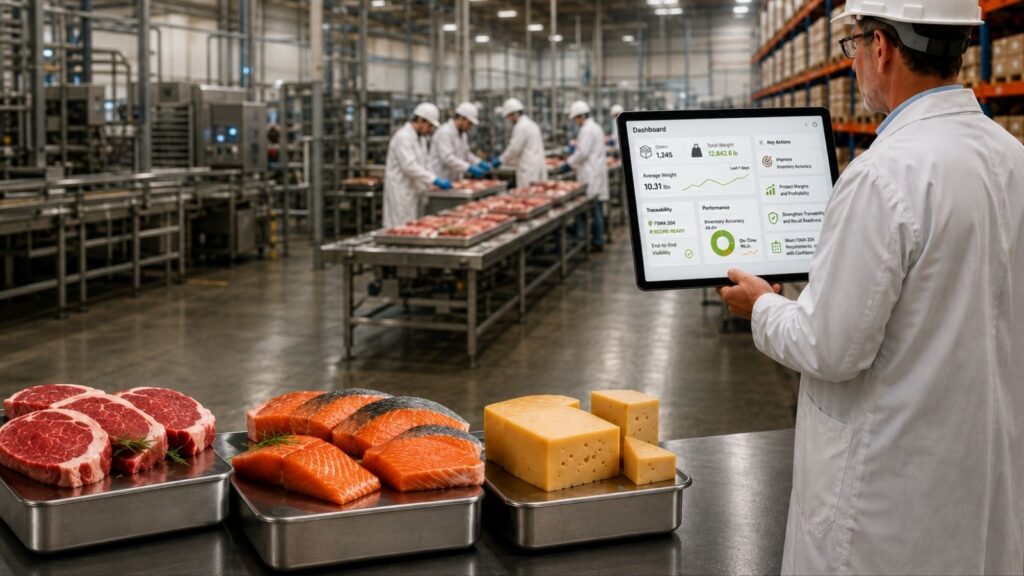
Walk through a meat processing facility, seafood distribution center, or cheese manufacturing operation, and you’ll quickly notice something that many ERP systems struggle to handle: products rarely weigh exactly what the label says they should.
Two cases may contain the same product. One weighs 48 pounds. The other weighs 53 pounds.
Yet many inventory systems still treat them as identical.
Over time, those seemingly small differences can create inventory discrepancies and margin erosion. They can also lead to fulfillment challenges and traceability gaps throughout the organization.
I’ve found that most food manufacturers do not struggle with a lack of data. They struggle because their systems fail to reflect the realities of variable-weight inventory.
A warehouse may show 1,000 cases available. Operations believes inventory is healthy. Finance believes costs are accurate.
But nobody knows the actual sellable weight sitting on the floor.
That is where Catch Weight management becomes critical.
For processors of meat, poultry, seafood, dairy, and cheese products, Catch Weight is no longer simply an inventory issue.
Catch Weight directly impacts profitability, planning, traceability, compliance, and executive decision-making.
For manufacturers and distributors managing variable-weight inventory, accurate Catch Weight management is essential.
Accurate Catch Weight management also supports profitability, traceability, and compliance.
As margins tighten and FSMA 204 traceability requirements become more important, food manufacturers need greater visibility into what is actually moving through their operations.
Catch Weight refers to products that are sold and tracked using both a standard unit of measure and their actual weight because each item naturally varies in size or weight.
This is common throughout the food industry, particularly for products with expected weight variation.
Examples include:
In a Catch Weight environment, inventory is managed using two measurements simultaneously:
For example, a processor may ship ten cases of beef loins. Each case represents one inventory unit. However, one case may weigh 48 pounds, while another may weigh 53 pounds.
The inventory system must accurately track both measurements.
This dual-tracking requirement is what separates Catch-Weight inventory management from traditional inventory management.
Executive Insight: Inventory Counts Don’t Pay the Bills
One of the most common conversations I have with food manufacturers starts with inventory accuracy and quickly turns into profitability.
A company may know exactly how many cases are sitting in a warehouse. What they often struggle to understand is how much sellable product is actually available and what that inventory is truly worth.
In food manufacturing, quantity alone rarely tells the full story. Actual weight drives costs, revenue, margins, and customer commitments.
Catch Weight inventory exists because food products naturally vary in size or weight, unlike manufactured parts.
A bolt, screw, or packaged consumer product can typically be counted and valued consistently.
Food products are different.
Weight variations occur naturally due to biological differences and processing. Moisture loss, trimming, aging, and packaging can also affect a product’s final weight.
Without accurate Catch Weight management, organizations often experience:
Raw material costs are incurred by weight.
Customers frequently purchase by weight.
Regulators increasingly expect traceability records that accurately reflect product movement throughout the supply chain.
I’ve seen processors lose confidence in their inventory numbers when actual product weights are tracked outside the ERP system. Spreadsheets, disconnected databases, and paper records make it harder to maintain a reliable view of inventory.
When teams begin questioning the accuracy of inventory data, planning and purchasing become more difficult. Fulfillment and financial reporting can also suffer.
As a result, specialized food ERP systems that support Catch Weight management have become increasingly important for food manufacturers.
Catch Weight management is particularly important in industries where inventory accuracy and traceability are critical.
Meat processors, seafood distributors, dairy manufacturers, and cheese producers often rely on dual-unit tracking. It supports profitability, customer satisfaction, and regulatory compliance.
As traceability requirements such as FSMA 204 continue to evolve, organizations are placing greater emphasis on connecting accurate weight data with lot tracking and supply chain records.
When evaluating Catch Weight performance, food manufacturers should start with four questions:
1. Can We Trust Our Inventory Numbers?
Inventory counts alone do not provide a complete picture. If quantities and actual weights do not align, planning and fulfillment decisions become less reliable.
2. Do We Know Our True Product Costs?
Even small weight variances can create significant costing distortions when multiplied across thousands of transactions.
3. Are We Prepared for FSMA 204 Traceability Requirements?
Inventory, lot tracking, production, and shipment records must align. Disconnected systems create compliance and recall risk.
4. Can Our Current Processes Support Future Growth?
Manual processes and spreadsheets become increasingly difficult to manage as organizations expand across facilities, warehouses, and distribution networks.
These questions often illuminate hidden operational risks that silently erode profitability and long-term growth potential.
Dual units of measure allow manufacturers to track both quantity and actual weight.
This is necessary because product weights can vary even when the inventory count stays the same.
| Inventory Unit | Actual Weight |
| 1 Case | 52.3 lbs |
| 1 Case | 48.9 lbs |
| 1 Case | 51.1 lbs |
Cheese manufacturers provide a perfect example.
A facility may have 100 cases of aged cheese in inventory. On paper, inventory appears straightforward.
The challenge is that moisture loss during aging causes weights to change over time.
The inventory count remains the same.
The actual weight does not.
Without dual-unit tracking, inventory valuation, production planning, and customer fulfillment become significantly more difficult.
The cases of cheese in inventory may weigh between 42 and 54 pounds.
You must track both quantity and actual weight to support:
Many ERP systems were originally designed around fixed-weight inventory assumptions.
They assume:
Food operations rarely match fixed inventory assumptions.
As a result, manufacturers often rely on spreadsheets, manual workarounds, disconnected databases, and custom processes to bridge the gap.
This creates common challenges, including:
A plant manager recently summarized the challenge this way:
“We do not struggle with counting inventory. We struggle with knowing what is actually there.”
That distinction is not academic; it can mean the difference between operational efficiency and costly surprises.
When thousands of pounds of product move through a facility every week, even small discrepancies can create significant operational and financial consequences.
Consider a meat processor that purchases raw materials by weight and sells finished products by weight.
If actual production yields vary from expected yields by just a few percentage points, the impact can quickly compound across thousands of pounds of product each week.
What initially appears to be a small inventory variance can affect purchasing and production planning. It can also distort customer profitability and financial reporting.
This is why leading food manufacturers increasingly view Catch Weight as a business performance issue rather than simply a warehouse issue.
Many organizations view Catch Weight as an operational issue.
Leading manufacturers now see Catch Weight as both an operational and financial issue.
A one-percent inventory variance may appear insignificant on paper.
For a processor moving millions of pounds annually, however, that variance can lead to substantial inventory write-offs and margin erosion. It can also create customer disputes and planning inefficiencies.
The challenge is not simply inventory accuracy.
It is about giving executives visibility into true profitability across products, customers, production lines, and facilities.
I’ve seen finance teams spend days reconciling inventory variances only to discover the root cause was inconsistent weight tracking somewhere earlier in the process.
By the time the issue reaches accounting, the operational event that caused it may have occurred weeks earlier, making resolution far more difficult.
Without accurate weight data, leaders struggle to answer critical questions:
Organizations that improve Catch Weight visibility gain better control over profitability and working capital. They can also improve forecasting and strategic planning.
Many organizations underestimate how quickly weight variability adds up.
Across thousands of products and transactions, even minor discrepancies can materially affect margins.
Common consequences include:
Inventory Variance
Inventory records no longer accurately reflect physical inventory.
Margin Erosion
Distorted product costs weaken profitability analysis.
Yield Reporting Issues
Production teams lose visibility into operational performance.
Revenue Leakage
Invoices may understate the value of the product delivered.
Industry research consistently shows that inventory visibility and operational accuracy remain among the strongest drivers of supply chain performance.
Getting Catch Weight accuracy right is not just beneficial; it’s a competitive edge.
Catch Weight and FSMA 204 Traceability
Catch Weight is no longer just an inventory issue.
It is increasingly a traceability issue.
The FDA’s Food Safety Modernization Act Section 204 places greater emphasis on end-to-end product visibility across the supply chain.
Under the FDA Food Traceability Final Rule, organizations handling foods on the Food Traceability List (FTL) must maintain Key Data Elements (KDEs) across Critical Tracking Events (CTEs) throughout the supply chain.
For companies handling variable-weight products, maintaining accurate traceability records requires tracking:
When traceability and inventory systems are disconnected, data gaps appear.
I’ve seen companies perform internal recall exercises and discover that inventory records, shipment data, and traceability documentation did not align as cleanly as expected.
Those exercises are valuable because they reveal where manual processes and disconnected systems create unnecessary risk before a real event occurs.
For importers, exporters, and companies operating across multiple facilities, those gaps become even more problematic.
Under FSMA 204, organizations need the ability to quickly connect products, lots, weights, transformations, and shipments throughout the supply chain.
During a recall event, the goal is not simply finding inventory.
The goal is finding the right inventory quickly and confidently.
Accurate Catch Weight data plays an important role in making that possible.
As FSMA 204 implementation moves forward, manufacturers need to integrate weight data with inventory and traceability records.
This can strengthen compliance, simplify recalls, and help teams make faster decisions.
Modern food ERP systems allow manufacturers to manage Catch Weight products on a single platform. They connect inventory and production with costing, traceability, and compliance.
A purpose-built Food ERP Catch Weight solution should provide:
Seafood processors and distributors have additional requirements beyond Catch Weight. These can include shelf-life management, product transformations, quality control, yields, and origin traceability.
A purpose-built seafood ERP system can bring these processes together within a connected operational environment.
For many food manufacturers, inventory visibility becomes the catalyst for broader operational improvement.
Many manufacturers also align their processes with GS1 traceability standards to improve supply chain visibility and data consistency.
Once leaders trust the numbers, they can make faster and more confident decisions.
Many food manufacturers use Microsoft Dynamics 365 Business Central as their ERP foundation. It brings inventory, finance, operations, and traceability into a unified platform.
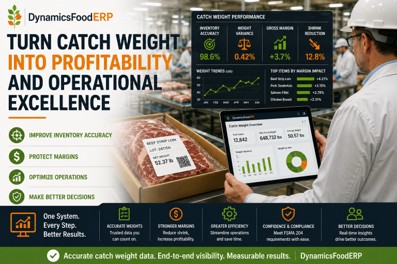
For years, Catch Weight was viewed primarily as a warehouse challenge.
Today, it sits at the intersection of:
The best food manufacturers do not try to eliminate variability.
They build systems that help them understand and manage it better than their competitors.
That distinction matters.
Variability is inevitable in food manufacturing. Visibility is not.
Better visibility into weights, yields, inventory, and traceability helps organizations make faster, more informed decisions.
Their competitive advantage comes from managing that variability with greater accuracy, visibility, and control.
As traceability requirements increase and margins remain under pressure, Catch Weight management is becoming a foundational capability for modern food operations.
While the underlying principles of Catch Weight management remain consistent, the operational challenges vary significantly by industry.
Dairy and cheese manufacturers must account for variable weights caused by moisture loss, aging, portioning, and production yields. Explore Catch Weight management for dairy and cheese manufacturers.
Seafood processors and distributors face Catch Weight challenges related to variable product sizes, yields, inventory accuracy, and traceability. Explore Catch Weight management for seafood processors and distributors.
Meat and poultry processors must manage variable-weight products while maintaining accurate inventory, costing, yields, and traceability. Explore how Catch Weight affects inventory accuracy in meat processing.
Food manufacturing has always been a business of variability.
Animal weights vary. Seafood harvests vary. Cheese loses moisture as it ages.
The challenge is not eliminating variability. The challenge is understanding it well enough to make better decisions.
After working with food manufacturers for many years, one thing has become clear: organizations rarely struggle because they lack data. They struggle because they lack confidence in the data they have.
Catch Weight management helps bridge that gap by turning operational variability into actionable business insight.
Catch Weight management provides a more accurate picture of inventory and profitability. It also improves visibility into traceability and operational performance.
Food manufacturers face continued margin pressure, rising customer expectations, and evolving regulations such as FSMA 204. As these pressures increase, accurate Catch Weight management is becoming less of a competitive advantage and more of a business requirement.
The companies that invest in visibility today will be better positioned to grow, adapt, and compete tomorrow.
If you’re evaluating how your current systems support Catch Weight inventory, traceability, and FSMA 204 requirements, I’d welcome a conversation. We can discuss what’s working, what isn’t, and where opportunities for improvement may exist.
The manufacturers that consistently outperform their competitors are rarely the ones with less variability. They’re the ones with greater visibility into it.
Schedule a conversation with the DynamicsFoodERP team to explore what’s possible.
What is Catch Weight in the food industry?
Catch Weight refers to products that are tracked and sold using both a standard unit of measure and their actual weight because each item naturally varies in size or weight. Common examples include meat cuts, seafood products, poultry, and cheese.
What industries use Catch Weight inventory?
Catch Weight inventory is commonly used in meat processing, poultry processing, seafood, dairy manufacturing, cheese production, produce distribution, and other food sectors where products do not have a consistent weight.
What is variable weight inventory?
Variable-weight inventory consists of products whose actual weight varies from item to item, even when they are packaged or sold as the same product. These products require inventory systems that can track both quantity and weight.
What are dual units of measure?
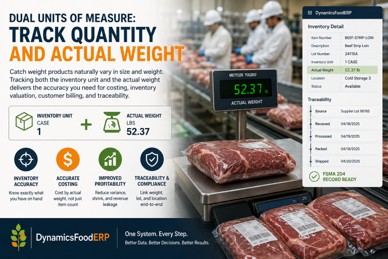
Dual units of measure allow manufacturers to track inventory using two measurements simultaneously, typically a count-based unit, such as cases or boxes, and an actual weight measurement, such as pounds or kilograms.
Why do food manufacturers struggle with Catch Weight inventory?
Many food manufacturers struggle because traditional inventory systems are designed for fixed-weight products. Managing actual weights, inventory valuation, costing, production yields, and customer invoicing requires specialized Catch Weight management capabilities.
How does Catch Weight affect inventory accuracy?
Catch Weight improves inventory accuracy by ensuring that actual product weights are recorded and tracked alongside inventory quantities. This provides a more realistic view of available inventory and helps reduce discrepancies between physical stock and system records.
How does Catch Weight impact profitability?
Catch Weight directly affects profitability because product costs, yields, inventory valuation, and customer billing are often based on actual weight. Inaccurate weight tracking can lead to margin erosion, invoicing errors, and unreliable financial reporting.
How does Catch Weight affect food traceability?
Catch Weight supports food traceability by linking actual product weights with lot numbers, production records, inventory movements, and shipment data. This creates a more complete record of product movement throughout the supply chain.
What is the relationship between Catch Weight and FSMA 204?
FSMA 204 requires enhanced traceability for certain food products. Accurate Catch Weight data helps food manufacturers and distributors maintain detailed records of inventory movements, transformations, and shipments, supporting compliance and recall readiness.
How does ERP software manage Catch-Weight products?
Food ERP systems track both quantity and actual weight for Catch Weight products. They also support inventory accuracy, costing, traceability, and automated workflows.
What features should food manufacturers look for in Catch Weight inventory software?
Food manufacturers should look for:
Why is Catch Weight management becoming more important?
As food companies face increasing pressure to improve profitability, strengthen traceability, and comply with regulations such as FSMA 204, accurate Catch Weight management has become essential for operational efficiency, compliance readiness, and informed decision-making.
Andrew Good is the founder of DynamicsFoodERP and a trusted advisor to food manufacturers and distributors seeking to improve operations through technology. With more than two decades of experience in manufacturing, operations, and ERP systems, Andrew helps food businesses strengthen traceability, improve inventory visibility, support compliance initiatives, and build scalable foundations for growth.
Before specializing in Microsoft Dynamics solutions, Andrew held engineering, maintenance, and operational leadership roles with global organizations including Unilever and Sony Music. His hands-on experience on the plant floor, combined with more than 14 years of working with Microsoft Dynamics NAV and Dynamics 365 Business Central, gives him a practical understanding of the challenges food manufacturers face every day.
Andrew works closely with companies across dairy, seafood, meat and poultry, and food distribution, helping them modernize ERP systems, streamline processes, improve food safety and compliance, and gain greater visibility across production and supply chain operations.