Introduction
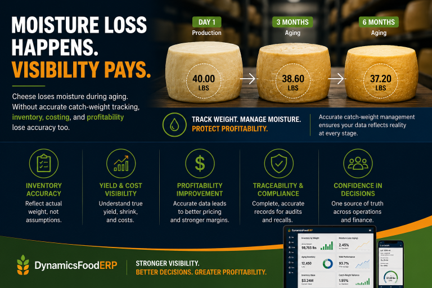
A cheese block that weighs 40 pounds today may not weigh 40 pounds six months from now.
For many dairy manufacturers, that simple reality creates one of the industry’s most overlooked operational and financial challenges.
Inventory changes while sitting in storage.
Product weight changes during aging.
Yields fluctuate throughout production.
Meanwhile, finance expects accurate inventory valuation, operations expects reliable production planning, sales expects available inventory, and leadership expects confidence in profitability reporting.
The challenge is that dairy products continue to evolve long after production ends.
Unlike many manufacturing sectors where inventory remains relatively stable after production, cheese manufacturers must manage products that lose moisture, change weight, mature over time, and navigate increasingly complex traceability and compliance requirements.
A small weight variance may seem insignificant.
Across thousands of aging cheese wheels, blocks, and specialty products, those variances can significantly impact inventory accuracy, costing, profitability, and executive decision-making.
One of the biggest misconceptions I encounter when speaking with dairy manufacturers is the belief that catch-weight management is primarily an inventory challenge.
It isn’t.
It is a visibility challenge.
When organizations cannot accurately connect production yields, aging losses, inventory movement, traceability records, and financial performance, leadership spends time questioning the data instead of acting on it.
The dairy manufacturers achieving the strongest results are not necessarily those with the most technology.
As consumer demand, traceability expectations, and regulatory requirements continue to evolve, dairy catch-weight management has become a strategic capability that influences profitability, compliance, inventory accuracy, and long-term growth.
In this article, we’ll explore why ERP solutions with specialized modules for variable-weight products, moisture loss tracking, and real-time inventory updates are essential for effective catch-weight management in dairy manufacturing.
Why Is Catch-Weight Management Important in Cheese and Dairy Manufacturing?
Dairy catch-weight management is important because many cheese and dairy products naturally change weight over time due to moisture loss, aging, and maturation. Accurate catch-weight tracking helps manufacturers maintain inventory accuracy, improve dairy yield tracking, strengthen traceability, support compliance requirements, and protect profitability.
Unlike fixed-weight products, cheese inventory cannot be managed effectively using quantity alone.
A pallet may contain the same number of cheese blocks at the end of an aging cycle, but the total weight may be significantly different than when the product entered storage.
This creates challenges that extend beyond inventory control.
Weight changes influence:
- Inventory valuation
- Production planning
- Yield calculations
- Customer fulfillment
- Financial reporting
- Traceability records
- Profitability analysis
For dairy manufacturers, managing both quantity and actual weight throughout the product lifecycle is essential for maintaining confidence in operational and financial performance.
Industry organizations such as the International Dairy Foods Association (IDFA) continue to emphasize operational efficiency, product quality, traceability, and supply chain transparency as critical priorities for dairy manufacturers.
How Do Moisture Loss and Aging Impact Catch-Weight Inventory Accuracy?
Moisture loss and aging impact inventory accuracy because cheese products naturally lose weight during maturation. If actual weight changes are not accurately tracked throughout storage and aging, inventory records, costing, profitability calculations, and financial reporting can become unreliable.
This challenge is unique within food manufacturing.
Most industries assume inventory remains relatively stable after production.
Cheese manufacturing is different.
As products age, moisture evaporates.
Weight decreases.
Inventory values change.
Yet many organizations continue to rely on static assumptions established during production.
Over time, those assumptions create increasing discrepancies between actual inventory and recorded inventory.
Andrew’s Perspective
I recently spoke with a cheese manufacturer that was struggling to reconcile inventory values across production, warehouse operations, and finance.
Initially, leadership believed they had an inventory accuracy problem.
After reviewing the process, the issue became much clearer.
Production was measuring yield.
Warehouse teams were tracking inventory movement.
Finance was valuing inventory.
But no one was consistently accounting for the impact of aging and moisture loss over time.
Different departments were working from different assumptions about product weight.
Once the organization established a consistent approach to tracking actual weight throughout the aging process, inventory confidence improved dramatically.
The challenge wasn’t missing data.
It was maintaining confidence in how that data remained connected as products evolved.
Organizations that continuously monitor actual product weight throughout aging gain significantly greater visibility into inventory performance and profitability.
“The challenge wasn’t missing data. It was maintaining confidence in how that data remained connected as products evolved.” — Andrew Good
How Does Catch-Weight Affect Dairy Yield, Costing, and Profitability?
Catch-weight directly affects dairy yield, costing, and profitability because production yields, inventory valuation, customer invoicing, and margin calculations depend on actual product weight. Inaccurate weight tracking can lead to margin erosion, inaccurate costing, inventory discrepancies, and unreliable financial reporting.
Yield management has always been one of the most important performance indicators in dairy manufacturing.
Small yield improvements often create meaningful profitability gains.
The challenge is that inaccurate weight information can distort those calculations.
When actual weights differ from expected weights, manufacturers may experience:
- Inaccurate inventory valuation
- Costing discrepancies
- Margin compression
- Revenue leakage
- Production planning challenges
- Financial reporting inconsistencies
For executives, these issues create more than operational inefficiencies.
They create uncertainty.
“One trend I continue to see across dairy manufacturing is that organizations often invest heavily in reporting while still struggling with confidence in the underlying data. Better reports do not solve visibility problems. Better information does.” — Andrew Good
Leadership teams need confidence that inventory values, production yields, and profitability reports accurately reflect reality. Building this confidence reassures executives and supports better strategic decisions.
Without reliable catch-weight data, that confidence becomes difficult to achieve.

“Many dairy manufacturers believe they have an inventory accuracy problem. More often, they have a visibility problem. When product weight changes over time, confidence in the data becomes just as important as the data itself.” — Andrew Good
Organizations that successfully connect production data, inventory records, aging information, and financial reporting create a stronger foundation for decision-making and profitability management.
How Can Dairy Manufacturers Improve Traceability and FSMA Compliance?
Traceability requirements continue to evolve across the food industry.
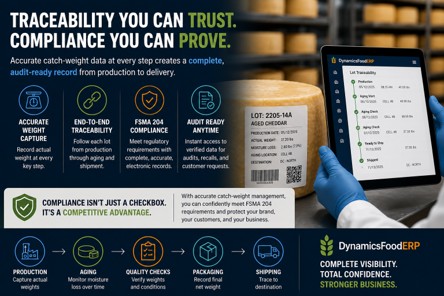
Under the FDA’s Food Traceability Final Rule (FSMA 204), food manufacturers are expected to maintain more comprehensive and accessible traceability records to improve recall readiness and supply chain visibility.
Dairy manufacturers improve traceability and FSMA compliance by maintaining accurate records of product movement, lot information, inventory changes, production activities, and actual product weights throughout the supply chain.
Traceability requirements continue to evolve across the food industry.
Retailers expect greater transparency.
Consumers expect more information about sourcing and production.
Regulators expect faster access to records when investigations or recalls occur.
Many dairy products and dairy-derived ingredients may be affected by evolving traceability expectations tied to the FDA’s Food Traceability List (FTL), making connected operational records increasingly important.
For dairy manufacturers, accurate catch-weight information strengthens traceability by ensuring that inventory records remain aligned with actual product movement throughout production, aging, storage, and distribution.
When traceability information is fragmented across spreadsheets, disconnected systems, or manual processes, organizations often struggle to respond quickly when information is needed.
The strongest traceability programs are built on connected operational data.
Many organizations are also adopting GS1 traceability standards to improve supply chain visibility, strengthen product identification, and support recall readiness.
This includes:
- Lot tracking
- Product genealogy
- Inventory movement records
- Aging information
- Production history
- Quality records
- Catch-weight data
The goal is not simply maintaining compliance.
The goal is to create confidence in the integrity of operational information.
What ERP Capabilities Help Cheese and Dairy Companies Manage Catch-Weight Inventory?
The most important ERP capabilities for dairy manufacturers include catch-weight management, dairy yield tracking, dual units of measure, inventory management, lot traceability, production management, compliance reporting, and profitability analysis.
One mistake I often see organizations make is evaluating ERP systems based primarily on feature lists.
A more important question is whether the solution was designed specifically for food and dairy operations.
Generic ERP systems frequently require extensive customization to manage variable-weight inventory, aging processes, traceability requirements, and dairy-specific production workflows.
Purpose-built dairy ERP software should provide:
Catch-Weight Management
Track inventory using both quantity and actual weight throughout the product lifecycle.
Dual Units of Measure
Maintain visibility into both count-based inventory and actual product weight.
Dairy Yield Tracking
Monitor production yields, aging losses, and operational performance.
Cheese Inventory Management
Improve inventory accuracy across aging rooms, warehouses, and distribution operations.
Traceability and Compliance
Support lot tracking, product genealogy, recall readiness, and regulatory requirements.
Costing and Profitability Analysis
Connect operational performance with financial outcomes.
Production and Distribution Management
Create a unified operational view across manufacturing, aging, inventory, compliance, and financial reporting.
The objective is not simply managing inventory.
The objective is to create a trusted operational foundation that supports profitability, compliance, and long-term growth.
The Future of Dairy Manufacturing Depends on Visibility
As frequently highlighted throughout the industry by publications such as Dairy Foods Magazine, dairy manufacturers continue to invest in technologies that improve operational visibility, inventory accuracy, and profitability.
The dairy industry has always managed complexity.
What is changing is the level of visibility required to remain competitive.
Consumers want transparency.
Retailers expect accountability.
Regulators demand traceability.
Leadership teams expect profitability.
Achieving all four requires accurate, connected information.
The dairy manufacturers gaining the greatest advantage from digital transformation are not necessarily those with the most advanced technology.
They are the ones that create confidence in their data.
Throughout my career, I’ve found that successful organizations rarely eliminate complexity.
They succeed because they gain visibility into it.
Dairy catch-weight management sits at the intersection of inventory accuracy, profitability, traceability, compliance, and executive decision-making.
Organizations that invest in connected systems and reliable information position themselves to respond faster, operate more efficiently, and make better decisions.
In today’s dairy industry, visibility is becoming one of the most important competitive advantages.
The organizations that understand moisture loss as a business visibility issue rather than a production issue will be better positioned to improve profitability and adapt to future industry demands.
Andrew’s Perspective
Many dairy manufacturers believe they have an inventory problem.
Often, what they really have is a visibility problem.
When inventory, yield, costing, traceability, and aging information live in separate systems, leaders spend time reconciling data rather than improving performance.
The organizations achieving the strongest results are the ones building confidence in their operational information.
Better visibility leads to better decisions.
Better decisions lead to stronger outcomes.
Ready to Strengthen Dairy Catch-Weight Management?
For cheese and dairy manufacturers, catch-weight management is no longer simply an operational requirement.
It has become a strategic capability that influences inventory value, profitability, compliance, and long-term growth.
Accurate dairy catch-weight management improves inventory accuracy, strengthens traceability, supports compliance initiatives, protects profitability, and provides leadership teams with greater confidence in the decisions driving the business.
DynamicsFoodERP was built specifically for food manufacturers and distributors, bringing catch-weight management, dairy yield tracking, cheese inventory management, traceability, production management, costing, and compliance into a single integrated platform.
If your organization is struggling with inventory discrepancies, aging-related visibility challenges, manual processes, or growing compliance requirements, now is the time to evaluate whether your current systems can support your future growth.
Contact DynamicsFoodERP today to schedule a personalized operational assessment and discover how modern dairy ERP technology can transform catch-weight management, traceability, profitability, and compliance into a competitive advantage.
What’s Next in This Series?
In our next article, we’ll examine how produce manufacturers and distributors manage catch-weight inventory and explore the unique challenges associated with highly perishable products, fluctuating weights, inventory shrinkage, and supply chain visibility.
We’ll discuss:
- How catch-weight management impacts produce operations
- The relationship between freshness, shrinkage, and profitability
- Traceability requirements across produce supply chains
- Inventory accuracy challenges in produce distribution
- ERP capabilities that improve visibility and operational performance
As we’ve seen throughout this series, catch-weight management is about much more than inventory.
It influences profitability, traceability, compliance, and executive decision-making across every segment of the food industry.
Produce operations provide another compelling example of why accurate, connected data has become a competitive advantage.
Frequently Asked Questions
What is dairy catch-weight management?
Dairy catch-weight management is the process of tracking cheese and other dairy products by both quantity and actual weight, as product weights naturally change during production, aging, and storage.
Why is catch-weight important in cheese manufacturing?
Catch-weight is essential because inventory valuation, yield calculations, profitability, customer billing, and traceability all depend on accurate weight information.
What industries commonly use catch-weight inventory management?
Catch-weight inventory management is widely used in dairy manufacturing, cheese production, seafood processing, meat and poultry processing, produce operations, and other food sectors where products naturally vary in weight.
How does moisture loss affect inventory accuracy?
Moisture loss changes the actual weight of aging products over time. Without accurate weight tracking, inventory records and financial reporting can become unreliable.
How does catch-weight impact profitability?
Catch-weight directly affects inventory valuation, production yields, costing accuracy, margin visibility, and customer invoicing. Accurate weight information helps protect profitability and improve business decisions.
How does catch-weight affect food traceability?
Catch-weight strengthens traceability by linking inventory records, lot information, product movement, and operational activities throughout the supply chain.
What is the relationship between catch-weight and FSMA compliance?
Accurate catch-weight information supports compliance by improving record accuracy, inventory visibility, traceability, and recall readiness.
What ERP features are most important for dairy manufacturers?
Key capabilities include catch-weight management, dairy yield tracking, cheese inventory management, dual units of measure, traceability, compliance reporting, production management, and profitability analysis.
What software is used to manage dairy catch-weight inventory?
Purpose-built dairy ERP software and cheese manufacturing ERP solutions are commonly used to manage variable-weight inventory, production operations, traceability requirements, and compliance initiatives.
About Andrew Good
Andrew Good is the founder of DynamicsFoodERP and a trusted advisor to food manufacturers and distributors seeking to improve operations through technology. With more than two decades of experience in manufacturing, operations, and ERP systems, Andrew helps food businesses strengthen traceability, improve inventory visibility, support compliance initiatives, and build scalable foundations for growth.
Before specializing in Microsoft Dynamics solutions, Andrew held engineering, maintenance, and operational leadership roles with global organizations including Unilever and Sony Music. His hands-on experience on the plant floor, combined with more than 14 years of working with Microsoft Dynamics NAV and Dynamics 365 Business Central, gives him a practical understandin