

Seafood supply chains don’t leave much room for uncertainty.
Product moves quickly. Weights vary. Shelf life is always ticking. Supply can change with seasonality, availability, weather, transportation, and sourcing conditions. A shipment arriving heavier, lighter, earlier, or later than expected can affect production plans, customer commitments, inventory value, and margins.
For executives, the challenge isn’t simply moving seafood from supplier to customer.
It is knowing, with enough confidence to make decisions, what you have, where it is, what it actually weighs, what it cost, how long you can use it, and whether you can fulfill the commitments you’ve made.
I’ve spent enough time around operations to know that businesses can become very good at compensating for systems that don’t provide that visibility. People build spreadsheets. Purchasing calls the warehouse. Sales checks with operations. Finance reconciles numbers after the fact.
The organization keeps moving.
But as volume and complexity increase, so does the effort required to keep all those versions of reality aligned.
That’s where I think the ERP conversation becomes much more interesting.
“Supply chain visibility isn’t about seeing more data. It’s about giving everyone enough confidence in the same data to make the next decision.” – Andrew Good, CEO, DynamicsFoodERP
For seafood processors, distributors, importers, and wholesalers, that can make ERP an important part of inventory control, cost management, fulfillment, and ultimately profitable growth.
From Seafood ERP Selection to Supply Chain Performance
Why Seafood Supply Chains Are Difficult to Manage
The Cost of Disconnected Systems
Supplier and Purchasing Visibility
Catch-Weight Receiving and Inventory Accuracy
Lot, Location, Status, and Shelf-Life Visibility
Processing Yield, Trim, and Weight Loss
Warehouse Scanning and Transaction Accuracy
EDI and Customer Order Management
Cost and Margin Visibility
Demand Planning and Replenishment
Executive Seafood Supply Chain KPIs
Seafood Supply Chain ERP Checklist
What’s Next: Traceability, Compliance, and Recall Readiness
Ready to Improve Seafood Supply Chain Visibility?
Frequently Asked Questions
In the first article in this series, “Seafood ERP Software: A Complete Guide for Processors, Distributors, and Importers,” we established what seafood ERP is and why capabilities such as catch weight, lot management, shelf life, processing, quality, warehousing, and connected financial information matter.
The second article, “General ERP vs. Seafood-Specific ERP Software: What Seafood Companies Need to Know,” took the conversation further. We looked at where a strong general ERP platform may be sufficient and where seafood-specific complexity begins to require additional functionality.
The principle I emphasized there was:
“Complexity should justify functionality. Functionality should not create complexity.”
Now we can ask the operational question that follows naturally from those discussions:
What should connected seafood ERP actually do for the supply chain?
The answer should be visible in better decisions from purchasing and receiving all the way through processing, inventory, fulfillment, and financial reporting.
Seafood combines several supply chain challenges that are individually manageable but considerably harder when they occur together.
You may be dealing with:
Consider what happens when purchasing orders 10,000 pounds of product.
What actually arrives may differ. The product may arrive across multiple lots. Freight and other charges affect landed cost. Some inventory may require inspection. Processing may change the weight again. Different output products may have different yields and values.
Meanwhile, sales needs to know what it can promise customers.
Finance needs to know the inventory’s value.
Operations needs to know what is physically available.
Those aren’t separate questions. They’re different views of the same supply chain.
Disconnected systems don’t always create dramatic failures.
Often, they create something more subtle: continuous organizational friction.
Someone re-enters receiving information.
Someone updates a spreadsheet.
Someone reconciles actual weight against the ERP.
Someone asks whether a particular lot has been released.
Finance adjusts costs.
Sales checks whether inventory is really available.
None of those activities may look particularly alarming on their own. Collectively, however, they consume time and increase the opportunity for error.
I remember working through an operational process in which several departments could answer an inventory question, but each answered a slightly different version.
The warehouse knew what was physically there.
Operations understood what could be processed.
Quality knew what could be released.
Sales knew what customers were expecting.
Finance had the recorded inventory value.
The problem wasn’t a lack of information. The problem was that the information had to be assembled before management could see the whole picture.
For me, that’s one of the clearest signs that an organization has outgrown disconnected processes.
When people become the integration layer between systems, growth usually means adding more reconciliation rather than simply adding more business.
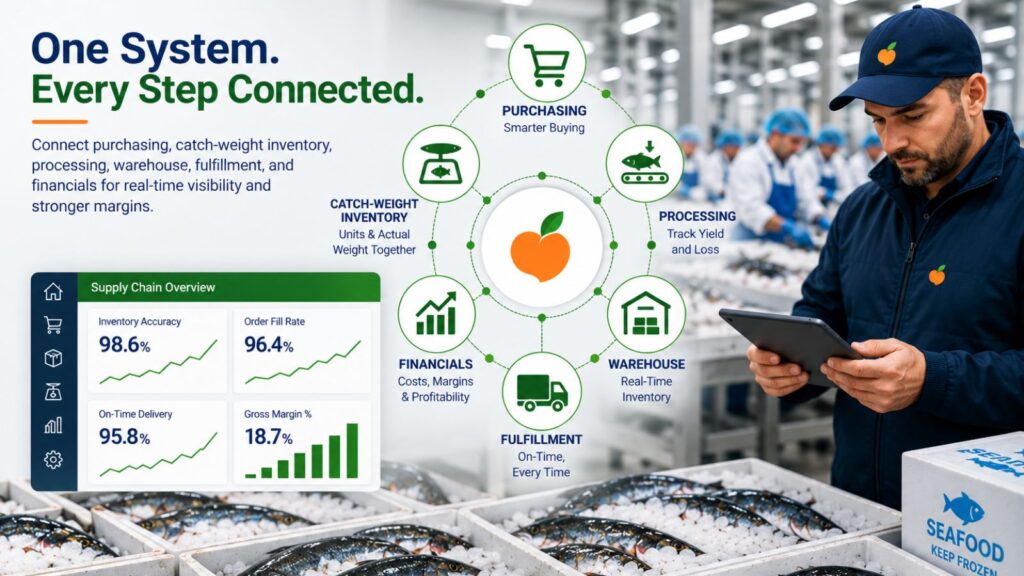
Connected seafood ERP brings purchasing, catch-weight inventory, processing, warehousing, fulfillment, and financial information together to improve supply chain visibility and decision-making.
Good seafood supply chain management starts before product arrives.
Purchasing teams need visibility into open purchase orders, expected receipts, supplier performance, pricing, origin information, freight, and other costs that affect inventory economics.
For executives, this matters beyond procurement efficiency.
If expected receipts aren’t visible, sales may make commitments against uncertain supply. If purchasing decisions are based on unreliable inventory data, working capital can become unnecessarily tied up. If landed costs aren’t captured accurately, margins can look healthier than they really are.
A connected ERP environment should help purchasing answer questions such as:
That last question becomes particularly important for imported seafood.
The purchase price alone does not necessarily reflect inventory economics. Freight, duties, brokerage, and other charges can materially change landed cost.
Business Central, for example, supports item charges for additional direct costs such as freight, allowing those costs to be assigned to items and reflected in direct unit cost.
A CFO shouldn’t have to wait until month-end to discover that the margin assumed when product was purchased wasn’t the margin ultimately realized.
Receiving is one of the points where seafood supply chain accuracy can either begin or start breaking down.
Suppose you’ve ordered 100 cases with an expected weight of 2,000 pounds.
The shipment arrives with 100 cases, but the actual weight is 2,087 pounds.
Which number is correct?
Both.
The warehouse has 100 physical cases, but the business also has 2,087 pounds of product.
That is the fundamental challenge behind catch-weight management and dual-unit inventory.
This is why catch-weight management is so important in seafood operations. The business needs to preserve both realities: the number of units received and the actual weight associated with those units. When one is captured accurately and the other is managed manually, inventory, costing, pricing, and fulfillment can begin to diverge.
DynamicsFoodERP’s catch-weight functionality is designed to maintain a base unit and weight unit across transactions such as purchasing, sales, transfers, production, and assembly. That means actual weight can remain connected to the product as it moves through the business rather than being reconciled separately.
This matters operationally, but it also matters financially.
If sales, inventory, production, and costing use different interpretations of quantity, discrepancies will eventually appear elsewhere.
As I often tell clients:
“Inventory accuracy doesn’t start with the inventory report. It starts with capturing the physical transaction correctly when it happens.”– Andrew Good
Knowing your total inventory quantity isn’t enough.
For seafood operations, availability can depend on several attributes simultaneously:
Lot. Location. Actual weight. Quality status. Shelf life. Customer requirements.
You might technically have 5,000 pounds of an item in inventory, but that doesn’t necessarily mean you have 5,000 pounds available to fulfill today’s orders.
Some could be:
Quality and inventory status are particularly important in seafood operations, where processors operate within established food-safety controls, including the FDA’s Fish and Fishery Products Hazards and Controls guidance.
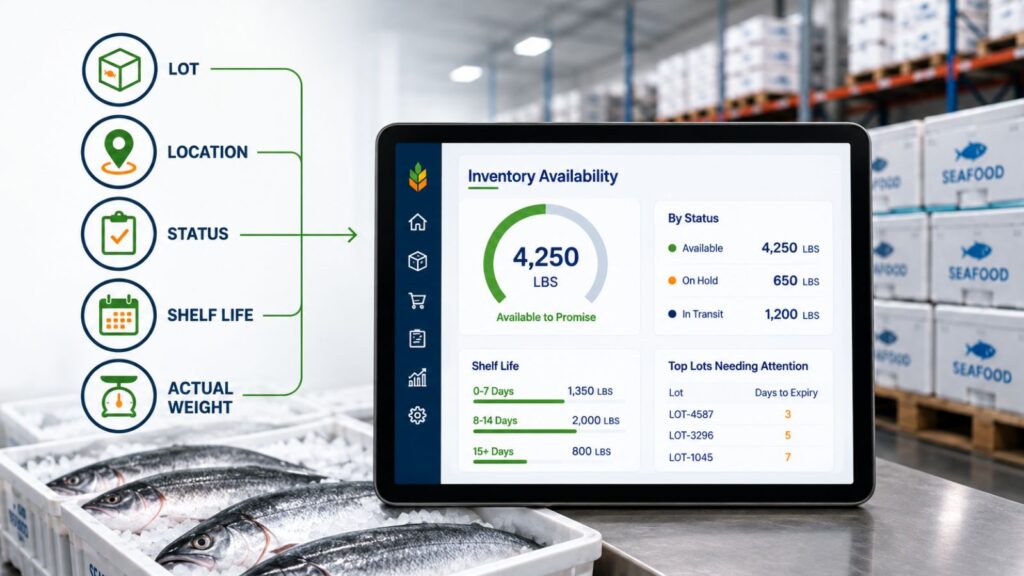
True seafood inventory visibility goes beyond quantity on hand. Lot, location, quality status, shelf life, and actual weight all help determine what inventory is genuinely available to promise.
This is where the distinction between inventory on hand and inventory available to promise becomes strategically important.
Microsoft Dynamics 365 Business Central provides item availability views that help users understand inventory by factors such as location, period, scheduled receipts, and demand.
I’ve seen situations where salespeople weren’t wrong when they told a customer that product was available. They were simply looking at a different definition of availability than operations.
The system said inventory existed.
Operations knew there was a reason it couldn’t ship.
That’s not really a sales problem or a warehouse problem. It’s a visibility problem.
A connected seafood ERP should help those teams make decisions from the same operational context.
BC also provides lot-level item tracking and availability information, helping users see whether quantities associated with a particular lot are already allocated to other open transactions.
Processing introduces another layer of complexity.
Raw seafood comes in. Different products come out.
Along the way, there may be:
For a COO, yield is an operational metric.
For a CFO, yield is also a financial metric.
If 1,000 pounds of raw material consistently produces 720 pounds of saleable output instead of 760, that difference has an economic consequence.
The ERP should therefore help connect physical transformation to inventory and cost.
That doesn’t mean every variance automatically indicates a problem. Seafood is naturally variable.
The objective is visibility.
What yield did we expect?
What did we actually achieve?
Is the variance normal?
Is it specific to a supplier, species, product, facility, or process?
What did it do to our margin?
Those are much more useful management questions than simply knowing that a production order was completed.
An ERP can only provide good visibility if transactions are recorded accurately and promptly.
That is why scanning and mobile workflows matter.
Receiving product on paper and entering it later creates a time gap.
Moving inventory physically but not digitally creates a location gap.
Picking one lot and recording another creates a traceability gap.
Shipping actual weight but invoicing an estimated weight creates a financial gap.
Individually, those gaps may be corrected.
But every correction adds work.
Warehouse scanning can help capture receiving, movement, picking, and shipping closer to where the physical transaction occurs. Scale integration can similarly reduce the need to re-enter weights manually.
The goal isn’t to eliminate people from the process.
It’s to eliminate unnecessary opportunities for people to translate the same information between systems.
The same principle applies on the customer side.
Many seafood businesses work with retailers, distributors, foodservice companies, and other customers that rely on electronic transactions.
EDI can connect purchase orders, acknowledgments, shipping information, invoices, and other documents with ERP workflows.
Why does that matter to the C-suite?
Because order-processing efficiency becomes increasingly important as transaction volume grows.
If every increase in sales requires a corresponding increase in administrative effort, the business isn’t scaling particularly well.
Connected order management can reduce manual entry while helping sales, warehouse, and finance teams work from consistent information.
More importantly, it can help connect the customer promise to operational reality.
This is where many of the preceding supply chain issues converge.
A seafood company’s real margin may depend on:
If those elements live in separate systems or arrive at different times, margin analysis can become retrospective.
Finance eventually tells leadership what happened.
I prefer a different objective.
ERP should help management understand the economics of operations soon enough to influence what happens next.
I once had a discussion with an executive who said, in effect, “We know which customers generate the most revenue. I’m not sure we know which customers generate the best business.”
That’s an important distinction.
Revenue doesn’t tell you how much complexity a customer creates, which products produce strong margins, whether freight is being recovered, or how actual yield is affecting profitability.
Connected supply chain and financial data helps turn margin from an accounting result into a management tool.
Better inventory information also improves the quality of planning.
Forecasting will never remove uncertainty from seafood supply chains. Nor should an ERP be expected to predict every disruption.
But planning becomes much more useful when it’s built on reliable information.
If inventory is overstated, purchasing may order too little.
If inventory is understated, the business may tie up working capital buying product it doesn’t need.
If aging inventory isn’t visible, new product may arrive while older product remains unused.
If sales demand and purchasing operate independently, shortages and excesses become more likely.
This is why I see demand planning as partly a data-confidence problem.
Better planning starts with better visibility into what you have, what is coming, what is committed, what is aging, and what customers are actually buying.
Executives don’t need hundreds of ERP metrics.
They need a manageable set that tells them whether the supply chain is becoming more predictable, efficient, and profitable.
| KPI | Executive Question |
| Inventory accuracy | Can we trust what the system says we have? |
| Yield percentage | Are we converting raw material as expected? |
| Weight variance | Where are expected and actual weights diverging? |
| Spoilage / write-offs | How much value are we losing to aging or unusable inventory? |
| Order fill rate | Can we satisfy customer demand from available inventory? |
| On-time delivery | Are we meeting customer commitments? |
| Gross margin | Are products and customers generating the return we expect? |
| Lot aging | How much inventory is approaching shelf-life risk? |
| Traceability response time | How quickly can we reconstruct product movement when required? |
The point isn’t simply to put these KPIs on a dashboard.
They should help leadership identify where to act.
“A dashboard has very little value if everyone spends the meeting explaining why the numbers aren’t quite right.”– Andrew Good
The objective is confidence, not decoration.
If you’re evaluating whether your ERP environment provides enough seafood supply chain visibility, I would start with these questions:
You don’t need every answer to be perfect before modernizing.
In fact, discovering where the answers are difficult is part of defining what the new ERP needs to solve.
Throughout this series, we’ve been following a logical progression.
We started by defining Seafood ERP Software. We then examined General ERP versus Seafood-specific ERP. In this article, we’ve looked at how connected ERP information can improve the day-to-day supply chain, from purchasing and catch-weight receiving through inventory, processing, fulfillment, and margin.
But there is another reason those records need to remain connected.
Sometimes the business needs to reconstruct exactly what happened to a product, quickly and confidently.
In the fourth and final article, “Seafood Traceability and Compliance: How ERP Supports Recall Readiness and FSMA 204,” we’ll examine lot genealogy, product transformation, quality holds, shipment history, record retrieval, recall investigations, and the role connected ERP data can play in traceability and compliance processes.
That is where operational visibility becomes risk visibility.
If you’re trying to improve seafood supply chain performance, I wouldn’t begin by asking how many ERP features you can add.
Begin with the decisions that are harder than they should be.
Can purchasing trust inventory before placing the next order?
Can sales see what can actually ship?
Can operations measure yield accurately?
Can finance understand landed cost and margin?
Can leadership see aging inventory before value is lost?
If answering those questions requires several systems, spreadsheets, emails, and people, the issue may not be a lack of data.
It may be that the data isn’t connected.
DynamicsFoodERP combines Microsoft Dynamics 365 Business Central (BC) with food-industry functionality designed to support catch weight, advanced lot management, scanning, EDI, processing, inventory, costing, and other connected operational workflows.
The objective is not simply better software. It is a supply chain in which operational and financial information remains closely connected enough for people to act with confidence.
Identify the gaps in your seafood inventory and supply chain visibility with DynamicsFoodERP. Talk with our team about where disconnected transactions, workarounds, and information gaps may be adding cost, risk and unnecessary complexity to your operation.
What is seafood supply chain management?
Seafood supply chain management coordinates the purchasing, receiving, inventory, processing, storage, sale, and delivery of seafood products. It must account for industry-specific factors such as variable weight, perishability, lots, origin, quality status, processing yield, transportation, and customer requirements.
How can ERP improve seafood supply chain visibility?
ERP can connect purchasing, inventory, processing, warehousing, sales, and financial information in a common environment. This can give teams more timely visibility into inventory availability, actual weight, lots, shelf life, expected receipts, customer demand, costs, and fulfillment.
Why is inventory accuracy particularly difficult in seafood?
Seafood inventory may need to be tracked simultaneously by units and actual weight. Product can also change during processing, experience weight loss, move between locations, or become unavailable due to quality or shelf-life restrictions. Therefore, accurate inventory requires more than a simple quantity count.
How does catch-weight management improve inventory control?
Catch-weight functionality allows the business to maintain a base unit, such as cases, alongside an actual weight. Keeping those measures connected across purchasing, transfers, production, sales, and other transactions can reduce the need for separate reconciliations and improve operational and financial accuracy.
Can seafood ERP help reduce spoilage?
ERP cannot eliminate the natural perishability of seafood, but better visibility into lot age, shelf life, location, demand, and inventory availability can help teams make more informed allocation, purchasing, and fulfillment decisions, potentially reducing avoidable spoilage and write-offs.
How does ERP help seafood companies understand margins?
By connecting purchase cost, actual weight, landed costs, processing activity, yield, freight, pricing, and sales information, ERP can provide a more complete view of product and customer economics. The quality of margin reporting still depends on accurate processes and data capture.
What seafood supply chain KPIs should executives monitor?
Useful measures can include inventory accuracy, yield percentage, weight variance, spoilage or write-offs, order fill rate, on-time delivery, gross margin, lot aging, and traceability response time. The most appropriate KPIs depend on the company’s operating model and strategic priorities.
Can Business Central support seafood supply chain management?
Microsoft Dynamics 365 Business Central can provide the core ERP platform for financials, purchasing, inventory, sales, warehousing, and other business processes. Seafood businesses may require additional configuration, integrations, or industry-specific functionality for requirements such as catch weight, advanced lot management, scanning, EDI, quality, and specialized operational workflows.
When should a seafood company consider replacing disconnected supply chain systems?
Warning signs include frequent spreadsheet reconciliation, delayed inventory updates, separate weight records, difficulty identifying commercially available inventory, manual quality controls, inconsistent costing, duplicate order entry, slow traceability investigations, and administrative effort increasing faster than transaction volume.
Andrew Good is the founder of DynamicsFoodERP and a trusted advisor to food manufacturers and distributors seeking to improve operations through technology. With more than two decades of experience in manufacturing, operations, and ERP systems, Andrew helps food businesses strengthen traceability, improve inventory visibility, support compliance initiatives, and build scalable foundations for growth.
Before specializing in Microsoft Dynamics solutions, Andrew held engineering, maintenance, and operational leadership roles with global organizations including Unilever and Sony Music. His hands-on experience on the plant floor, combined with more than 14 years of working with Microsoft Dynamics NAV and Dynamics 365 Business Central, gives him a practical understanding of the challenges food manufacturers face every day.
Andrew works closely with companies across dairy, seafood, meat and poultry, and food distribution, helping them modernize ERP systems, streamline processes, improve food safety and compliance, and gain greater visibility across production and supply chain operations.