The food and beverage industry isn’t getting any simpler. Between rising consumer expectations, tighter regulations, and the push for sustainability, businesses are juggling more than ever. And while growth is the goal, the real question is: how do you get there without burning out your team or blowing up your budget?
The answer might surprise you. It’s not just about adding more tools or hiring more people. It’s about connecting what you already have. Integration is the secret ingredient that turns a good operation into a great one.
Why integration is a game-changer
Picture this: your finance team is buried in spreadsheets, your QA team is chasing compliance updates, your supply chain team is scrambling to reroute shipments, and your sales team is trying to keep customers happy, all while working in separate systems. Sound familiar?
When systems don’t talk to each other, you end up with silos, duplicated work, and a whole lot of frustration. Integration flips that script. By connecting ERP, CRM, QA, and supply chain tools, you create a single source of truth. No more guessing, no more manual data entry, and no more “who has the latest version?” chaos.
The industry is changing and fast
Let’s talk numbers. According to the CDC, every year, 48 million Americans get sick from foodborne illnesses. Predictive analytics can prevent outbreaks—but only if your systems share data. Integration makes that possible.
And traceability? It’s booming. The global food traceability market is projected to skyrocket by Future Market Insights: from $19.3 billion in 2025 to $41.8 billion by 2035, at a CAGR of 8%. Cloud-based solutions will dominate with 52.6% market share. Why? Because consumers want transparency, and regulators demand it.
Sustainability Is Non-Negotiable
Eco-friendly packaging and AI-driven solutions aren’t just trends—they’re shaping the future. 90% of Americans say they’re more likely to buy from brands with sustainable packaging, and 43% are willing to pay extra for it (Shorr Packaging Corp.’s “2025 Sustainable Packaging Report”).
Big changes start with small steps. Integration is that first step. Connected systems help track carbon footprints, optimize packaging, and align with sustainability goals. Instead of waiting for problems to happen, integrated systems let you spot risks early and take action before they become costly recalls. That’s the power of connected data.
The Big Picture
Integration isn’t a tech upgrade—it’s a growth strategy. It’s what turns complexity into clarity and chaos into control. And here’s the good news: you don’t have to start from scratch.
This is where DynamicsFoodERP comes in. It’s built on Microsoft Dynamics 365 Business Central, so you start with a powerful ERP foundation, and then add the food-industry functionality you need.
First, what Business Central brings to the table:
- Real-time visibility into inventory, production, and compliance.
- Automated workflows that cut down on repetitive tasks.
- Centralized dashboards so decision-makers can act fast.
- Scalable architecture that grows with you—whether you’re adding new product lines or expanding into new markets.
Then, what DynamicsFoodERP adds on top:
- Recipe and formulation management for precise control.
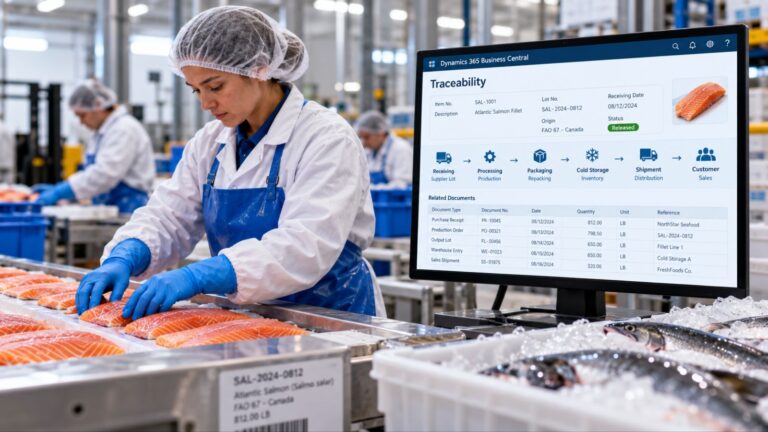
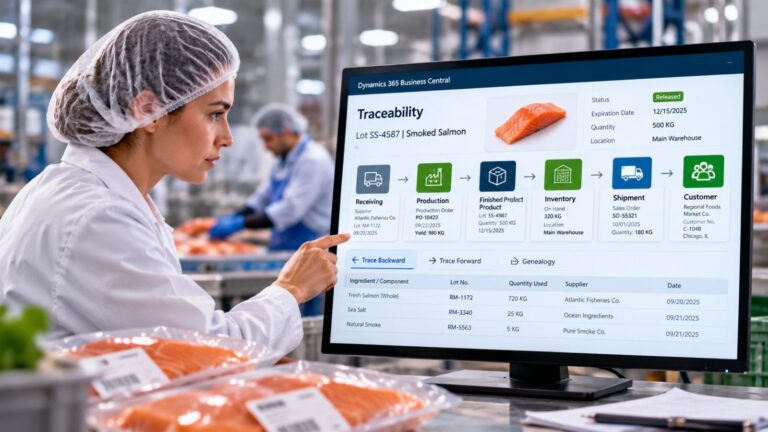
- Lot tracking and traceability to meet regulatory requirements.
- Quality assurance tools for proactive compliance.
- Integrated supply chain features to keep operations moving smoothly.
Bottom line? You get the best of both worlds: the strength of Business Central and the depth of a solution tailored for food and beverage operations.
So, how do you make it happen?
Here’s where the rubber meets the road. If you’re wondering how to bring this connected vision to life, Microsoft Dynamics 365 Business Central is the backbone that makes it possible. It’s not just an ERP—it’s the glue that holds your operations together. Business Central integrates ERP, CRM, QA, and supply chain tools so your teams can collaborate in real time, make smarter decisions, and future-proof your business.
Ready to Take the Next Step?
Growth in the food and beverage industry depends on more than great products—it depends on connected systems. DynamicsFoodERP, built on Microsoft Dynamics 365 Business Central, gives you the tools to streamline operations, improve compliance, and scale with confidence.
Start building a smarter, more agile business today. Learn more about DynamicsFoodERP →