
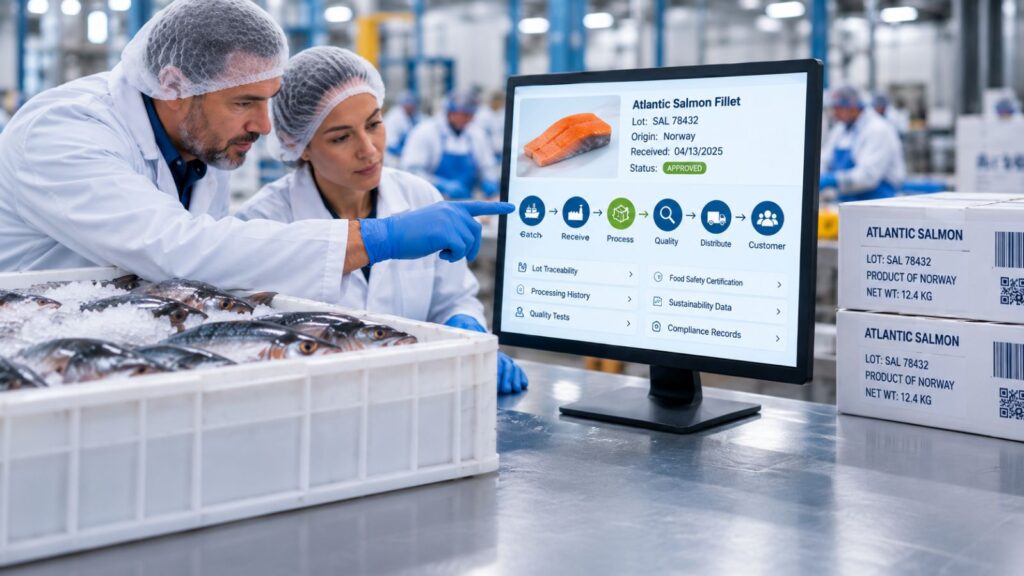
When I talk with executives about seafood traceability, I like to start with a scenario rather than a software feature.
Imagine receiving a call that a specific supplier lot may be affected by a quality or food-safety issue.
How quickly can your organization answer these questions?
Which inventory came from that supplier lot? Where is the remaining product? Was any of it processed, repacked, combined, or regraded? Which finished products contain it? Which customers received those products? How much was shipped, and how much remains under your control?
If answering those questions requires people from purchasing, quality, operations, warehousing, sales, and IT to compare spreadsheets and search separate systems, you have learned something important about your traceability environment.
“You don’t really know how good your traceability is when everything is running normally. You find out when somebody asks a difficult question and starts the clock.” – Andrew Good, CEO, DynamicsFoodERP.
For C-suite leaders, seafood traceability is more than a compliance requirement. It is an issue of risk visibility, customer confidence, operational control, and business continuity.
The objective is not simply to collect more data. It is to preserve the relationships between the data so the organization can reconstruct the product’s story when it matters.
Why Seafood Traceability Is Operationally Complex
What End-to-End Seafood Traceability Really Means
Lot Tracking from Supplier to Customer
Connecting Catch-weight and Traceability Data
Recording Processing and Transformation Events
Quality Testing, Holds, and Release Status
Customer and Shipment Traceability
Recall Investigation and Readiness
FSMA 204 and Seafood Traceability
Common Seafood Traceability Gaps
An Executive Seafood Traceability Evaluation Checklist
Frequently Asked Questions
What This Series Has Shown Us
Evaluate Your Seafood Traceability Readiness
Seafood traceability becomes difficult because the product rarely follows a simple straight line from supplier to customer.
A seafood company may receive the same species from multiple suppliers or countries of origin. Products may arrive in variable weights and different lots. They may move between warehouse locations, be placed on quality hold, processed, split, combined, repacked, regraded, frozen, thawed, or transformed into different finished products.
Then those products are shipped to multiple customers.
The challenge is not merely recording each event.
The challenge is maintaining the relationships between those events.
A receiving record may tell you what arrived. A production record may tell you what was consumed. A warehouse record may show where inventory moved. A sales record may tell you what was shipped.
But during an investigation, you need those records to tell one connected story.
That is the difference between having data and having seafood genealogy.
From an executive perspective, I would ask:
Can we trace backward from a customer shipment to its source and forward from a supplier lot to every affected finished product and customer without rebuilding the chain manually?
If the answer is uncertain, that deserves attention.
End-to-end seafood traceability means maintaining the product’s identity and relevant history from receipt through inventory movement, processing or transformation, and ultimately customer shipment.
In practical terms, the chain might look like this:
Supplier → Incoming Lot → Receiving → Storage → Processing → Finished Lot → Warehouse → Shipment → Customer
Every step matters.
If you manually reassign the incoming lot during processing, the relationship can weaken.
If quality information lives in a separate spreadsheet, product status may not be visible to fulfillment.
If actual weight changes without remaining tied to the lot, quantity information can become unreliable.
If you create finished product without preserving the relationship to consumed raw material, the traceability chain can break precisely where the operation adds complexity.
“Traceability isn’t a report you run at the end. It’s the result of maintaining the right relationships every time the product moves or changes.”
That is why I believe executives should evaluate traceability as an operating model, not simply a reporting capability.
Lot tracking is the foundation, but effective seafood traceability requires more than assigning a lot number.
A strong seafood lot tracking environment should help the business connect vendor lots, internal lots, origin information, inventory movement, transformation activity, and shipment history.
Suppose a processor receives three salmon lots from two suppliers.
One lot is moved to another warehouse. Part of it is processed into fillets. Some fillets are repacked for a private-label customer. Another portion remains in raw inventory.
Later, the original supplier lot becomes the subject of an investigation.
A connected system should help the team determine what happened to that lot without asking employees to manually reconstruct its history.
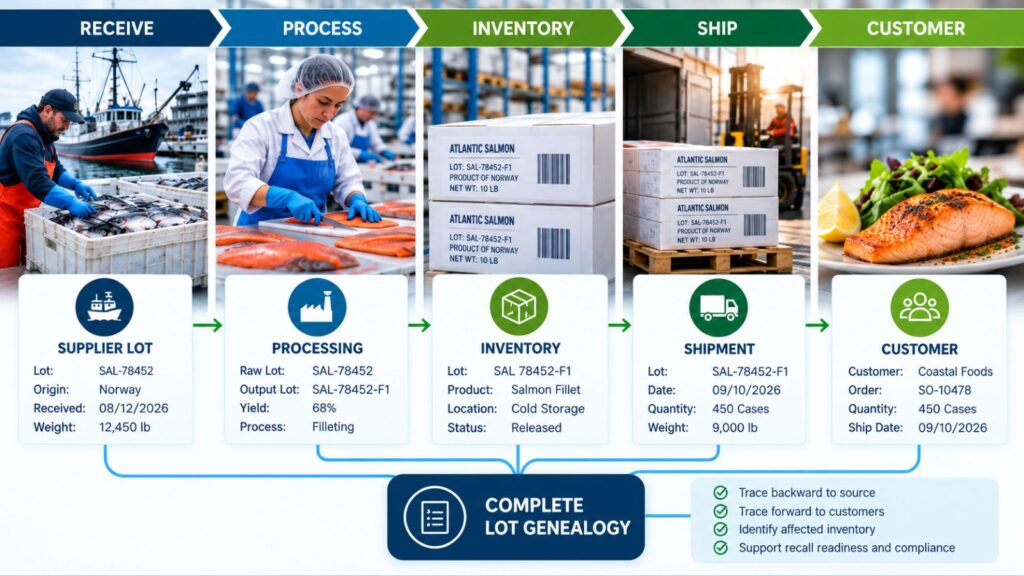
Complete lot genealogy connects supplier, processing, inventory, shipment, and customer records, helping seafood companies trace backward to the source and forward to affected customers.
Origin information can also matter, particularly for seafood importers. NOAA’s Seafood Import Monitoring Program is a risk-based traceability program that requires reporting and recordkeeping for covered seafood imports, including key chain-of-custody information from harvest to entry into U.S. commerce. (NOAA Fisheries)
For executives, the test is simple:
If I give my team one lot number, how much of the product’s history can they confidently reconstruct?
Catch-weight adds another dimension because seafood companies may need to know not only which lot moved, but also how much actual product moved.
Suppose 20 cases represent 812 pounds when received.
Those cases may later be split across locations, processed, sold, or shipped in different actual weights.
If the lot identity remains in the ERP but the weight information is maintained elsewhere, you technically have traceability data, but the operational picture may still be incomplete.
During an investigation, management may need to know:
This is why catch-weight management and traceability cannot always be treated as independent functions.
We covered seafood catch-weight management in greater depth earlier in this series, so I don’t want to repeat that discussion here.
The key point for traceability is that unit, weight, lot identity, and product movement must remain connected.
That connection helps strengthen inventory accuracy in normal operations and provides better information when something goes wrong.
For seafood processors, product transformation is one of the most challenging areas for traceability.
Consider:
Whole fish → Fillets → Portions → Packaged finished product
The business needs to know what raw material was consumed and which finished lots resulted.
But seafood processing can also involve:
Each transformation creates another relationship that may eventually matter during an investigation.
This is why a finished lot number alone does not provide complete traceability.
If a customer calls about a packaged product, you may need to trace backward through finished production to the incoming raw material. Conversely, if a supplier alerts you to a problem, you need to trace forward through every transformation involving that raw material.
I have seen organizations where people know how the product moved because they work with it every day. That operational knowledge is valuable, but it should not be the company’s primary traceability architecture.
“If your traceability depends on somebody remembering what happened to the product, you have knowledge. You don’t necessarily have control.”
For the C-suite, this becomes as much a scalability issue as a compliance issue. More products, more locations, more suppliers, more customers, and more processing steps all increase the number of relationships the business must preserve.
Traceability tells you what the product is and where it went.
Quality status helps tell you whether it should be allowed to move at all.
A lot may physically exist in inventory while being unavailable for fulfillment because it is:
That distinction matters.
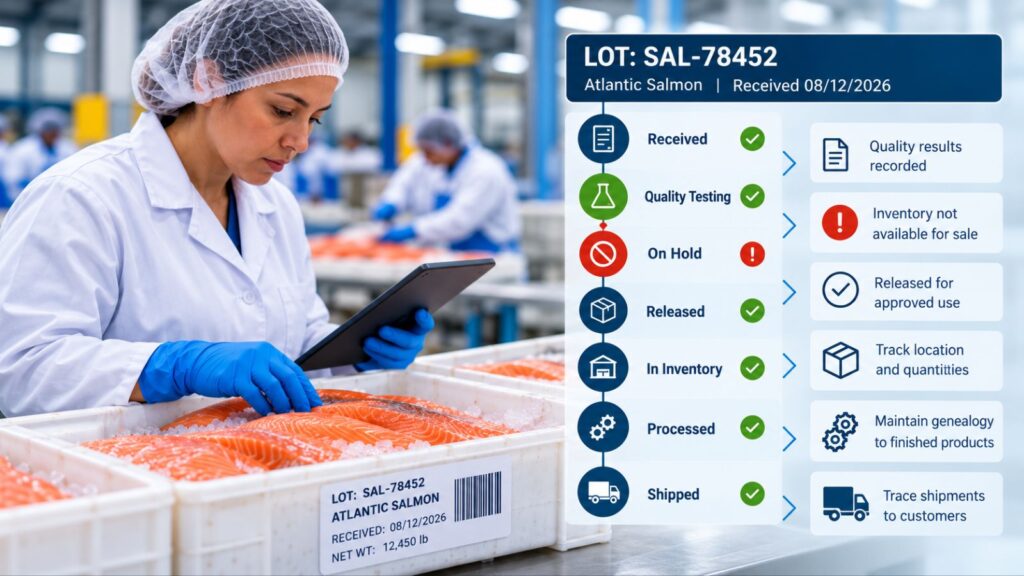
Connected quality and lot controls help seafood companies maintain traceability while preventing held or unapproved inventory from becoming available for fulfillment.
If quality status is managed outside the ERP, warehouse or sales employees may see inventory without seeing why it shouldn’t be allocated.
The result can create unnecessary risk.
DynamicsFoodERP’s Advanced Lot Management functionality is designed for food operations requiring stronger lot selection, shelf-life management, vendor-specific lot rules, traceability, and compliance controls, an area specifically highlighted in the series brief.
From an executive standpoint, I would want confidence that a hold is more than a note in someone’s spreadsheet.
Can the operational workflow help prevent unapproved inventory from accidentally becoming available for fulfillment?
That is where seafood quality management and traceability begin to converge.
Traceability is incomplete until you connect the outbound side of the transaction.
When seafood leaves your control, you should be able to establish which lot went to which customer, when it shipped, and in what quantity or actual weight.
That completes the genealogy:
Supplier → Lot → Transformation → Finished Product → Shipment → Customer
Why does this matter to an executive?
Because the scope of an investigation often determines the scope of the business disruption.
If you cannot confidently identify which customers received affected product, the response may need to become broader than necessary.
Better information does not eliminate the underlying event. It can, however, help the organization understand its boundaries faster.
That is a critical distinction.
Recall Investigation and Readiness
I prefer the term recall readiness to “recall management” because readiness begins long before a recall occurs.
A recall investigation should not be the first time the organization tests whether its traceability records connect.
A seafood ERP environment should help the team answer questions such as:
These questions closely follow the recall-readiness framework established in the brief.
For a CFO or CEO, I would add another question:
How dependent is our response on specific employees?
If one person understands the spreadsheet, another remembers the lot conversion, and someone else knows which report contains the shipment history, you may eventually find the answers.
But that is different from having a repeatable, resilient process.
“Recall readiness isn’t about assuming you’ll have a recall. It’s about making sure that if you have a serious traceability question, your business can answer it without losing valuable time figuring out where the information lives.”
That is operational resilience.
FSMA 204 has increased attention on food traceability, and seafood companies have good reason to understand how the Food Traceability Rule applies to their operations.
The FDA Food Traceability Rule establishes additional recordkeeping requirements for entities that manufacture, process, pack, or hold foods on the Food Traceability List. At its core are Key Data Elements (KDEs) associated with specific Critical Tracking Events (CTEs). The FDA also requires covered entities to be capable of providing specified information to the agency within 24 hours, or within another reasonable time agreed to by FDA.
Several major seafood categories appear on the FDA Food Traceability List, including specified finfish, smoked finfish, crustaceans, and certain bivalve molluscan shellfish.
There is also an important timing update.
The original Food Traceability Rule compliance date was January 20, 2026. FDA proposed extending it by 30 months to July 20, 2028, and Congress subsequently directed FDA not to enforce the rule before that date. FDA states that it intends to comply with that directive.
For executives, however, I would not treat that additional time as a reason to postpone traceability work.
If your organization needs to connect supplier, receiving, transformation, lot, and shipment information, that is not simply a regulatory project. It is an operational-data project.
And those projects benefit from time.
ERP software does not automatically make a seafood company FSMA 204 compliant. Processes, responsibilities, trading-partner data, recordkeeping practices, system configuration, and the company’s specific regulatory obligations all matter. A seafood traceability ERP helps create a more connected information foundation for the workflows and records the business needs to manage.
That distinction is important.
Compliance belongs to the business. Technology supports the process.
Common Seafood Traceability Gaps
When I evaluate traceability, I would pay particular attention to the handoffs.
That is often where otherwise capable systems lose continuity.
Common warning signs include:
Traceability gap – What it can mean for the business
Transformation records are incomplete. Raw-to-finished genealogy may be difficult to reconstruct
Lots are reassigned manually. Traceability relationships may depend on human accuracy
Quality information is maintained separately. Held or unapproved inventory may not be visible throughout operations
Weight information is inconsistent. Quantity affected by an investigation may be difficult to establish
Supplier or origin records are incomplete. Backward tracing can take longer
Shipment records are disconnected. Identifying affected customers may require manual research
Reports take hours to assemble. Response time depends on reconciliation rather than retrieval
Traceability depends on one employee. Business continuity risk increases
I would not view these merely as quality-department inconveniences.
They signal information architecture and organizational risk.
When evaluating seafood traceability software or a broader seafood ERP platform, I recommend walking through a real product scenario rather than relying only on feature demonstrations.
Ask the vendor and your internal team:
Supplier and receiving
Inventory
Processing
Quality
Outbound
Investigation
Governance
The final question I would ask is the one executives sometimes overlook:
Can we demonstrate this process, or are we assuming it works?
There is a big difference.
Yes. A seafood ERP system can connect supplier, lot, inventory, processing, quality, warehouse, and shipment records so a business can trace product backward to its source and forward to customers. The effectiveness of the traceability environment depends on the company’s processes, data quality, system configuration, integrations, and industry-specific requirements. ERP should support traceability, not automatically guarantee regulatory compliance.
Yes. Connected ERP records can help an organization identify the supplier lot involved, remaining inventory, finished products that used the lot, customer shipments, and affected quantities or weights. Recall readiness also depends on documented procedures, employee responsibilities, testing, and reliable data capture. A useful practice is to run traceability exercises before an incident exposes process weaknesses.
Catch-weight means the business may need to maintain both a logistical quantity, such as cases, and an actual weight for the same seafood inventory. During a traceability investigation, lot identity alone may not provide the full picture without reliable weight information. Keeping lot, unit, actual weight, transformation, and shipment information connected can improve both everyday inventory accuracy and investigation readiness.
The required information depends on the business and applicable regulations. Operationally, a seafood company should generally be able to identify supplier and incoming lot information, origin (where relevant), receipt details, inventory location and status, processing or transformation history, resulting finished lots, customer shipments, and relevant quantities or weights. For foods covered by the FDA Food Traceability Rule, applicable CTE and KDE requirements must also be considered.
No. ERP software can support capturing, connecting, retrieving, and reporting traceability information, but software alone does not establish compliance. Companies need to understand whether the rule applies to their products and activities, identify applicable Critical Tracking Events and Key Data Elements, establish appropriate procedures and responsibilities, and ensure their records meet FDA requirements.
This article completes our four-part seafood ERP series, and I think the progression reflects how executives should approach an ERP decision.
In our first article,“Seafood ERP Software: A Complete Guide for Processors, Distributors, and Importers,” we established the foundation: what seafood ERP is, why seafood operations create specialized requirements, and which capabilities executives should evaluate.
In the second,“General ERP vs. Seafood-Specific ERP Software: What Seafood Companies Need to Know,” we examined where standard ERP functionality may be sufficient and where catch-weight, advanced lot controls, shelf life, product transformations, and other seafood requirements can create gaps.
Then, in the third article,“How Seafood ERP Software Improves Inventory, Cost, and Fulfillment,” we followed the operational flow from purchasing and receiving through processing, warehousing, fulfillment, costing, and margin visibility.
And now, in this final article, we arrive at the question that tests how well all of those pieces are connected:
When something goes wrong, can you reconstruct exactly what happened?
That’s why I see traceability as the culmination of the series, not a separate compliance topic.
Catch-weight matters. Inventory accuracy matters. Processing records matter. Quality status matters. Warehouse execution matters. Shipment information matters.
Traceability reveals whether those capabilities actually work together.
A seafood company does not need to wait for a regulatory request, customer inquiry, or recall investigation to find out whether its traceability environment works.
Test it.
Choose a finished product and trace it backward.
Choose an incoming supplier lot and trace it forward.
Include a product that was processed or repacked. Include a quality hold. Include actual weight. Include multiple shipments.
Then ask your team how long it took, which systems they used, which spreadsheets they opened, and where they had to rely on somebody’s memory.
The answers will tell you far more than a software feature list.
At DynamicsFoodERP, we believe the objective should be a connected operational foundation that helps seafood businesses manage the product from receipt through processing, inventory, quality, and customer shipment.
Because when a difficult traceability question arises, the most valuable thing your system can give leadership is not more data.
It is confidence in the answer.
Evaluate your seafood traceability readiness and identify where disconnected processes, data, or systems may be creating unnecessary operational, compliance, or business risk.
Andrew Good is the founder of DynamicsFoodERP and a trusted advisor to food manufacturers and distributors seeking to improve operations through technology. With more than two decades of experience in manufacturing, operations, and ERP systems, Andrew helps food businesses strengthen traceability, improve inventory visibility, support compliance initiatives, and build scalable foundations for growth.
Before specializing in Microsoft Dynamics solutions, Andrew held engineering, maintenance, and operational leadership roles with global organizations including Unilever and Sony Music. His hands-on experience on the plant floor, combined with more than 14 years of working with Microsoft Dynamics NAV and Dynamics 365 Business Central, gives him a practical understanding of the challenges food manufacturers face every day.
Andrew works closely with companies across dairy, seafood, meat and poultry, and food distribution, helping them modernize ERP systems, streamline processes, improve food safety and compliance, and gain greater visibility across production and supply chain operations.
Connect with Andrew on LinkedIn.