
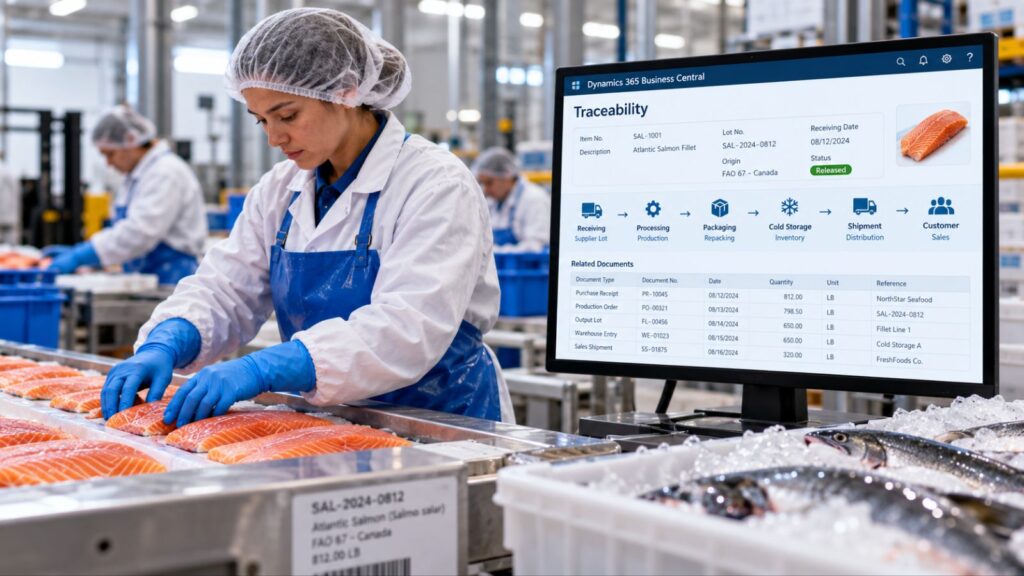
A shipment of seafood arrives at your facility. The receiving team checks the supplier documentation, records the product, confirms the weight, and moves it into cold storage.
Everything appears straightforward.
But consider what happens next.
Some of that product is processed into fillets. Some is repacked for a private-label customer. Another portion remains in its original form. Weights change during processing, and finished products move through different storage locations before shipment.
Now imagine receiving a call questioning the origin or quality of one incoming lot.
Can your team determine exactly where that product went?
I’ve spent enough time working with manufacturing and operational systems to know the challenge usually isn’t a complete absence of information. More often, the information exists, but the relationships between records are hard to reconstruct.
For seafood processors and distributors, that problem can become serious very quickly.
In seafood, the product can change form, weight, location, and ownership several times. Your traceability has to survive every one of those changes.
For a CEO, the concern is customer confidence and business continuity. For a COO, it’s knowing which inventory and operations may be affected. For a CFO, it’s understanding the financial exposure without unnecessarily restricting unaffected product.
That’s why effective seafood traceability isn’t just a food safety requirement. It’s an operational control capability.
What Seafood Companies Need to Trace
Lot and Origin Information: Know Where Your Product Came From
Maintaining Traceability Through Processing, Splitting, and Repacking
Catch-weight and Variable-Weight Inventory
Shelf Life, Cold Storage, and Perishable Inventory
Speed During a Seafood Recall: Finding the Right Answers
How ERP Connects Seafood Traceability
What Executives Should Evaluate in Seafood Traceability Software
What’s Next in This Series
Turning Seafood Traceability Into Operational Confidence
Frequently Asked Questions
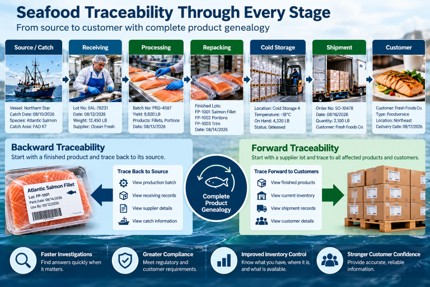
Seafood traceability is the ability to follow seafood from its source through receiving, processing, storage, and shipment to the customer, while preserving the relationships between the records created along the way.
A typical seafood traceability chain might look like:
Source / Catch / Harvest → Receiving → Incoming Lot → Processing → Repacking → Cold Storage → Shipment → Customer
Not every seafood business follows exactly this sequence. An importer distributing frozen finished goods has different operational requirements from a processor converting whole fish into portions.
But both need reliable product history.
Two tracing directions matter.
Backward traceability starts with a finished product or customer shipment and traces back to its source. It helps answer questions about the supplier, incoming lot, processing activity, and origin.
Forward traceability starts with a supplier or incoming lot and identifies the connected products, inventory locations, shipments, and customers.
The distinction matters most when a single incoming lot creates multiple finished products.
I often ask executives a question that seems simple:
Can you start with one incoming lot and identify everything that happened to it without asking several departments to reconstruct the answer?
If the answer requires combining spreadsheets, warehouse records, production documents, and shipment reports, the business may have the data but lack connected traceability.
This builds on the broader principles discussed in our first article, “Food Traceability: What Food Companies Need to Track From Supplier to Customer.” Seafood adds another layer of complexity because product identity must remain connected to changes in weight, form, quality, and location.
Origin is a particularly important element of seafood traceability.
Depending on the product, supply chain, applicable regulations, and customer requirements, a seafood company may need information about the supplier, source, harvest or production area, species, receiving date, original lot identification, and supporting documentation.
The challenge is preserving that information as product moves through the business.
Consider a processor receiving salmon from two suppliers. Both shipments may contain the same species and product type, but their source records, receiving dates, lot numbers, and customer eligibility may differ.
Once the product enters inventory, those distinctions cannot simply disappear.
For certain imported seafood products, NOAA Fisheries’ Seafood Import Monitoring Program establishes reporting and recordkeeping requirements related to designated species and species groups. Applicability depends on the product and import circumstances.
Similarly, the FDA’s Food Traceability List identifies foods subject to additional traceability recordkeeping requirements under the Food Traceability Rule, subject to applicable exemptions.
These requirements differ, and seafood companies should evaluate which obligations apply to their specific products and activities.
The operational principle is broader than any single regulation.
Origin information is only valuable if it stays connected to the product after receiving. If that connection disappears during processing, you’ve created a traceability gap.
For executives, source visibility supports more than compliance. It also helps with supplier accountability, customer inquiries, purchasing decisions, and confidence in the product being sold.
Processing is where seafood product genealogy becomes particularly challenging.
Imagine receiving one lot of whole fish.
A portion is processed into fillets. Some fillets are packaged for retail. Others are packed in bulk for foodservice customers. Remaining product may be frozen, repacked, or regraded.
One incoming lot has now contributed to several finished products.
The ERP environment must preserve the relationships between those products and the original material.
The reverse can also happen.
A processor may combine material from multiple incoming lots into one production batch. In that case, the finished-product genealogy must reflect every contributing lot.
This creates two important requirements:
One-to-many traceability: One incoming lot can produce multiple finished lots.
Many-to-one traceability: Multiple incoming lots can contribute to one finished lot.
Both relationships matter during an investigation.
Suppose a supplier questions one incoming lot. The processor must determine which production runs consumed it and which finished products resulted.
If those relationships were recorded only on paper or in disconnected production spreadsheets, employees may need to reconstruct the genealogy manually.
That approach becomes harder to sustain as the business grows.
I’ve always believed that a process should become more reliable as the company scales, not more dependent on a few experienced people remembering what happened.
Product genealogy isn’t meant to create a more detailed history for its own sake. It gives the business confidence it can follow the product through every transformation.
For seafood companies evaluating ERP, the key question is whether they capture those production relationships as part of normal operations.
Seafood traceability becomes more complicated when product quantities are measured in both logistical units and actual weight.
Consider an illustrative shipment of 20 cases representing 812 pounds.
The warehouse may receive, store, and pick the product in cases, while purchasing, pricing, production, and sales depend on actual weight.
Now suppose some cases are processed into fillets, others are repacked, and the remaining product is shipped in its original form.
The business needs to know more than the original case count.
It may need to determine the actual weight received, the weight consumed in processing, the finished weight produced, the quantity remaining, and the weight shipped to each customer.
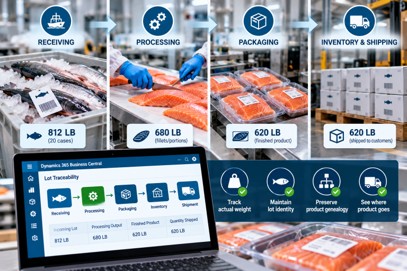
If one system tracks lot identity and another tracks actual weight, reconstructing the product’s history becomes more difficult.
That creates an operational problem and could also create a financial one.
For the CFO, inaccurate weight information can affect inventory valuation, purchasing reconciliation, invoicing, and margin visibility.
For the COO, it can affect available inventory, processing yield, and fulfillment accuracy.
For the quality team, it can complicate determining how much affected product remains or has shipped.
Catch-weight and traceability need to work together.
The objective is to maintain the relationship between lot identity, logistical quantity, actual weight, and product movement.
Our article on seafood catch-weight management explores these requirements in greater detail.
Here, the executive takeaway is straightforward:
If you can trace the lot but cannot confidently reconcile the actual weight that moved through your operation, you’re still missing an important part of the story.
Seafood inventory decisions are often time-sensitive.
Depending on the product and storage conditions, freshness, shelf life, expiration dates, temperature-control practices, and quality status can influence whether inventory is suitable for a particular order.
A seafood company may know exactly where a lot is located but still need to determine whether it should be available for shipment.
That is an important distinction.
Physical inventory is not necessarily available inventory.
A lot may be awaiting inspection, subject to a quality hold, approaching an applicable shelf-life limit, or restricted by customer requirements.
If those conditions are managed outside the operational system, warehouse and sales employees may lack the information needed to make the right allocation decision.
Consider a distributor with the same product in several cold-storage locations. One lot may suit a nearby customer needing immediate delivery, while another may better fit a different order because of its remaining shelf life.
Traceability should help support those decisions rather than record what happened afterward.
This is where food-specific lot-management requirements become important.
Depending on configuration and available functionality, controls around expiration, lot selection, customer requirements, and quality status can help organizations manage inventory more consistently.
For executives, the benefit is not simply better recordkeeping. It is greater confidence that the inventory being promised to customers is the inventory the business can actually fulfill.
A seafood traceability system proves its value when the business needs to investigate a problem quickly and confidently.
Imagine receiving a notification that one supplier lot may be affected by a quality or food safety issue.
Your team needs answers.
Which incoming lots are involved? Were they split, processed, combined, or repacked? What finished products resulted? Is any affected inventory still on hand? Which customers received shipments?
The answers may exist in purchasing records, production documents, warehouse systems, quality files, and sales transactions.
But how quickly can the organization bring them together?
In a disconnected environment, employees spend valuable time locating records, comparing information, and resolving discrepancies.
In a connected environment, the objective is to retrieve related operational information more efficiently so the team can concentrate on investigation and appropriate action.
This does not mean an ERP system guarantees a particular recall response time. Results depend on data quality, system configuration, integrations, operational processes, and employees.
However, better-connected information can help teams identify affected inventory, determine which product to place on hold, understand shipment exposure, and make more precise decisions.
I encourage seafood executives to conduct realistic mock traceability exercises.
Don’t simply ask whether the system can produce a report. Give the team a lot number and ask them to demonstrate the complete investigation.
During a traceability investigation, leadership needs to avoid five departments debating whose information is correct. They need a dependable picture of what happened so they can decide what happens next.
For the CEO, that means greater confidence in customer communication. For the COO, it means better information about inventory and production continuity. For the CFO, it means understanding the scope of potential financial exposure.
Faster access to reliable information is key to seafood recall readiness.
A well-designed seafood ERP environment should help preserve traceability relationships across the transactions that run the business.
That includes receiving, purchasing, inventory, production, warehousing, quality processes, and customer shipments.
Microsoft Dynamics 365 Business Central provides an ERP foundation for connecting purchasing, inventory, production, sales, warehousing, and financial records.
Its native item-tracking functionality supports serial, lot, and package numbers. Microsoft also documents capabilities for tracing item-tracked inventory backward and forward through recorded transactions.
These capabilities are described in Microsoft’s documentation on item tracking and tracing item-tracked items.
However, standard Business Central functionality should not be confused with every specialized capability seafood businesses may require.
More complex seafood operations may need additional functionality for catch-weight, dual-unit inventory, specialized processing workflows, advanced lot selection, quality controls, and integrations.
DynamicsFoodERP builds on Business Central and adds food-industry functionality designed to address these specialized requirements.
The specific capabilities available depend on the selected solution components, configuration, and integrations.
I believe executives should carefully evaluate that architecture.
The goal isn’t simply to acquire another traceability application. The goal is to keep the information needed for traceability connected to the operational transactions that created it.
That is where ERP can become much more valuable than a collection of separate systems.
When evaluating seafood traceability software, ask vendors to demonstrate realistic product movements rather than present a conventional feature checklist.
Take a supplier lot through receiving, processing, repacking, storage, and shipment. Then ask the system to reconstruct its history.
Use the following questions to guide the evaluation.
Executive Questions
Source and origin: Can we connect supplier, source, origin, and receiving information to the correct lot?
Lot genealogy: Can we trace both forward and backward through processing and repacking?
Catch-weight: Can we maintain lot identity alongside cases and actual weight?
Shelf life: Can expiration and freshness information influence inventory decisions?
Quality: Can we identify held, restricted, or released inventory?
Inventory visibility: Can we locate affected inventory across warehouses and cold-storage locations?
Customer shipments: Can we identify customers, shipped quantities, and relevant lots?
Investigation speed: How quickly can employees retrieve and reconcile the information?
I would also ask how many separate systems are involved in completing the demonstration.
A sophisticated-looking dashboard is not particularly useful if employees must manually assemble the information behind it.
For organizations comparing a general ERP with a specialized seafood solution, our article on general ERP vs. seafood ERP provides additional evaluation considerations.
You can also explore how advanced lot management can support more specialized inventory requirements in the food industry.
The final question I would ask is this:
Can your system demonstrate what happened to a product, or does your team still have to reconstruct the answer?
That distinction tells executives a great deal about how mature their traceability environment is.
This article is the second in our four-part food traceability series.
In our first article, “Food Traceability: What Food Companies Need to Track From Supplier to Customer,” we explored why connected information matters more than simply maintaining lot numbers.
Here, we’ve examined how seafood traceability becomes more complicated as products move through sourcing, processing, variable-weight inventory, cold storage, and distribution.
Our next article, “Cheese & Dairy Traceability: Tracking Raw Materials Through Production and Finished Product,” will examine a different set of challenges.
We’ll look at how milk, cultures, ingredients, and packaging materials connect to production batches, and how traceability must continue through quality testing, aging, maturation, finished-product inventory, and customer shipments.
The industry changes, but the executive question remains consistent:
Can your organization reconstruct the product’s complete history when it matters?
After years of working with ERP and operational systems, I’ve learned that connected information’s real value isn’t how many reports a system can generate.
It’s the confidence those reports give decision-makers.
Seafood processors and distributors operate in an environment where products can change form, weight, location, and quality status throughout their journey.
Traceability must keep pace with those changes.
For executives, the objective should be to reduce uncertainty. That means understanding where the product originated, how it was processed, what remains in inventory, and which customers received it.
Good seafood traceability doesn’t eliminate operational complexity. It gives your people a more reliable way to manage it.
Microsoft Dynamics 365 Business Central provides a connected ERP foundation, while DynamicsFoodERP adds food-specific functionality to address specialized seafood operational requirements.
How quickly could your team trace a supplier lot through processing, inventory, and customer shipments?
DynamicsFoodERP helps seafood processors and distributors connect critical operational information using Microsoft Dynamics 365 Business Central and food-specific functionality.
Talk with our team about your seafood traceability requirements. Together, we can identify where disconnected information, manual processes, or gaps in lot genealogy may be creating unnecessary operational risk.
Seafood traceability is the ability to track seafood products from source through receiving, processing, storage, distribution, and shipment to customers. It connects information about origin, suppliers, lots, production activities, inventory movements, and customers. Effective seafood traceability supports both backward tracing from a finished product to its source and forward tracing from an incoming lot to the resulting products and shipments. The goal is to preserve reliable product history as seafood changes form, weight, location, or packaging.
Seafood traceability involves more than assigning and recording lot numbers. Products may be split, combined, filleted, frozen, repacked, or relabeled. Their actual weights can change during processing, while shelf life and quality status influence inventory decisions. Each activity can create new relationships between incoming and finished-product lots. Effective traceability must preserve those relationships so a processor can determine where a product originated, what happened to it, where it remains, and which customers received it.
Catch-weight requires connecting logistical quantities, such as cases, to actual product weight. A shipment of 20 cases might contain 812 pounds, and the actual weight may change through processing and repacking. Seafood traceability should maintain the relationship between lot identity, units, weight, inventory movements, and customer shipments. This supports more accurate investigations and helps purchasing, production, inventory, sales, and finance work from consistent information.
ERP can improve seafood recall readiness by connecting supplier lots, production records, inventory movements, quality information, and customer shipments. When these relationships are maintained correctly, employees can retrieve relevant information without relying as heavily on disconnected spreadsheets or paper records. This can help identify potentially affected products, locate remaining inventory, determine customer exposure, and support appropriate holds or other actions. Actual investigation speed depends on data quality, processes, configuration, and the organization’s traceability practices.
Andrew Good is the founder of DynamicsFoodERP and a trusted advisor to food manufacturers and distributors seeking to improve operations through technology. With more than two decades of experience in manufacturing, operations, and ERP systems, Andrew helps food businesses strengthen traceability, improve inventory visibility, support compliance initiatives, and build scalable foundations for growth.
Before specializing in Microsoft Dynamics solutions, Andrew held engineering, maintenance, and operational leadership roles with global organizations including Unilever and Sony Music. His hands-on experience on the plant floor, combined with more than 14 years of working with Microsoft Dynamics NAV and Dynamics 365 Business Central, gives him a practical understanding of the challenges food manufacturers face every day.
Andrew works closely with companies across dairy, seafood, meat and poultry, and food distribution, helping them modernize ERP systems, streamline processes, improve food safety and compliance, and gain greater visibility across production and supply chain operations.