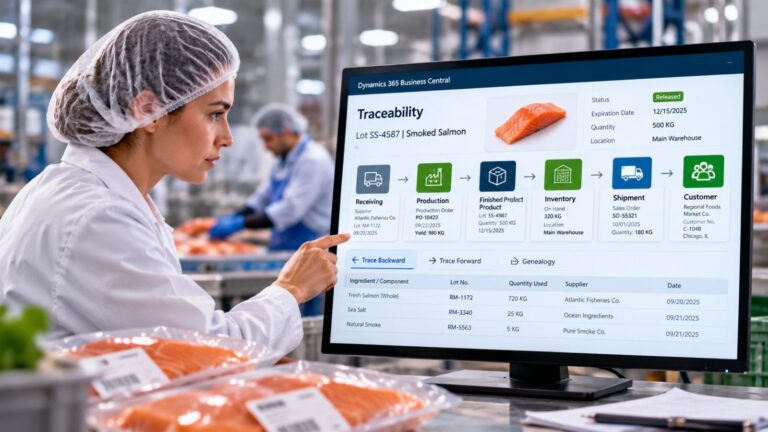
A 1% yield variance may not sound significant.
For processors moving millions of pounds, a 1% yield variance means hundreds of thousands of pounds in lost margin.
The core issue extends beyond inventory accuracy alone.
It’s knowing precisely what was produced, its cost, its destination, and its profitability.
Over the years, I’ve worked with processors ranging from growing regional operations to large multi-site organizations. Regardless of size, I hear a remarkably similar concern:
“We know product is moving. We’re just not always confident the numbers reflect what’s actually happening on the floor.”
That lack of confidence creates far bigger problems than inventory discrepancies alone.
In conversations with meat and poultry processors, one challenge consistently rises to the top of the list: managing inventory accurately when every product naturally varies in weight.
Unlike standardized manufacturers, protein processors deal with products that are never identical. A case of beef loins, a box of chicken breasts, or a pallet of pork cuts might have the same unit count, but the actual weight can vary widely.
That variability affects more than inventory; it impacts yield, shrink, profitability, customer satisfaction, compliance, and recall readiness.
As margins shrink and traceability needs grow, strong catch-weight management is now vital in meat processing ERP systems.
Table of Contents
Why Catch-Weight Is Different in Meat Processing
What I See Most Often in Processing Facilities
Why Meat Processors Struggle with Variable-Weight Inventory
The Executive Cost of Poor Inventory Visibility
How Catch-Weight Impacts Yield, Shrink, and Profitability
Why Meat Yield Tracking Matters
Catch-Weight and Traceability
USDA Compliance and Recall Readiness
FSMA 204 and Meat Processing
What ERP Capabilities Should Meat Processors Prioritize?
The Future of Meat Processing Depends on Better Visibility
Ready to Gain Control of Catch-Weight Inventory
Frequently Asked Questions
Why Is Catch-Weight Management Different in Meat and Poultry Processing?
In our previous article, What Is Catch-Weight in the Food Industry?, we explored the fundamentals of catch-weight management and why it is essential for food manufacturers handling variable-weight products.
Meat and poultry operations face an additional level of complexity.
Every production run introduces natural variation caused by:
- Animal size differences
- Processing methods
- Trim levels
- Yield fluctuations
- Moisture retention
- Packaging variations
A pallet may contain twenty cases of product, but the total weight can differ substantially from one shipment to the next.
To maintain accurate records, processors must continuously track:
- Item count
- Actual weight
- Lot numbers
- Production batches
- Inventory location
- Customer shipments
Each of these variables influences profitability, compliance, and operational performance.
This operational complexity highlights why standard inventory systems often struggle to support modern meat processing operations.
Why Do Meat Processors Struggle with Variable-Weight Inventory?
When I visit processing facilities, I rarely find a single catastrophic inventory problem.
What I usually find is something more subtle.
One spreadsheet tracks receiving weights.
Another tracks production yields.
A third helps reconcile inventory.
Good people work incredibly hard to keep everything aligned.
The challenge is that every manual process introduces risk. As operations grow, those small inconsistencies accumulate until leadership begins questioning the numbers used to make critical business decisions.
Meat processors struggle with variable-weight inventory because weights change constantly, yet precise data is vital for valuation, planning, costing, billing, and traceability.
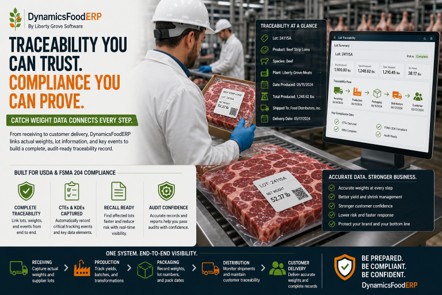
Common challenges include:
Manual Data Entry
Weights are often captured manually, creating opportunities for errors.
Spreadsheet Dependencies
Many organizations rely on disconnected spreadsheets to reconcile production and inventory.
Inventory Reconciliation Issues
Recorded inventory frequently differs from actual inventory on hand.
Limited Visibility
Management lacks real-time insight into inventory weight, yields, and profitability.
Billing Discrepancies
Differences between shipped and invoiced weight can lead to customer disputes and revenue leakage.
As operations grow, these challenges intensify, making dedicated catch-weight inventory software essential to manage them effectively. This need for specialized tools leads directly to broader business impacts.
A modern cloud-based ERP addresses these challenges and secures the future of your operation.
What I See Most Often in Processing Facilities
When I visit processing facilities, I rarely find a single catastrophic inventory problem.
What I usually find is something more subtle.
One spreadsheet tracks receiving weights.
Another tracks production yields.
A third helps reconcile inventory.
People work incredibly hard to keep everything aligned.
The problem is that every manual process introduces risk.
As operations grow, those small inconsistencies accumulate until leadership begins questioning the numbers used to make critical business decisions.
The Executive Cost of Poor Inventory Visibility
Many processors view catch-weight management as only a warehouse responsibility.
Leading processors recognize catch-weight management as a business issue that provides executives with actionable data to make informed decisions, drive profitability, and support strategic goals.
Inaccurate inventory weights mean executives lose visibility into key performance metrics.
Questions become difficult to answer:
I recently spoke with a processor that believed inventory accuracy was their primary challenge.
After examining the situation more closely, the larger issue turned out to be inconsistent yield reporting across facilities.
Inventory was simply where the symptom appeared first.
The real problem was visibility.
Different teams were making decisions based on different versions of the truth.
Once leadership gained confidence in the underlying data, conversations shifted from explaining discrepancies to improving performance.
- How much sellable inventory is actually available?
- Which products generate the highest margins?
- Where are yields declining?
- Which customers are most profitable?
- How much revenue leakage is occurring?
When leadership teams lose confidence in inventory data, decision-making slows.
Procurement becomes more conservative.
Production schedules become harder to optimize.
Inventory buffers grow.
Working capital increases.
None of these issues typically appear on a financial statement as “catch-weight problems.”
Instead, they quietly erode profitability across the organization.
Poor visibility often creates:
Margin Erosion
Inaccurate weights distort product costing and profitability analysis.
Excess Inventory
Organizations carry additional inventory to compensate for uncertainty.
Purchasing decisions become less reliable when inventory data cannot be trusted.
Customer Service Issues
Order fulfillment becomes more difficult when available inventory differs from recorded inventory.
Strategic Blind Spots
Executives lose confidence in the data needed to make critical pricing, production, and growth decisions, undermining their ability to drive profitability and strategic initiatives.
The main challenge for processors is business visibility, not just inventory accuracy.
Visibility into all aspects of the business underpins success in meat processing.
Executive Insight
In my experience, processors rarely struggle because they lack data.
They struggle because data exists in multiple systems that were never designed to work together.
The organizations that gain the greatest advantage from ERP modernization are often those that improve visibility first and automation second.
How Catch-weight Impacts Yield, Shrink, and Profitability
Catch-weight directly affects yield, shrink, and profitability because product weight determines inventory value, production efficiency, costs, and revenue.
For meat processors, profitability often comes down to a few critical measurements.
Yield Performance
Yield measures how much saleable product is produced from raw materials.
Without accurate data, yield calculations are unreliable.
Shrink Reduction
Shrink occurs when actual inventory differs from recorded inventory due to handling losses, processing variance, or inaccurate data capture.
Even small discrepancies cause significant losses when multiplied across thousands of pounds.
Margin Protection
Product costs are driven by weight.
Without accurate weights, margin calculations become distorted, and managers lose sight of profitability.
Better Business Decisions
When executives have confidence in inventory and yield data, they can make more informed decisions regarding pricing, procurement, production planning, and customer contracts.
Top processors recognize catch-weight is more than a warehouse concern.
Ultimately, it is a profitability issue; a thread running through all aspects discussed in the following sections.
Why Meat Yield Tracking Matters
In many plants, yield conversations happen every day.
Yet I’ve seen organizations spend hours debating yield variances because they weren’t confident in the underlying inventory data.
When catch-weight information is inaccurate, yield reporting becomes reactive instead of actionable.
Teams spend their time explaining numbers rather than improving them.
Meat yield tracking links raw inputs to saleable outputs, helping processors assess efficiency and profitability.
Accurate yield tracking enables processors to:
- Identify production inefficiencies
- Reduce waste
- Improve labor productivity
- Monitor plant performance
- Protect margins
- Improve forecasting accuracy
Because yield calculations need actual weights, effective catch-weight management enables reliable reporting.
Organizations that consistently monitor yield performance gain a significant advantage in controlling costs and improving operational efficiency.
Catch-Weight and Traceability
Traceability becomes more complex when products vary in weight.
Meat processors maintain traceability by linking catch-weight data with lot numbers, production records, inventory movements, and customer shipments throughout the supply chain.
Processors must maintain accurate records of:
- Supplier lots
- Receiving weights
- Production batches
- Processing events
- Packaging records
- Inventory movements
- Shipment information
- Customer deliveries
Each traceability event must remain connected to both the product’s identity and its actual weight.
When systems work alone, information gaps appear.
Modern meat processing ERP solutions help maintain these connections automatically, reducing risk and improving visibility.
“Successful processors rarely win because they eliminate complexity. They win because they gain visibility into it.” – Andrew Good
USDA Compliance and Recall Readiness
Regulatory compliance depends on accurate recordkeeping.
USDA inspection and food safety requirements place significant emphasis on accurate documentation, traceability, and record retention throughout meat and poultry operations.
During an audit, investigation, or recall event, processors must quickly answer critical questions:
- What product was produced?
- Which lots were affected?
- Where was the product shipped?
- How much product was involved?
- Which customers received it?
Accurate catch-weight records strengthen the integrity of those answers.
When weight information, lot tracking, and inventory transactions are connected, organizations can respond more quickly and confidently during compliance events.
This capability becomes increasingly important as regulators and customers demand greater supply chain transparency.
FSMA 204 and Meat Processing
FSMA 204 has elevated traceability from a regulatory concern to a strategic business priority.
Most processors I speak with are not concerned about compliance because they don’t care about traceability.
They’re concerned because they understand the operational burden of producing complete records during an audit, customer inquiry, or recall event.
The challenge is rarely collecting data.
The challenge is connecting it.
Under the FDA Food Traceability Final Rule, organizations handling foods on the Food Traceability List must maintain Key Data Elements (KDEs) at Critical Tracking Events (CTEs) throughout the supply chain.
The FDA’s Food Traceability Final Rule establishes new recordkeeping requirements designed to improve food traceability and accelerate investigations during food safety events. For many food manufacturers, these requirements are driving renewed investment in traceability systems and operational visibility.
For meat and poultry processors, maintaining accurate traceability requires capturing:
- Critical Tracking Events (CTEs)
- Key Data Elements (KDEs)
- Lot information
- Product transformations
- Shipment records
- Receiving records
- Actual product weights
Many organizations focus only on documentation.
Successful compliance depends on maintaining accurate operational data at every step of the process.
Catch-weight information plays a critical role in ensuring those records remain complete, reliable, and audit-ready.
What ERP Capabilities Should Meat Processors Prioritize?
One mistake I frequently see is organizations evaluating ERP systems based solely on functionality checklists.
Features matter.
But executives should also ask:
Can we trust the data?
Can we scale with confidence?
Can we support future compliance requirements?
Can we make faster decisions?
The best ERP investments improve operational visibility as much as operational efficiency.
Meat processors should seek ERP systems that support both operational performance and regulatory compliance.
While many protein manufacturing ERP solutions offer inventory functionality, processors handling variable-weight products often require specialized catch-weight inventory software capabilities to support profitability, traceability, and compliance.
A modern meat processing ERP should provide:
Dual Unit of Measure Management
Track inventory quantity and actual weight simultaneously.
Real-Time Inventory Visibility
View inventory by location, lot, and weight.
Yield and Shrink Reporting
Measure operational performance and profitability.
Integrated Traceability
Maintain end-to-end visibility across the supply chain.
USDA and FSMA Support
Support compliance and recall readiness initiatives.
Production Management
Connect production, inventory, costing, and traceability within a single platform.
The objective is not simply recording weights.
The objective is to create a trusted operational foundation that supports growth, profitability, and compliance.
The Future of Meat Processing Depends on Better Visibility
The meat industry has always managed complexity.
What is changing is the level of visibility required to remain competitive.
Customers demand transparency.
Regulators demand traceability.
Executives demand profitability.
Meeting all three objectives requires accurate data.
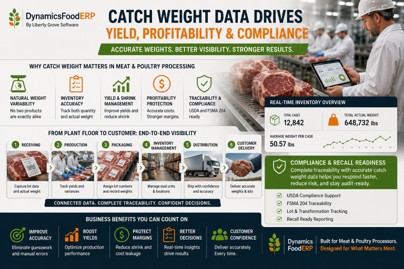
Catch-weight management is central to inventory accuracy, yield performance, compliance readiness, and financial success.
Organizations investing in modern meat processing ERP systems gain more than operational efficiency.
They gain confidence in the decisions that shape the business’s future.
Throughout my career, I’ve found that successful processors rarely win because they eliminate complexity.
They win because they gain visibility into it.
Catch-weight variability is part of the business.
Andrew’s Perspective
The processors that achieve the best results are not necessarily the ones with the most sophisticated facilities.
They are the ones that trust their data.
When inventory, yield, costing, and traceability information align, leaders can make faster decisions, respond more effectively to change, and focus on improving performance rather than reconciling numbers.
Better decisions begin with better information.
Ready to Gain Control of Catch-Weight Inventory?
For meat and poultry processors, inventory accuracy is no longer simply an operational objective. It is a business imperative.
Accurate catch-weight management in meat and poultry processing improves yield visibility, reduces shrink, protects margins, strengthens traceability, and supports regulatory compliance. It gives leadership teams confidence that the numbers driving critical decisions are accurate and actionable.
DynamicsFoodERP was designed specifically for food manufacturers and protein processors, combining catch-weight inventory management for meat and poultry processors, yield tracking, lot traceability, production management, costing, and compliance capabilities into a single integrated platform.
If your organization is struggling with inventory discrepancies, limited visibility, manual processes, or rising traceability requirements, now is the time to evaluate whether your current systems can support your business’s future.
Contact DynamicsFoodERP today to schedule a personalized assessment and discover how modern meat-processing ERP technology can transform catch-weight management into a competitive advantage.
Coming Next in This Series
In our next article, we’ll explore seafood catch-weight management and examine why seafood processors, importers, and distributors face some of the industry’s most demanding traceability and compliance requirements.
We’ll discuss:
- Why is catch-weight especially critical in seafood operations?
- How seafood companies improve inventory accuracy and margins
- The growing importance of seafood traceability
- The impact of FSMA 204 on seafood importers and distributors
- ERP capabilities that support seafood compliance and operational excellence
Frequently Asked Questions
What is meat processing catch-weight?
Meat processing catch-weight refers to tracking products by both inventory quantity and actual weight, as products naturally vary in size and weight.
Why is catch-weight important in meat processing?
Catch-weight is crucial because inventory, costing, billing, yield, and profitability depend on accurate weight data.
What is meat yield tracking?
Meat yield tracking measures the saleable product from raw materials to evaluate efficiency and profitability.
How does catch-weight affect profitability?
Accurate catch-weight data improves costing accuracy, reduces shrink, supports yield analysis, and helps protect margins.
How does catch-weight impact traceability?
Catch-weight links actual product weights with lot records, inventory movements, production data, and shipment records, strengthening traceability.
How does catch-weight support USDA compliance?
Accurate weight and inventory records help processors maintain compliance documentation and improve recall readiness.
What is the relationship between catch-weight and FSMA 204?
FSMA 204 requires enhanced traceability. Catch-weight data supports traceability by connecting inventory records, product movements, and critical tracking events.
What ERP features are most important for meat processors?
Key features include dual units of measure, catch-weight management, yield tracking, traceability, inventory visibility, costing, production management, and compliance reporting.
What software is used to manage catch-weight inventory?
Purpose-built meat processing ERP software and protein manufacturing ERP solutions are typically used to manage variable-weight inventory and compliance requirements.
How much inventory shrink can inaccurate catch-weight data cause?
The impact varies by operation, product mix, and production volume. However, even small discrepancies in weight tracking can create significant financial losses over time through inventory variance, yield inaccuracies, revenue leakage, and margin erosion.
About Andrew Good
Andrew Good is the founder of DynamicsFoodERP and a trusted advisor to food manufacturers and distributors seeking to improve operations through technology. With more than two decades of experience in manufacturing, operations, and ERP systems, Andrew helps food businesses strengthen traceability, improve inventory visibility, support compliance initiatives, and build scalable foundations for growth.
Before specializing in Microsoft Dynamics solutions, Andrew held engineering, maintenance, and operational leadership roles with global organizations including Unilever and Sony Music. His hands-on experience on the plant floor, combined with more than 14 years of working with Microsoft Dynamics NAV and Dynamics 365 Business Central, gives him a practical understanding of the challenges food manufacturers face every day.
Andrew works closely with companies across dairy, seafood, meat and poultry, and food distribution, helping them modernize ERP systems, streamline processes, improve food safety and compliance, and gain greater visibility across production and supply chain operations.