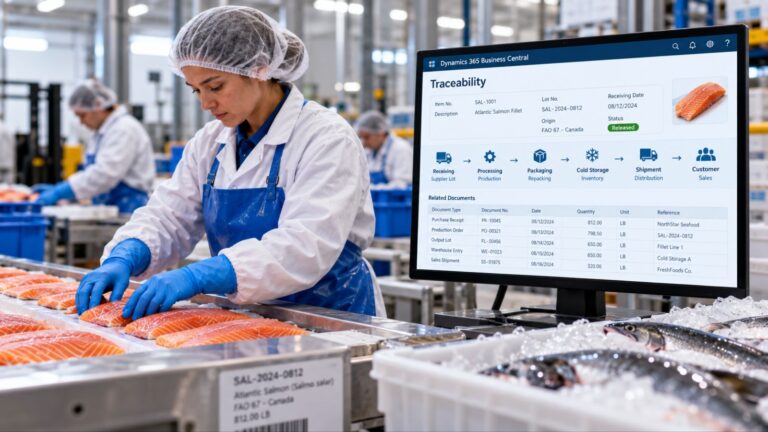
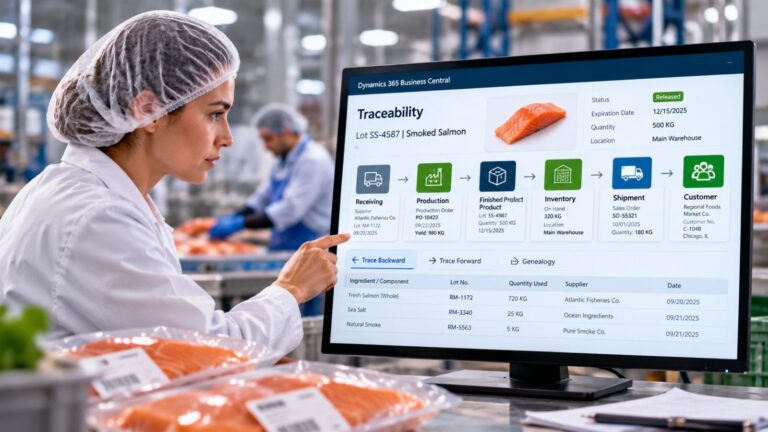
Many food manufacturers are still running Microsoft Dynamics NAV today, particularly older versions such as Dynamics NAV 2009, that have been out of support for years.
In most cases, that’s not because the system is failing. It’s because it still appears to be doing its job.
Orders are processed.
Production runs.
Inventory moves.
Financials get closed.
From the outside, everything looks fine.
The challenge is that ERP risk in food manufacturing rarely shows up as a sudden system failure. It tends to surface when the business needs to do something new.
A customer requests more detailed lot traceability reporting.
An infrastructure upgrade gets delayed because the ERP cannot support it.
A security review exposes unsupported technology.
An audit uncovers processes that have become increasingly difficult to maintain.
Following Dynamics NAV end of support, older versions like NAV 2009 stopped receiving security updates, platform enhancements, and compatibility improvements.
The software didn’t stop working, but it did stop evolving.
For food manufacturers, this creates growing exposure in areas such as traceability, audit readiness, cybersecurity, infrastructure modernization, and regulatory compliance.
As requirements around food safety, customer reporting, and operational visibility continue to evolve, legacy ERP systems can become increasingly difficult to support.
Many organizations don’t recognize these limitations until they begin planning a modernization initiative, responding to customer requirements, preparing for an audit, or evaluating a move to Dynamics 365 Business Central for Food Manufacturing.
The question isn’t whether Dynamics NAV still works.
For many food manufacturers, the more important question is whether it’s helping the business move forward.
Why are so many food manufacturers still on Dynamics NAV?
The simple answer is that Dynamics NAV earned its reputation as a reliable ERP system.
Many food manufacturers implemented NAV years ago as their food manufacturing ERP system to manage finance, inventory, purchasing, and production.
For a long time, it did exactly what it was supposed to do.
It became deeply embedded in day-to-day operations and, in many organizations, remains one of the most stable systems in the business.
That stability is one of the main reasons companies continue to rely on it today.
Leadership teams often remember the original ERP implementation as a major undertaking.
It required significant investment, operational disruption, training, and change management.
When the current system still supports production, order fulfillment, inventory management, and financial reporting, it’s understandable why modernization gets pushed down the priority list.
Customization is another factor.
Many food manufacturers have spent years tailoring NAV to support lot traceability, quality management, production reporting, customer compliance requirements, and other operational processes unique to the industry.
The more customized the system becomes, the more difficult and riskier an upgrade can appear.
There’s also a common assumption that if the ERP is still running, the risks must be minimal.
In reality, unsupported ERP systems rarely create immediate problems.
The challenges tend to develop gradually due to aging infrastructure, increasing cybersecurity exposure, limited integration options, and growing difficulty in supporting new business requirements.
We’ve worked with food manufacturers running Dynamics NAV 2009 years after support ended.
In many cases, the software itself wasn’t the problem.
The issue was that the ERP had become tightly connected to outdated servers, legacy technology, and unsupported environments, limiting the company’s ability to modernize.
From the outside, the system appeared stable.
Behind the scenes, it was quietly restricting what the business could do next.
Is Running Unsupported Dynamics NAV Safe for Food Manufacturers?
In most cases, no.
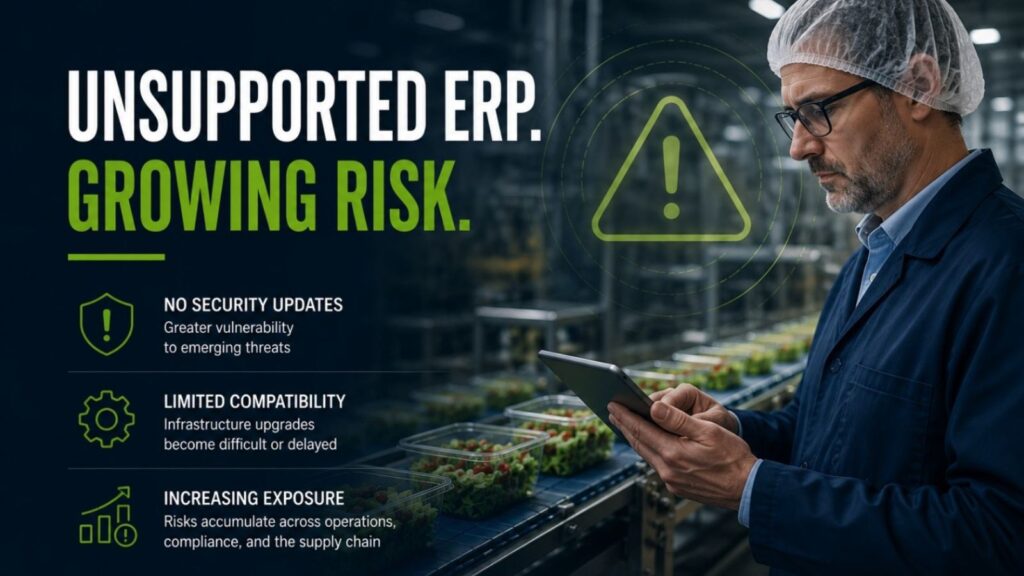
Running an unsupported version of Dynamics NAV creates risks that extend beyond the ERP system itself.
While the software may continue to function, it no longer receives security updates, platform enhancements, or compatibility improvements from Microsoft.
Over time, that can create operational, compliance, and infrastructure challenges that become increasingly difficult to manage.
For food manufacturers, those risks are often amplified because ERP systems support processes that directly affect traceability, quality management, inventory control, production reporting, and audit readiness.
The challenge is that unsupported ERP systems rarely fail dramatically. More often, the risks accumulate gradually.
A cybersecurity assessment identifies unsupported technology.
A customer requests additional traceability reporting.
An infrastructure upgrade is delayed because critical systems cannot be updated. An audit uncovers manual workarounds that have developed over time.
Individually, these issues may seem manageable.
Collectively, they create growing exposure for the business.
Food manufacturers also operate in an environment where customer requirements, food safety expectations, and regulatory standards continue to evolve.
Whether preparing for customer audits, supporting SQF or BRCGS initiatives, improving recall readiness, or strengthening food safety programs, manufacturers need systems that can adapt as operational and compliance requirements evolve.
The challenge with unsupported ERP environments is not simply maintaining today’s processes. It’s about maintaining confidence that those processes can continue to support tomorrow’s requirements.
Whether supporting lot traceability, recall readiness, quality programs, or audit preparation, ERP systems play a central role in maintaining operational control and visibility.
An unsupported ERP platform does not automatically mean a company will fail an audit or experience a security incident.
However, it does mean the organization is relying on technology that is becoming increasingly difficult to secure, maintain, and modernize.
The real risk is not that Dynamics NAV suddenly stops working.
The real risk is that the business continues to evolve while the ERP becomes progressively harder to support.
What Actually Causes ERP Projects to Fail in Food Manufacturing?
Many ERP projects are blamed on software.
In reality, software is rarely the reason a project succeeds or fails.
Over the years, we’ve seen food manufacturers struggle with ERP initiatives for reasons that have little to do with technology and everything to do with planning, alignment, and execution.
Whether the project involves Dynamics NAV, Dynamics 365 Business Central, or another ERP platform entirely, the same patterns tend to appear.
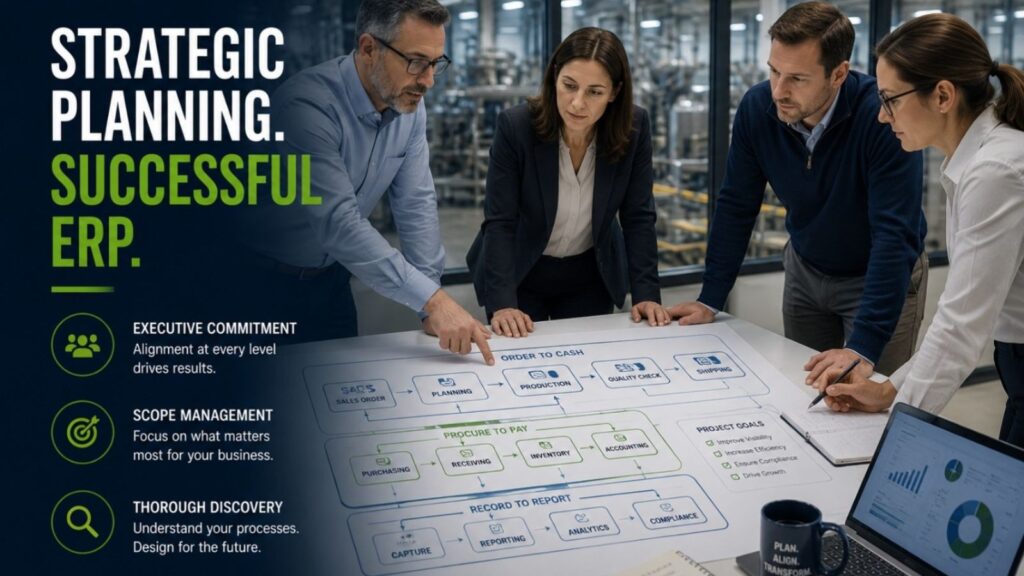
Executive Commitment Matters More Than Software
Successful ERP projects are treated as business initiatives, not IT projects.
Leadership teams establish clear goals, communicate priorities, and stay actively involved throughout the project.
When difficult decisions arise around process changes, standardization, or operational trade-offs, executive alignment helps keep the project moving forward.
When leadership engagement fades, projects often slow down as competing priorities take over.
Scope Creep Creates Unnecessary Risk
Food manufacturers rarely struggle to find opportunities for improvement.
The challenge is deciding which problems need to be solved first.
ERP modernization often uncovers years of manual processes, reporting requests, customizations, and operational workarounds.
Trying to address every issue during a single implementation can quickly increase complexity, cost, and project risk.
The most successful projects focus on the capabilities required for a successful go-live and build from there.
Discovery Is Where Success Begins
One of the most common mistakes in ERP projects is treating discovery as a formality.
In food manufacturing, discovery should uncover far more than software requirements.
It should identify how production, inventory, quality management, traceability, purchasing, warehousing, and financial processes operate today.
It should also identify where those processes create bottlenecks, compliance challenges, or limitations that may affect future growth.
When discovery is rushed, teams often end up recreating existing problems in a newer system.
When discovery is done well, ERP becomes an opportunity to improve operations rather than simply replace software.
That’s why some ERP projects become transformational while others become expensive system replacements with limited business value.
NAV to Business Central: What Food Manufacturers Should Actually Plan For
Many organizations approach a Dynamics NAV-to-Business Central migration as a software upgrade.
In reality, the software is often the easiest part.
The bigger challenge is understanding how the ERP supports the business today and what needs to change to support the future.
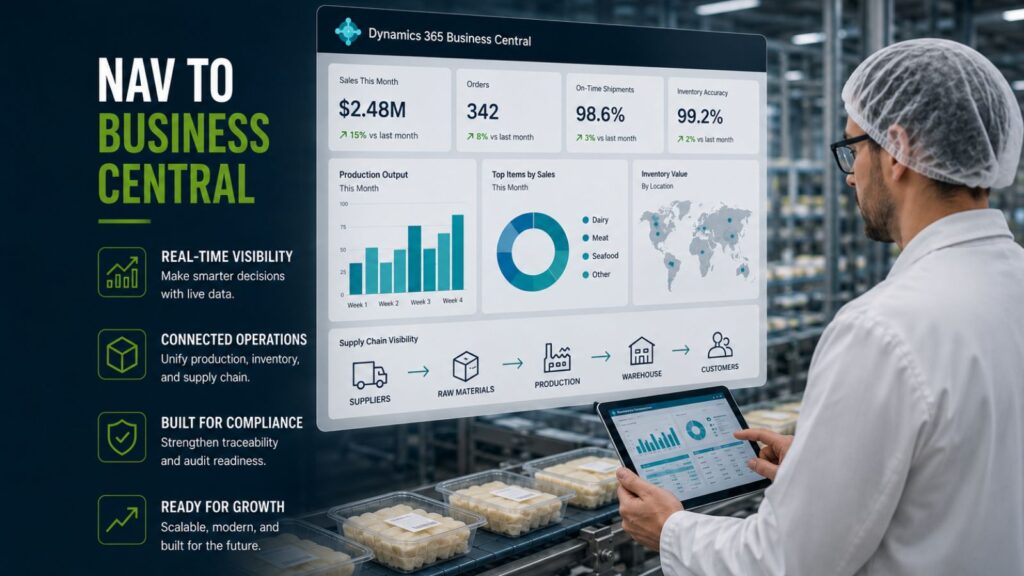
That includes reviewing customizations, integrations, reporting requirements, operational processes, and infrastructure dependencies that have accumulated over the years.
For food manufacturers, modernization should start with operational requirements, not software features.
Questions such as these are often more important than the technology itself:
- Can we improve lot traceability and recall readiness?
- Do we have the visibility needed to manage inventory effectively?
- Are quality management and compliance processes creating unnecessary manual work?
- Can the business support future growth without adding complexity?
- Are we able to meet evolving customer and reporting requirements?
The answers help define what the next ERP environment needs to accomplish.
Moving from Dynamics NAV to Dynamics 365 Business Central for Food Manufacturing also creates an opportunity to simplify.
Many manufacturers discover that processes, customizations, and workarounds that made sense years ago are no longer necessary.
Modern ERP platforms often provide capabilities that previously required custom development or manual processes.
That doesn’t mean every customization should be removed. It means every customization should be evaluated.
The most successful modernization projects are not focused on recreating the past.
They’re focused on building a platform that supports the next stage of the business.
For food manufacturers, that often means improving visibility, strengthening traceability, reducing manual processes, and creating a technology foundation that can adapt as operational and compliance requirements continue to evolve.
The Hidden Cost of Staying on Dynamics NAV
When food manufacturers evaluate ERP modernization, the conversation often focuses on the cost of upgrading.
What gets less attention is the cost of waiting.
Those costs rarely appear as a single line item on a budget. Instead, they show up gradually across the organization.
An infrastructure project takes longer than expected because legacy systems need special accommodation.
Reporting requires manual work that should have been automated years ago.
Integrations become increasingly difficult to maintain.
Technology decisions are influenced by what the ERP can support rather than what the business needs.
Over time, those limitations create operational friction.
In food manufacturing, friction often appears in areas such as traceability, customer reporting, compliance initiatives, inventory visibility, and process improvement efforts.
Teams find themselves spending more time working around system limitations and less time improving operations.
Most organizations don’t notice these costs all at once.
They accumulate gradually.
That’s one reason companies can remain on unsupported ERP systems for years while still believing everything is working as intended.
The ERP continues to process transactions, but the business becomes increasingly constrained by its environment.
The challenge isn’t always the software itself.
It’s the opportunities that become harder to pursue because of the software.
When Should a Food Manufacturer Move Off Dynamics NAV?
Most food manufacturers don’t start evaluating Dynamics NAV because the ERP stops working.
They start because something around the ERP stops working.
An infrastructure upgrade gets delayed.
A customer asks for reporting that is difficult to produce.
A cybersecurity review identifies unsupported technology.
A traceability initiative uncovers limitations that have been hiding in plain sight for years.
The ERP may still be running exactly as it did yesterday.
The business, however, is trying to move somewhere new.
That’s why the question isn’t really whether Dynamics NAV still works.
For many manufacturers, the better question is whether the system can continue supporting the business over the next five to ten years.
We’ve seen organizations stay on NAV successfully for years after support ended.
The challenge is that the costs of waiting are often difficult to see.
They show up as delayed projects, growing technical debt, increasing security concerns, and operational limitations that make change harder than it should be.
In food manufacturing, those limitations often surface around traceability, reporting, customer compliance requirements, audit preparation, and visibility across production and inventory operations.
None of this means a company should immediately replace its ERP.
It does mean leadership should understand the trade-offs.
The most successful modernization projects rarely begin with a crisis.
They begin when leadership recognizes that the business is changing and takes the time to evaluate whether the current ERP environment is equipped to support what’s next.
Planning early creates options.
Waiting until a server fails, a customer requirement can’t be met, or a critical system reaches end of life usually does not.
Most food manufacturers don’t move off Dynamics NAV because the system fails.
They move because the business eventually outgrows what the system can support.
Final Perspective
Dynamics NAV has served many food manufacturers well for a long time. In many cases, it’s still supporting critical business processes every day.
That’s exactly why these conversations can be difficult.
The system continues to work, making it easy to assume it will support the business indefinitely.
But in our experience, the decision to modernize is rarely driven by whether the ERP still functions. It’s driven by whether the business can continue to grow, adapt, and improve while relying on it.
Most food manufacturers don’t move off Dynamics NAV because it fails.
They move because the business eventually reaches a point where staying put becomes more limiting than moving forward.
The important thing is understanding where your organization stands today.
That means evaluating infrastructure dependencies, customizations, traceability requirements, compliance expectations, reporting capabilities, and long-term business objectives before a technology constraint or operational challenge forces the conversation.
The best modernization decisions aren’t made under pressure.
They’re made with a clear understanding of the business, the risks, and the opportunities ahead.
Need Help Evaluating Your Dynamics NAV Environment?
If you’re still running Dynamics NAV and want a clearer understanding of the risks, limitations, and modernization options available to your business, we’re here to help.
Our team works exclusively with food manufacturers to assess ERP environments, identify operational and compliance challenges, and develop practical modernization strategies aligned with long-term business goals.
Ready to start the conversation? Contact the DynamicsFoodERP team today.
About Andrew Good
Andrew Good is the founder of DynamicsFoodERP and a trusted advisor to food manufacturers and distributors seeking to improve operations through technology. With more than two decades of experience in manufacturing, operations, and ERP systems, Andrew helps food businesses strengthen traceability, improve inventory visibility, support compliance initiatives, and build scalable foundations for growth.
Before specializing in Microsoft Dynamics solutions, Andrew held engineering, maintenance, and operational leadership roles with global organizations including Unilever and Sony Music. His hands-on experience on the plant floor, combined with more than 14 years of working with Microsoft Dynamics NAV and Dynamics 365 Business Central, gives him a practical understanding of the challenges food manufacturers face every day.
Andrew works closely with companies across dairy, seafood, meat and poultry, and food distribution, helping them modernize ERP systems, streamline processes, improve food safety and compliance, and gain greater visibility across production and supply chain operations.